Kirjojen hintavertailu. Mukana 12 152 606 kirjaa ja 12 kauppaa.

Kirjailija

Mariano Torras

Kirjat ja teokset yhdessä paikassa: 10 kirjaa, julkaisuja vuosilta 2003-2022, suosituimpien joukossa Welfare, Inequality, and Resource Depletion. Vertaile teosten hintoja ja tarkista saatavuus suomalaisista kirjakaupoista.

10 kirjaa

Kirjojen julkaisuhaarukka 2003-2022.

Macroeconomics in Context

Macroeconomics in Context

Neva Goodwin; Jonathan M. Harris; Julie A. Nelson; Pratistha Joshi Rajkarnikar; Brian Roach; Mariano Torras

TAYLOR FRANCIS LTD
2022
nidottu
Macroeconomics in Context lays out the principles of macroeconomics in a manner that is thorough, up to date, and relevant to students. Like its counterpart, Microeconomics in Context, the book is uniquely attuned to economic, social, and environmental realities. The “In Context” books offer engaging coverage of current topics including policy responses to recession and inflation, inequality, deficits and government debt, economic impacts of the COVID-19 pandemic, and the economics of environmental sustainability.This fourth edition includes:Improved and concise discussions of introductory topics, especially on key economic activities, macroeconomic goals, and economic modelsFurther emphasis on inequality, environmental sustainability, financialization, the changing nature of work, and international developments such as the role of transnational corporations and supply chain issuesDiscussion of the impacts of the COVID-19 pandemic on macroeconomic factors like well-being, inequality, and labor marketsPresentation of policy issues in historical, environmental, institutional, social, political, and ethical contexts, including an updated discussion of fiscal policy in relation to the Biden administration’s infrastructure and social investment spendingClear explanations of basic economic concepts alongside more in-depth analysis of macroeconomics models and economic activityThis book combines real-world relevance with a thorough grounding in multiple economic paradigms. It is the ideal textbook for modern introductory courses in macroeconomics.The book’s companion website is available at: http://www.bu.edu/eci/macro
Macroeconomics in Context

Macroeconomics in Context

Neva Goodwin; Jonathan M. Harris; Julie A. Nelson; Pratistha Joshi Rajkarnikar; Brian Roach; Mariano Torras

TAYLOR FRANCIS LTD
2022
sidottu
Macroeconomics in Context lays out the principles of macroeconomics in a manner that is thorough, up to date, and relevant to students. Like its counterpart, Microeconomics in Context, the book is uniquely attuned to economic, social, and environmental realities. The “In Context” books offer engaging coverage of current topics including policy responses to recession and inflation, inequality, deficits and government debt, economic impacts of the COVID-19 pandemic, and the economics of environmental sustainability.This fourth edition includes:Improved and concise discussions of introductory topics, especially on key economic activities, macroeconomic goals, and economic modelsFurther emphasis on inequality, environmental sustainability, financialization, the changing nature of work, and international developments such as the role of transnational corporations and supply chain issuesDiscussion of the impacts of the COVID-19 pandemic on macroeconomic factors like well-being, inequality, and labor marketsPresentation of policy issues in historical, environmental, institutional, social, political, and ethical contexts, including an updated discussion of fiscal policy in relation to the Biden administration’s infrastructure and social investment spendingClear explanations of basic economic concepts alongside more in-depth analysis of macroeconomics models and economic activityThis book combines real-world relevance with a thorough grounding in multiple economic paradigms. It is the ideal textbook for modern introductory courses in macroeconomics.The book’s companion website is available at: http://www.bu.edu/eci/macro

Microeconomics in Context

Microeconomics in Context

Neva Goodwin; Jonathan M. Harris; Julie A. Nelson; Pratistha Joshi Rajkarnikar; Brian Roach; Mariano Torras

TAYLOR FRANCIS LTD
2022
sidottu
Microeconomics in Context lays out the principles of microeconomics in a manner that is thorough, up to date, and relevant to students. Like its counterpart, Macroeconomics in Context, the book is uniquely attuned to economic, social, and environmental realities. The "In Context" books offer an engaging coverage of current research and policy issues from economic inequality and climate change, to taxes and globalization. Key features include:Up-to-date discussions of the impacts of the COVID-19 pandemic on inequality, labor markets, and beyondAnalysis of recent trade issues and the implications of Brexit Presentation of policy issues in historical, environmental, institutional, social, political, and ethical contexts—an approach that fosters critical evaluation of the standard microeconomic models Clear explanations of basic concepts and analytical tools, with advanced models presented in optional chapter appendices A powerful graphical presentation of various measures of well-being in the United States and other countries, including income inequality, tax systems, educational attainment, and environmental quality A focus on human well-being from a multidimensional perspective, including traditional economic metrics and factors such as health, equity, and political inclusionA full complement of student and instructor support materials online.The book combines real-world relevance with a thorough grounding in multiple economic paradigms. It is the ideal textbook for modern introductory courses in microeconomics. The book's companion website is available at: www.bu.edu/eci/micro
Microeconomics in Context

Microeconomics in Context

Neva Goodwin; Jonathan M. Harris; Julie A. Nelson; Pratistha Joshi Rajkarnikar; Brian Roach; Mariano Torras

TAYLOR FRANCIS LTD
2022
nidottu
Microeconomics in Context lays out the principles of microeconomics in a manner that is thorough, up to date, and relevant to students. Like its counterpart, Macroeconomics in Context, the book is uniquely attuned to economic, social, and environmental realities. The "In Context" books offer an engaging coverage of current research and policy issues from economic inequality and climate change, to taxes and globalization. Key features include:Up-to-date discussions of the impacts of the COVID-19 pandemic on inequality, labor markets, and beyondAnalysis of recent trade issues and the implications of Brexit Presentation of policy issues in historical, environmental, institutional, social, political, and ethical contexts—an approach that fosters critical evaluation of the standard microeconomic models Clear explanations of basic concepts and analytical tools, with advanced models presented in optional chapter appendices A powerful graphical presentation of various measures of well-being in the United States and other countries, including income inequality, tax systems, educational attainment, and environmental quality A focus on human well-being from a multidimensional perspective, including traditional economic metrics and factors such as health, equity, and political inclusionA full complement of student and instructor support materials online.The book combines real-world relevance with a thorough grounding in multiple economic paradigms. It is the ideal textbook for modern introductory courses in microeconomics. The book's companion website is available at: www.bu.edu/eci/micro
Principles of Economics in Context

Principles of Economics in Context

Neva Goodwin; Brian Roach; Mariano Torras; Jonathan Harris; Julie Nelson

Routledge
2019
sidottu
The study of economics should not be highly abstract, but closely related to real-world events. Principles of Economics in Context addresses this challenge, laying out the principles of micro-and macroeconomics in a manner that is thorough, up to date and relevant to students, keeping theoretical exposition close to experience. Emphasizing writing that is compelling, clear, and attractive to students, it addresses such critical concerns as ecological sustainability, distributional equity, the quality of employment, and the adequacy of living standards.Key features include:Clear explanation of basic concepts and analytical tools, with Discussion Questions at the end of each section, encouraging immediate review of what has been read and relating the material to the students’ own experience;Full complement of instructor and student support materials online, including test banks and grading through Canvas;Key terms highlighted in boldface throughout the text, and important ideas and definitions set off from the main text;A glossary at the end of the book containing all key terms, their definitions, and the number of the chapter(s) in which each was first used and defined.Updates for the second edition include:Expanded coverage of topics including inequality, financialization and debt issues, the changing nature of jobs, and sustainable development;New material on wage discrimination by race and gender; an expanded section on labor markets and immigration;Updated discussion of fiscal policy to include more recent developments such as the Trump tax cuts;New material on behavioral economics, public goods, and climate change policy; a new section on “The Economics of Renewable Energy.”This new, affordable edition combines the just-released new editions of Microeconomics in Context and Macroeconomics in Context to provide an integrated full-year text covering all aspects of both micro-and macro-analysis and application, with many up-to-date examples and extensive supporting Web resources for instructors and students.The companion website can be found at: http://www.bu.edu/eci/education-materials/textbooks/principles-of-economics-in-context/
Macroeconomics in Context

Macroeconomics in Context

Neva Goodwin; Jonathan M. Harris; Julie A. Nelson; Pratistha Joshi Rajkarnikar; Brian Roach; Mariano Torras

Routledge
2019
nidottu
Macroeconomics in Context lays out the principles of macroeconomics in a manner that is thorough, up to date, and relevant to students. Like its counterpart, Microeconomics in Context, the book is uniquely attuned to economic realities. The "in Context" books offer engaging coverage of current topics including financial crises, rising inequality, debt and deficits, and environmental sustainability, while also providing a clear and accessible exploration of economic theory and applications. The third edition features: Clear explanations of basic economic concepts alongside more in-depth analysis of macroeconomics models and economic activity Expanded coverage of topics including, inequality, financialization and debt issues, the changing nature of jobs, and sustainable development Thoroughly updated figures and data A full complement of online instructor and student support materials such as additional tables and data, PowerPoint slides and a study guideThis engaging textbook offers students an excellent guide to macroeconomics. The latest addition to the "In Context" series, it combines real-world relevance with a thorough grounding in multiple economic paradigms.The book's companion website is available at: http://www.bu.edu/eci/education-materials/textbooks/macroeconomics-in-context/
Macroeconomics in Context

Macroeconomics in Context

Sebastian Dullien; Neva Goodwin; Jonathan Harris; Julie Nelson; Brian Roach; Mariano Torras

Routledge
2017
nidottu
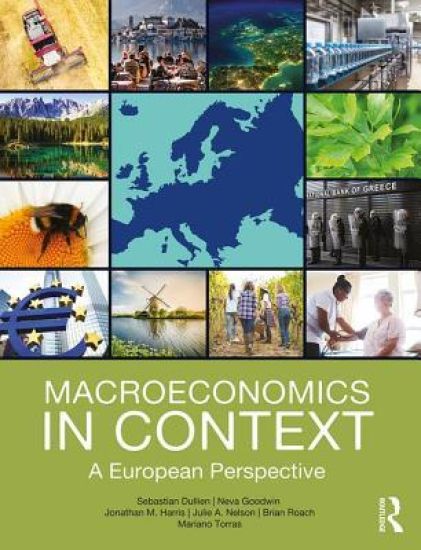
Macroeconomics in Context: A European Perspective lays out the principles of macroeconomics in a manner that is thorough, up to date, and relevant to students. With a clear presentation of economic theory throughout, this latest addition to the bestselling "In Context" set of textbooks is written with a specific focus on European data, institutions, and historical events, offering engaging treatment of high-interest topics, including sustainability, Brexit, the euro crisis, and rising inequality. Policy issues are presented in context (historical, institutional, social, political, and ethical), and always with reference to human well-being. This book is divided into four parts, covering the following key issues: The context of economic analysis, including basic macroeconomic statistics and tools; The basics of macroeconomic measurements, including GDP, inflation, and unemployment, as well as alternative measures of well-being, and the particular structures of the European economies; Methods for analyzing monetary and fiscal policy, including an in-depth coverage of the instruments and approaches of the European central bank and some coverage of an open economy; The application of the tools learnt to selected macroeconomic issues, such as the euro crisis, the global financial crisis, public debt, global development, and environmental sustainability. Far more than any other existing macroeconomic textbook, this book combines real-world relevance of the topics covered with a strong focus on European institutions and structures within an approach that explains multiple economic paradigms. This combination helps to raise students’ interest in macroeconomics as well as enhance their understanding of the power and limitation of macroeconomic analysis.Visit http://www.bu.edu/eci/education-materials/textbooks/macroeconomics-in-context-a-european-perspective/ for online resources for both lecturers and students. A video of a panel discussion about the book can be found at https://youtu.be/xjHJrW9WP44.
Macroeconomics in Context

Macroeconomics in Context

Sebastian Dullien; Neva Goodwin; Jonathan Harris; Julie Nelson; Brian Roach; Mariano Torras

Routledge
2017
sidottu
Macroeconomics in Context: A European Perspective lays out the principles of macroeconomics in a manner that is thorough, up to date, and relevant to students. With a clear presentation of economic theory throughout, this latest addition to the bestselling "In Context" set of textbooks is written with a specific focus on European data, institutions, and historical events, offering engaging treatment of high-interest topics, including sustainability, Brexit, the euro crisis, and rising inequality. Policy issues are presented in context (historical, institutional, social, political, and ethical), and always with reference to human well-being. This book is divided into four parts, covering the following key issues: The context of economic analysis, including basic macroeconomic statistics and tools; The basics of macroeconomic measurements, including GDP, inflation, and unemployment, as well as alternative measures of well-being, and the particular structures of the European economies; Methods for analyzing monetary and fiscal policy, including an in-depth coverage of the instruments and approaches of the European central bank and some coverage of an open economy; The application of the tools learnt to selected macroeconomic issues, such as the euro crisis, the global financial crisis, public debt, global development, and environmental sustainability. Far more than any other existing macroeconomic textbook, this book combines real-world relevance of the topics covered with a strong focus on European institutions and structures within an approach that explains multiple economic paradigms. This combination helps to raise students’ interest in macroeconomics as well as enhance their understanding of the power and limitation of macroeconomic analysis.Visit http://www.bu.edu/eci/education-materials/textbooks/macroeconomics-in-context-a-european-perspective/ for online resources for both lecturers and students. A video of a panel discussion about the book can be found at https://youtu.be/xjHJrW9WP44.
Welfare, Inequality, and Resource Depletion
This book breaks new ground by accounting for the welfare implications of both severe inequality and environmental degradation and developing a sustainable development indicator that incorporates changes over time in each of these dimensions. The model is applied to data from Brazil spanning the 1965 -1998 period. The book's findings cast significant doubt on the proposition that rapid economic growth in Brazil has resulted in comparable welfare gains. The evidence presented more generally illustrates the often unsustainable nature of rapid GDP growth phases, as well as the general unreliability of GDP growth as an indicator of well-being improvement. The specific policy implication is that Brazil should discontinue - or at least severely curtail - the regressive and resource intensive economic policies it has followed in recent decades in the interest of welfare improvement not only for the poorer groups in society, but for future generations of Brazilians as well.
Welfare, Inequality, and Resource Depletion

Welfare, Inequality, and Resource Depletion

Mariano Torras

Ashgate Publishing Limited
2003
sidottu
This book breaks new ground by accounting for the welfare implications of both severe inequality and environmental degradation and developing a sustainable development indicator that incorporates changes over time in each of these dimensions. The model is applied to data from Brazil spanning the 1965 -1998 period. The book's findings cast significant doubt on the proposition that rapid economic growth in Brazil has resulted in comparable welfare gains. The evidence presented more generally illustrates the often unsustainable nature of rapid GDP growth phases, as well as the general unreliability of GDP growth as an indicator of well-being improvement. The specific policy implication is that Brazil should discontinue - or at least severely curtail - the regressive and resource intensive economic policies it has followed in recent decades in the interest of welfare improvement not only for the poorer groups in society, but for future generations of Brazilians as well.