Kirjojen hintavertailu. Mukana 12 657 676 kirjaa ja 12 kauppaa.

Kirjailija

Marie Boas Hall

Kirjat ja teokset yhdessä paikassa: 5 kirjaa, julkaisuja vuosilta 1991-2002, suosituimpien joukossa Henry Oldenburg. Vertaile teosten hintoja ja tarkista saatavuus suomalaisista kirjakaupoista.

5 kirjaa

Kirjojen julkaisuhaarukka 1991-2002.

Henry Oldenburg

Henry Oldenburg

Marie Boas Hall

Oxford University Press
2002
sidottu
Henry Oldenburg, born in 1619 in Bremen, Germany, first came to England as a diplomat on a mission to see Oliver Cromwell. He stayed on in England and in 1662 became the Secretary of the Royal Society, and its best known member to the entire learned world of his time. Through his extensive correspondence, now published, he disseminated the Society's ideals and methods at home and abroad. He fostered and encouraged the talents of many scientists later to be far more famous than he, including Newton, Flamsteed, Malpighi, and Leeuwenhoek with whom, as with many others, he developed real friendship. He founded and edited the Philosophical Transactions, the world's oldest scientific journal. His career sheds new light on the intellectual world of his time, especially its scientific aspects, and on the development of the Royal Society; his private life expands our knowledge of social mobility, the urban society, and the religious views of his time.
All Scientists Now

All Scientists Now

Marie Boas Hall

Cambridge University Press
2002
pokkari
The history of the Royal Society in the nineteenth century is published as a full-length account for the first time in this book. Dr Marie Boas Hall has meticulously explored this fascinating period, using the Royal Society’s own records. In 1800 the Royal Society was a leisurely club for scientists, scholars/politicians and patrons of science and learning. More important, it was a centre for improving knowledge of the natural sciences, and adviser to the Government on scientific matters. The first half of the book describes the manner of transition; the struggles and controversies among the most eminent scientists of the day. The second half concerns the emergence of the Royal Society as once again a leader of scientific opinion, as the recognised intermediary between science and Government, and as the chief advisory body to the Government. In the nineteenth century it became, in fact, the national academy of science.
Promoting Experimental Learning

Promoting Experimental Learning

Marie Boas Hall

Cambridge University Press
2002
pokkari
In spite of all that has been written in the past decades about the first half-century of the Royal Society’s existence, no one has so far examined just what took place at the Society’s weekly meetings nor how far they fulfilled the expressed aim of promoting ‘experimental learning’. Students of the early Royal Society have often taken its aim to have been fully expressed in the writings of such Fellows as Boyle, Hooke and Newton, aware that Hooke especially performed very many experiments at the meetings between 1662 and 1703, while he and others wrote about the necessity of doing so. This study attempts to analyse the content of the meetings in detail in order to discover how far and in what manner the aims of the Society were fulfilled in the seventeenth and early eighteenth centuries. This book for the first time explores the practices of the Society’s Fellows, and shows how these altered between 1660 and 1727.
The Scientific Renaissance, 1450-1630

The Scientific Renaissance, 1450-1630

Marie Boas Hall

Dover Publications Inc.
1994
pokkari
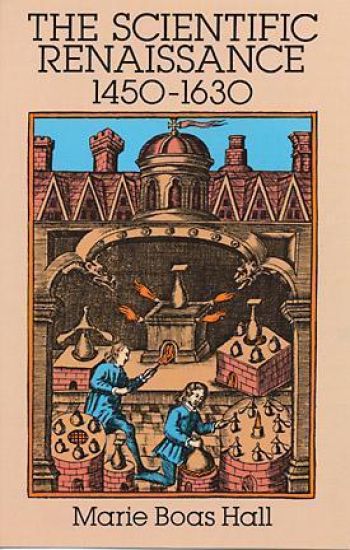
Stimulating, illuminating, and thoughtfully presented, this study explores the early stages of the scientific revolution. A noted historian of science examines the Copernican revolution, the anatomical work of Vesalius, the work of Paracelsus, Harvey's discovery of the circulatory system, the effects of Galileo's telescopic discoveries, and much more.
Promoting Experimental Learning

Promoting Experimental Learning

Marie Boas Hall

Cambridge University Press
1991
sidottu
In spite of all that has been written in the past decades about the first half-century of the Royal Society's existence, no one has so far examined just what took place at the Society's weekly meetings nor how far they fulfilled the expressed aim of promoting 'experimental learning'. Students of the early Royal Society have often taken its aim to have been fully expressed in the writings of such Fellows as Boyle, Hooke and Newton, aware that Hooke especially performed very many experiments at the meetings between 1662 and 1703, while he and others wrote about the necessity of doing so. This study attempts to analyse the content of the meetings in detail in order to discover how far and in what manner the aims of the Society were fulfilled in the seventeenth and early eighteenth centuries. This book for the first time explores the practices of the Society's Fellows, and shows how these altered between 1660 and 1727.