Kirjojen hintavertailu. Mukana 12 595 353 kirjaa ja 12 kauppaa.

Kirjailija

Marie-Cécile Cervellon

Kirjat ja teokset yhdessä paikassa: 4 kirjaa, julkaisuja vuosilta 2012-2020, suosituimpien joukossa Emerald Studies in Alternativity and Marginalization Book Set (2017-2019). Vertaile teosten hintoja ja tarkista saatavuus suomalaisista kirjakaupoista.

4 kirjaa

Kirjojen julkaisuhaarukka 2012-2020.

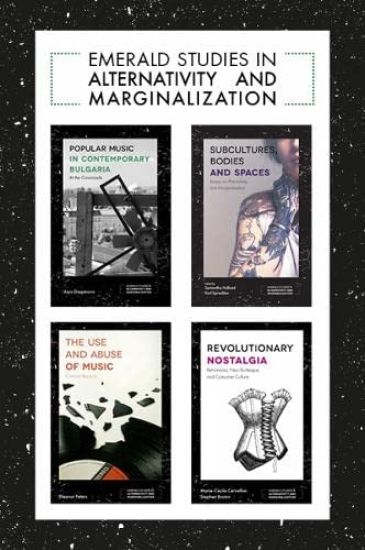
Emerald Studies in Alternativity and Marginalization Book Set (2017-2019)

Emerald Studies in Alternativity and Marginalization Book Set (2017-2019)

Amanda DiGioia; Karl Spracklen; Samantha Holland; Marie-Cécile Cervellon; Asya Draganova; Eleanor Peters

Emerald Publishing Limited
2020
muu
Do we really understand what it means to be 'alternative'? In contemporary society, alternative music scenes such as heavy metal, goth and punk have spread around the world; and alternative fashions and embodiment practices are now adopted by footballers and fashion models. Alternativity delineates those spaces, scenes, sub-cultures, objects and practices in modern society that are actively designed to be counter or resistive to mainstream popular culture.However, there is a lack of understanding of the challenges faced by those who embrace alternative lifestyles and what it means to be alternative in globalised society. What 'alternative' looks like is explored in these titles, providing unique home for research that will expand our understanding of sub-cultures, scenes and practices defined as alternative. Titles included in this set: Childbirth and Parenting in Horror Texts:The Marginalized and the Monstrous;The Evolution of Goth Culture:The Origins and Deeds of the New Goths;Popular Music in Contemporary Bulgaria:At the Crossroads;Revolutionary Nostalgia:Retromania, Neo-Burlesque, and Consumer Culture;Subcultures, Bodies and Spaces:Essays on Alternativity and Marginalization;The Use and Abuse of Music:Criminal Records;
Revolutionary Nostalgia

Revolutionary Nostalgia

Marie-Cécile Cervellon; Stephen Brown

Emerald Publishing Limited
2018
nidottu
Nostalgia, they say, is not what it used to be. Once a witticism, this statement about the past has come to pass. Nostalgia really isn’t what it used to be. Less than a generation ago, it was regarded as reactionary, as regressive, as reprehensible. Now, it is considered conducive to health, wealth, and human wellbeing. It is something that helps sell products and move merchandise, an underexploited critical resource with emancipatory potential. Nowhere is this transformation better illustrated than in the neo-burlesque community, whose members not only embrace the art-form’s golden age, and happily acquire heritage goods and vintage services, but turn their nostalgic leanings to emancipatory effect. They are retro revolutionaries, feather boa-wearing insurgents who find women’s liberation in sequins and stilettos. This book shines a spotlight on weapons-grade nostalgia, indicating how it is integral to insurrections throughout history, be they political, technological, or cultural. It reveals, through a combination of empirical ethnographic research and revolutionary literary criticism, the part nostalgia plays in a subversive consumer collective that uses fans, fishnets, and frivolity to fight for the right to party against patriarchy and find a fourth-wave form of female emancipation that foregoes old-school feminist fault-finding for good old-fashioned fun, fun, fun.
Dialogic Formations

Dialogic Formations

Marie-Cécile Cervellon; Peter T. F. Raggatt; Miguel M. Gonçalves

Information Age Publishing
2012
sidottu
This volume understands itself as an invitation to follow a fundamental shift in perspective, away from the self-contained ‘I’ of Western conventions, and towards a relational self, where development and change are contingent on otherness. In the framework of ‘Dialogical Self Theory’ (Hermans & Hermans-Konopka, 2010; Hermans & Gieser, 2012), it is precisely the forms of interaction and exchange with others and with the world that determine the course of the self’s development.The volume hence addresses dialogical processes in human interaction from a psychological perspective, bringing together previously separate theoretical traditions about the ‘self’ and about ‘dialogue’ within the innovative framework of Dialogical Self Theory. The book is devoted to developmental questions, and so broaches one of the more difficult and challenging topics for models of a pluralist self: the question of how the dynamics of multiplicity emerge and change over time. This question is explored by addressing ontogenetic questions, directed at the emergence of the dialogical self in early infancy, as well as microgenetic questions, addressed to later developmental dynamics in adulthood. Additionally, development and change in a range of culture-specific settings and practices is also examined, including the practices of mothering, of migration and cross-cultural assimilation, and of ‘doing psychotherapy’.
Dialogic Formations

Dialogic Formations

Marie-Cécile Cervellon; Peter T. F. Raggatt; Miguel M. Gonçalves

Information Age Publishing
2012
nidottu
This volume understands itself as an invitation to follow a fundamental shift in perspective, away from the self-contained ‘I’ of Western conventions, and towards a relational self, where development and change are contingent on otherness. In the framework of ‘Dialogical Self Theory’ (Hermans & Hermans-Konopka, 2010; Hermans & Gieser, 2012), it is precisely the forms of interaction and exchange with others and with the world that determine the course of the self’s development.The volume hence addresses dialogical processes in human interaction from a psychological perspective, bringing together previously separate theoretical traditions about the ‘self’ and about ‘dialogue’ within the innovative framework of Dialogical Self Theory. The book is devoted to developmental questions, and so broaches one of the more difficult and challenging topics for models of a pluralist self: the question of how the dynamics of multiplicity emerge and change over time. This question is explored by addressing ontogenetic questions, directed at the emergence of the dialogical self in early infancy, as well as microgenetic questions, addressed to later developmental dynamics in adulthood. Additionally, development and change in a range of culture-specific settings and practices is also examined, including the practices of mothering, of migration and cross-cultural assimilation, and of ‘doing psychotherapy’.