

Kirjailija
Marija ILIC
Kirjat ja teokset yhdessä paikassa: 6 kirjaa, julkaisuja vuosilta 2001-2017, suosituimpien joukossa Teatar Iluzija. Vertaile teosten hintoja ja tarkista saatavuus suomalaisista kirjakaupoista.
6 kirjaa
Kirjojen julkaisuhaarukka 2001-2017.

Discourse and Ethnic Identity. the Case of the Serbs from Hungary
Marija ILIC
Peter Lang Gmbh, Internationaler Verlag Der Wissenschaften
2014
nidottu

Deregulation is causing dramatic change in the power industry but little is known about how power systems will function under competition. What are suitable performance objectives? What control designs are required and what economic techniques should be used? This detailed analysis attempts to answer these questions. The authors provide a modelling, analysis and systems control framework that makes it possible to relate distinctive features of the electric power industry to more conventional supply/demand processes in other industries. Some parts of the system can be distributed while other parts must remain co-ordinated. This authoritative and detailed study is highly topical and will be of interest to those working in the systems control area, especially in electrical power. It is also most relevant for industrial economists as well as academics in electrical power engineering.

Valuation, Hedging and Speculation in Competitive Electricity Markets
Petter L. Skantze; Marija Ilic
Springer-Verlag New York Inc.
2012
nidottu
The challenges currently facing particIpants m competitive electricity markets are unique and staggering: unprecedented price volatility, a crippling lack of historical market data on which to test new modeling approaches, and a continuously changing regulatory structure. Meeting these challenges will require the knowledge and experience of both the engineering and finance communities. Yet the two communities continue to largely ignore each other. The finance community believes that engineering models are too detailed and complex to be practically applicable in the fast changing market environment. Engineers counter that the finance models are merely statistical regressions, lacking the necessary structure to capture the true dynamic properties of complex power systems. While both views have merit, neither group has by themselves been able to produce effective tools for meeting industry challenges. The goal of this book is to convey the fundamental differences between electricity and other traded commodities, and the impact these differences have on valuation, hedging and operational decisions made by market participants. The optimization problems associated with these decisions are formulated in the context of the market realities of today's power industry, including a lack of liquidity on forward and options markets, limited availability of historical data, and constantly changing regulatory structures.

Price-Based Commitment Decisions in the Electricity Market
Eric Allen; Marija Ilic
Springer London Ltd
2012
nidottu
The series Advances in Industrial Control aims to report and encourage technology transfer in control engineering. The rapid development of control technology impacts all areas of the control discipline. New theory, new controllers, actuators, sensors, new industrial processes, computer methods, new applications, new philosophies . . . , new challenges. Much of this development work resides in industrial reports, feasibility study papers and the reports of advanced collaborative projects. The series offers an opportunity for researchers to present an extended exposition of such new work in all aspects of industrial control for wider and rapid dissemination. Deregulation of electricity markets is a worldwide activity with leading and distinctive developments occurring in the European and US markets. The immediate impact of these changes is felt in the higher levels of the power production hierarchy where tools to aid short-term economic decision making are needed. At the lower levels of the production control hierarchy the impact is to demand much more flexible unit operation so that the determined short-term goals can be met. Allen and Illic have produced this useful monograph on the decision algorithms needed to determine unit commitment proflles over the shorter time frame of hours and days. The method of dynamic programming has been used and the work covers modelling, cost function and construction, an introduction to dynamic programming and a detailed assessment of its use. The monograph comes complete with programs in Appendix D and with other appendices giving the necessary supporting theory.
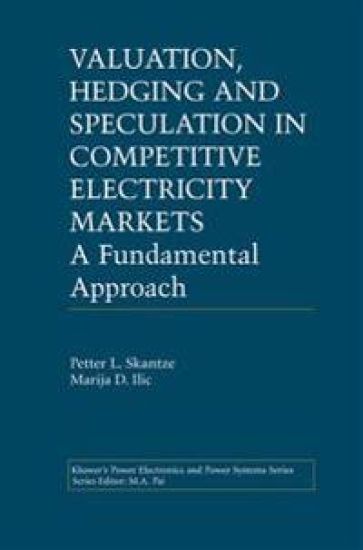
Valuation, Hedging and Speculation in Competitive Electricity Markets
Petter L. Skantze; Marija Ilic
Springer
2001
sidottu
The challenges currently facing particIpants m competitive electricity markets are unique and staggering: unprecedented price volatility, a crippling lack of historical market data on which to test new modeling approaches, and a continuously changing regulatory structure. Meeting these challenges will require the knowledge and experience of both the engineering and finance communities. Yet the two communities continue to largely ignore each other. The finance community believes that engineering models are too detailed and complex to be practically applicable in the fast changing market environment. Engineers counter that the finance models are merely statistical regressions, lacking the necessary structure to capture the true dynamic properties of complex power systems. While both views have merit, neither group has by themselves been able to produce effective tools for meeting industry challenges. The goal of this book is to convey the fundamental differences between electricity and other traded commodities, and the impact these differences have on valuation, hedging and operational decisions made by market participants. The optimization problems associated with these decisions are formulated in the context of the market realities of today's power industry, including a lack of liquidity on forward and options markets, limited availability of historical data, and constantly changing regulatory structures.