Kirjojen hintavertailu. Mukana 12 595 353 kirjaa ja 12 kauppaa.

Kirjailija

Marina Ottaway

Kirjat ja teokset yhdessä paikassa: 7 kirjaa, julkaisuja vuosilta 1990-2022, suosituimpien joukossa The Political Economy of Ethiopia. Vertaile teosten hintoja ja tarkista saatavuus suomalaisista kirjakaupoista.

7 kirjaa

Kirjojen julkaisuhaarukka 1990-2022.

Algeria

Algeria

David Ottaway; Marina Ottaway

University of California Press
2022
sidottu
In 1962 when Algeria finally obtained its independence from France after an eight-year guerilla war, it immediately embarked upon a second revolution aimed at destroying the colonial economic and social order. While the nationalist leaders struggled for power in the first hours of independence, peasants seized French farms and workers the factories, thus setting Algeria on the road toward a new socialist order. This book is a study of the Algerian socialist revolution, of those who made it and those who gained by it. The primary focus is on political behavior, on those aspects of the struggle among Algerian leader which vitally affected the character of the new order. The authors find that even though Algeria acquired all the trappings of a socialist state and economy, politics remained almost exclusively a question of personal relations, alliances, and rivalries among a small group of leaders--what the authors call, borrowing a concept from the fourteenth-century Arab historian Ibn Khaldun, the politics of assabiya. Algeria's first President, Ahmed Ben Bella, tried to integrate the new and old political groups into a modern political system, but he failed. His overthrow by the army opened a second phase in the process of building stable political institutions and of overcoming the tradition of "palace conspiracies and rebellions of feudal lords." The authors trace in details this cyclical process during the first six years of Alergian independence. The work benefits from a wealth of first-hand information gathered during the authors' three-year stay in the country. The resulting picture is that of a new nation embarked upon a socialist "revolution" which owes little to Soviet or Chinese influences or, in some respects, even to the intentions of its leaders. This title is part of UC Press's Voices Revived program, which commemorates University of California Press's mission to seek out and cultivate the brightest minds and give them voice, reach, and impact. Drawing on a backlist dating to 1893, Voices Revived makes high-quality, peer-reviewed scholarship accessible once again using print-on-demand technology. This title was originally published in 1970.

Algeria

Algeria

David Ottaway; Marina Ottaway

University of California Press
2022
pokkari
In 1962 when Algeria finally obtained its independence from France after an eight-year guerilla war, it immediately embarked upon a second revolution aimed at destroying the colonial economic and social order. While the nationalist leaders struggled for power in the first hours of independence, peasants seized French farms and workers the factories, thus setting Algeria on the road toward a new socialist order. This book is a study of the Algerian socialist revolution, of those who made it and those who gained by it. The primary focus is on political behavior, on those aspects of the struggle among Algerian leader which vitally affected the character of the new order. The authors find that even though Algeria acquired all the trappings of a socialist state and economy, politics remained almost exclusively a question of personal relations, alliances, and rivalries among a small group of leaders--what the authors call, borrowing a concept from the fourteenth-century Arab historian Ibn Khaldun, the politics of assabiya. Algeria's first President, Ahmed Ben Bella, tried to integrate the new and old political groups into a modern political system, but he failed. His overthrow by the army opened a second phase in the process of building stable political institutions and of overcoming the tradition of "palace conspiracies and rebellions of feudal lords." The authors trace in details this cyclical process during the first six years of Alergian independence. The work benefits from a wealth of first-hand information gathered during the authors' three-year stay in the country. The resulting picture is that of a new nation embarked upon a socialist "revolution" which owes little to Soviet or Chinese influences or, in some respects, even to the intentions of its leaders. This title is part of UC Press's Voices Revived program, which commemorates University of California Press's mission to seek out and cultivate the brightest minds and give them voice, reach, and impact. Drawing on a backlist dating to 1893, Voices Revived makes high-quality, peer-reviewed scholarship accessible once again using print-on-demand technology. This title was originally published in 1970.

A Tale of Four Worlds

A Tale of Four Worlds

Marina Ottaway; David Ottaway

C Hurst Co Publishers Ltd
2019
sidottu
First came the disintegration of the Ottoman Empire following World War I; then, in the 1950s and '60s, the Nasser-inspired wave of Arab nationalism and socialism. The Arab world's third great political cataclysm of the past 100 years has also brought permanent changes, but not as its activists had hoped: the 2011 uprisings. Their consequences have differed greatly from area to area, splintering the Arab region into four different worlds. The Levant states have disintegrated, possibly irreversibly. The Gulf monarchies have embarked on far- reaching plans of economic and social change to stave off discontent. Egypt has retreated into military authoritarianism and a war on Islamists, threatening its future stability. Only the Maghreb countries, which have started integrating Islamists into their political systems, offer some hope for progress toward democracy. Marina and David Ottaway have brought together fifty years of experience observing the Arab world, and a wealth of first-hand information gathered from living and travelling extensively in the region. A Tale of Four Worlds is an indispensable analysis of the profound upheavals that have shaken--and continue to transform--Arab and global politics.
Democracy Challenged

Democracy Challenged

Marina Ottaway

Carnegie Endowment for International Peace
2002
nidottu
During the 1990s, international democracy promotion efforts led to the establishment of numerous regimes that cannot be easily classified as either authoritarian or democratic. They display characteristics of each, in short they are semi-authoritarian regimes. These regimes pose a considerable challenge to U.S. policymakers because the superficial stability of many semi-authoritarian regimes usually masks severe problems that need to be solved lest they lead to a future crisis. Additionally, these regimes call into question some of the ideas about democratic transitions that underpin the democracy promotion strategies of the United States and other Western countries. Despite their growing importance, semi-authoritarian regimes have not received systematic attention. Marina Ottaway examines five countries (Egypt, Azerbaijan, Venezuela, Croatia, and Senegal) which highlight the distinctive features of semi-authoritarianism and the special challenge each poses to policymakers. She explains why the dominant approach to democracy promotion isn't effective in these countries and concludes by suggesting alternative policies. Marina Ottaway is senior associate and codirector of the Democracy and Rule of Law Project at the Carnegie Endowment.
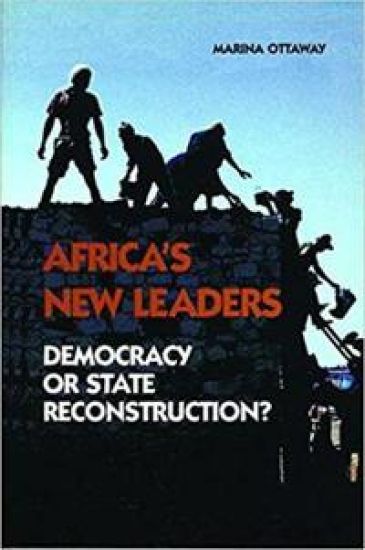
Africa's New Leaders

Africa's New Leaders

Marina Ottaway

Carnegie Endowment for International Peace
1999
nidottu
This book's starting assumption is that democracy is always desirable, but may not always be possible in the short and medium run. The road to democracy thus may not initially be democratic. In this perspective, the author examines the experience of a small number of African countries which--under the guidance of energetic new leaders--have turned the corner away from conflict and economic disintegration and are now pursuing economic and political reform and assertive foreign policies that have made them into important regional players. Uganda, Ethiopia, and Eritrea--countries long synonymous with war and economic chaos--are now among the most dynamic on the continent. Their success is making them into a model attractive to other African governments, particularly in other countries emerging from conflict. Yet these countries' new leaders refuse to carry out the democratic reforms favored by the U.S., arguing that such measures would cause more conflict. Instead, they will move toward political reform in their own way and at their own pace. Can this process eventually lead to democracy or is it bound to restart a vicious circle of authoritarianism and economic decay? And can the U.S. influence the change, while accepting that the process is bound to be long and complex? These questions will confront the U.S. with increasing frequency in coming years. As the countries where democratic transformation was easiest move forward toward consolidation, policy makers will be forced to deal with those countries where democratic change is more complex.
South Africa

South Africa

Marina Ottaway

Brookings Institution
1993
nidottu
The unbanning of the African National Congress and the release of Nelson Mandela in February of 1990 cleared the way for negotiations toward a new, post-apartheid political order in South Africa. But three years later, the main parties have made little progress toward a compromise, while violence escalates in the townships. In this revealing study, Marina Ottaway examines the new conflicts emerging in South Africa, the factors influencing them, and the probable outcome. She shows that the black-on-white conflict that has made the country a pariah in the past has evolved into a much more complex state of affairs and explains that the transition is likely to take an unprecedented form. Beginning with a brief history of the events since Mandela's release, Ottaway provides a vivid account of the evolving conflict over apartheid. She discuses the complexity of conflict resolution in a country where internal and external currents work against each other, and where the struggle for power transcends any strides toward peace. Ottaway thoroughly addresses the issues involved in South Africa's transition from apartheid. She explains that the abolition of the pervasive system has more far-reaching implications than originally thought. South Africa explores the effects that the international climate of the 1990s has had on the county’s transition. Ottaway contends that the international community rejects apartheid but is unsympathetic to black demands for redistribution, and has condemned the white government’s vision of separate development but accepts ethnic nationalism as inevitable. She describes the dramatic effects the new world order has had on South Africa and assesses what those changes will mean to the country’s difficult transition.
The Political Economy of Ethiopia

The Political Economy of Ethiopia

Marina Ottaway

Praeger Publishers Inc
1990
sidottu
The essays collected here evolved from a two-day conference on Ethiopia held at the Johns Hopkins School for Advanced International Studies. Written by both academics and Ethiopians who have participated personally in the events they discuss, the papers describe and interpret the Ethiopian revolution and explore its successes, failures, and intrinsic qualities. The contributors express a variety of viewpoints and approaches to the current crisis situation in Ethiopia, demonstrating that although the 15-year revolution has failed to measurably improve the lot of Ethiopians, Ethiopia's history, demographics, and climate have also been important contributing factors. A number of articles deal with aspects of the political crisis while others analyze the economic crisis, looking at present problems and their historical roots. Taken together, these essays make a major contribution to our understanding of the persistent problems faced by Ethiopia today. Following the editor's introduction, the volume is divided into three sections. In Part I, four papers explore the Ethiopian state and the problem of power. Individual chapters examine such issues as change and continuity in Ethiopian politics, decisions and elections, and the question of rural transformation. Part II looks at different facets of the national question, now or in the past--the character of the leadership, the concept of government, and the decision-making process. The third section analyzes the current economic crisis in two papers which discuss Ethiopia's agricultural crisis and development strategy. The concluding chapter presents an overall perspective on revolution, nationality, and the Ethiopian state. Students of political economy, African studies, and economic development will find The Political Economy of Ethiopia illuminating reading.