Kirjojen hintavertailu. Mukana 12 390 323 kirjaa ja 12 kauppaa.

Kirjailija

Marinus A. Kaashoek

Kirjat ja teokset yhdessä paikassa: 4 kirjaa, julkaisuja vuosilta 2007-2023, suosituimpien joukossa Completeness Theorems and Characteristic Matrix Functions. Vertaile teosten hintoja ja tarkista saatavuus suomalaisista kirjakaupoista.

4 kirjaa

Kirjojen julkaisuhaarukka 2007-2023.

Completeness Theorems and Characteristic Matrix Functions

Completeness Theorems and Characteristic Matrix Functions

Marinus A. Kaashoek; Sjoerd M. Verduyn Lunel

BIRKHAUSER VERLAG AG
2023
nidottu
This monograph presents necessary and sufficient conditions for completeness of the linear span of eigenvectors and generalized eigenvectors of operators that admit a characteristic matrix function in a Banach space setting. Classical conditions for completeness based on the theory of entire functions are further developed for this specific class of operators. The classes of bounded operators that are investigated include trace class and Hilbert-Schmidt operators, finite rank perturbations of Volterra operators, infinite Leslie operators, discrete semi-separable operators, integral operators with semi-separable kernels, and period maps corresponding to delay differential equations. The classes of unbounded operators that are investigated appear in a natural way in the study of infinite dimensional dynamical systems such as mixed type functional differential equations, age-dependent population dynamics, and in the analysis of the Markov semigroup connected to the recently introduced zig-zag process.
Completeness Theorems and Characteristic Matrix Functions

Completeness Theorems and Characteristic Matrix Functions

Marinus A. Kaashoek; Sjoerd M. Verduyn Lunel

BIRKHAUSER VERLAG AG
2022
sidottu
This monograph presents necessary and sufficient conditions for completeness of the linear span of eigenvectors and generalized eigenvectors of operators that admit a characteristic matrix function in a Banach space setting. Classical conditions for completeness based on the theory of entire functions are further developed for this specific class of operators. The classes of bounded operators that are investigated include trace class and Hilbert-Schmidt operators, finite rank perturbations of Volterra operators, infinite Leslie operators, discrete semi-separable operators, integral operators with semi-separable kernels, and period maps corresponding to delay differential equations. The classes of unbounded operators that are investigated appear in a natural way in the study of infinite dimensional dynamical systems such as mixed type functional differential equations, age-dependent population dynamics, and in the analysis of the Markov semigroup connected to the recently introduced zig-zag process.
A State Space Approach to Canonical Factorization with Applications

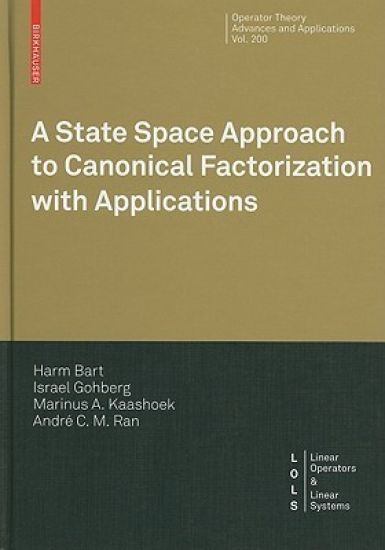
A State Space Approach to Canonical Factorization with Applications

Harm Bart; Israel Gohberg; Marinus A. Kaashoek; André C.M. Ran

Birkhauser Verlag AG
2010
sidottu
The present book deals with canonical factorization problems for di?erent classes of matrix and operator functions. Such problems appear in various areas of ma- ematics and its applications. The functions we consider havein common that they appear in the state space form or can be represented in such a form. The main results are all expressed in terms of the matrices or operators appearing in the state space representation. This includes necessary and su?cient conditions for canonical factorizations to exist and explicit formulas for the corresponding f- tors. Also, in the applications the entries in the state space representation play a crucial role. Thetheorydevelopedinthebookisbasedonageometricapproachwhichhas its origins in di?erent ?elds. One of the initial steps can be found in mathematical systems theory and electrical network theory, where a cascade decomposition of an input-output system or a network is related to a factorization of the associated transfer function. Canonical factorization has a long and interesting history which starts in the theory of convolution equations. Solving Wiener-Hopf integral equations is closely related to canonical factorization. The problem of canonical factorization also appears in other branches of applied analysis and in mathematical systems theory, in H -control theory in particular.
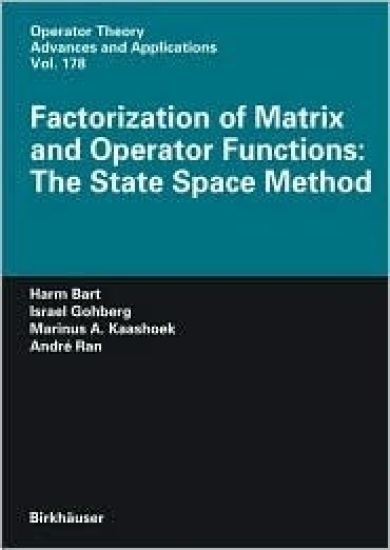
Factorization of Matrix and Operator Functions: The State Space Method

Factorization of Matrix and Operator Functions: The State Space Method

Harm Bart; Israel Gohberg; Marinus A. Kaashoek; André C.M. Ran

Birkhauser Verlag AG
2007
sidottu
Thepresentbookdealswithvarioustypesoffactorizationproblemsformatrixand operator functions. The problems appear in di?erent areasof mathematics and its applications. A uni?ed approach to treat them is developed. The main theorems yield explicit necessaryand su?cient conditions for the factorizations to exist and explicit formulas for the corresponding factors. Stability of the factors relative to a small perturbation of the original function is also studied in this book. The unifying theory developed in the book is based on a geometric approach which has its origins in di?erent ?elds. A number of initial steps can be found in: (1) the theory of non-selfadjoint operators, where the study of invariant s- spaces of an operator is related to factorization of the characteristic matrix or operator function of the operator involved, (2) mathematical systems theory and electrical network theory, where a cascade decomposition of an input-output system or a network is related to a fact- ization of the associated transfer function, and (3) thefactorizationtheoryofmatrixpolynomialsintermsofinvariantsubspaces of a corresponding linearization. In all three cases a state space representation of the function to be factored is used, and the factors are expressed in state space form too. We call this approach the state space method. It hasa largenumber of applications.For instance, besides the areasreferred to above, Wiener-Hopf factorizations of some classes of symbols can also be treated by the state space method.