Kirjojen hintavertailu. Mukana 12 152 606 kirjaa ja 12 kauppaa.

Kirjailija

Marjorie Perloff

Kirjat ja teokset yhdessä paikassa: 32 kirjaa, julkaisuja vuosilta 1992-2025, suosituimpien joukossa Rosa - Augusto de Campos 90. Vertaile teosten hintoja ja tarkista saatavuus suomalaisista kirjakaupoista.

32 kirjaa

Kirjojen julkaisuhaarukka 1992-2025.

The Darkest Pastoral

The Darkest Pastoral

John Kinsella; Marjorie Perloff

WW NORTON CO
2025
sidottu
Illuminated by the spirit of ecological activism and decolonisation, The Darkest Pastoral engages deeply with nature, climate catastrophe and grief and the interconnectedness between humans and the natural world. John Kinsella’s poetry stretches and often breaks the lyric in an attempt to create new modes of intervention and action. Though focused around his homeplace in the Western Australian wheatbelt, much of his poetry converses with other places around the world, especially those he has lived in for extended periods of time, including central Ohio, Cambridge, West Cork and southern Germany. Often writing in an anti-pastoral mode, Kinsella experiments with the histories of poetry, art and music, to create a poetry that will respect ecologies and bring positive changes in destructive human behaviours. His poetry, both experimental and pastoral, about the natural world is centrally preoccupied with birds and plants and often features the landscape of Western Australia. Kinsella’s artistic response to ecological catastrophe is in dynamic conversation with the work of many artists and writers—Andy Warhol, Jackson Pollock, Helen Frankenthaler and Jacques Derrida, amongst others. With acuity and empathy, this collection is a poetic attempt to reckon with a world in transition. “These are great ecological poems, whose wide sweep becomes increasingly astonishing as the years go by. At this writing, John Kinsella is a mere sixty. Who knows what is yet to come?”—from the foreword by Marjorie Perloff
Rosa - Augusto de Campos 90

Rosa - Augusto de Campos 90

Augusto De Campos; Marjorie Perloff; Caetano Veloso

Editora Hedra
2022
pokkari
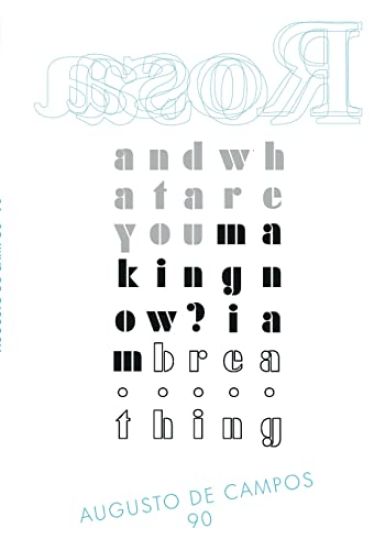
Augusto de Campos' work in the international poetry scene, via translation, captures transformations in poetry and the arts. His decisions with respect to translation, as well as his practice itself-which he inventively affirms-have played a fundamental role in forming a generation attentive to the innovation of the North American, European, and Russian avant-gardes, setting the stage for discussions about the reception of concretismo in Brazil.
Infrathin

Infrathin

Marjorie Perloff

University of Chicago Press
2021
sidottu
The “infrathin” was Marcel Duchamp’s playful name for the most minute shade of difference: that between the report of a gunshot and the appearance of the bullet hole, or between two objects in a series made from the same mold. “Eat” is not the same thing as “ate.” The poetic, Marjorie Perloff suggests, can best be understood as the language of infrathin. For in poetry, whether in verse or prose, words and phrases that are seemingly unrelated in ordinary discourse are realigned by means of sound, visual layout, etymology, grammar, and construction so as to “make it new.” In her revisionist “micropoetics,” Perloff draws primarily on major modernist poets from Stein and Yeats to Beckett, suggesting that the usual emphasis on what this or that poem is “about,” does not do justice to its infrathin possibilities. From Goethe’s eight-line “Wanderer’s Night Song” to Eliot’s Four Quartets, to the minimalist lyric of Rae Armantrout, Infrathin is designed to challenge our current habits of reading and to answer the central question: what is it that makes poetry poetry?
Infrathin

Infrathin

Marjorie Perloff

University of Chicago Press
2021
pokkari
The “infrathin” was Marcel Duchamp’s playful name for the most minute shade of difference: that between the report of a gunshot and the appearance of the bullet hole, or between two objects in a series made from the same mold. “Eat” is not the same thing as “ate.” The poetic, Marjorie Perloff suggests, can best be understood as the language of infrathin. For in poetry, whether in verse or prose, words and phrases that are seemingly unrelated in ordinary discourse are realigned by means of sound, visual layout, etymology, grammar, and construction so as to “make it new.” In her revisionist “micropoetics,” Perloff draws primarily on major modernist poets from Stein and Yeats to Beckett, suggesting that the usual emphasis on what this or that poem is “about,” does not do justice to its infrathin possibilities. From Goethe’s eight-line “Wanderer’s Night Song” to Eliot’s Four Quartets, to the minimalist lyric of Rae Armantrout, Infrathin is designed to challenge our current habits of reading and to answer the central question: what is it that makes poetry poetry?
Circling the Canon, Volume II

Circling the Canon, Volume II

Marjorie Perloff

University of New Mexico Press
2021
nidottu
One of our most important contemporary critics, Marjorie Perloff has been a widely published and influential reviewer, especially of poetry and poetics, for over fifty years. Circling the Canon, Volume II focuses on the second half of her prolific career, showcasing reviews from 1995 through her 2017 reconsiderations of Jonathan Culler's theory of the lyric and William Empson's classic Seven Types of Ambiguity. In this volume Perloff provides insight into the twenty-first-century literary landscape, from revaluations of its leading poets and translations of European poetry from Goethe to the Brazilian Noigandres group and interart studies and performance art. Key issues of the past few decades, such as the controversy over the role and function of poetry anthologies, receive extended treatment, and Perloff frequently voices a minority view, as in the case of the acclaimed British poet Philip Larkin.
Circling the Canon, Volume I

Circling the Canon, Volume I

Marjorie Perloff

University of New Mexico Press
2021
nidottu
One of our most important contemporary critics, Marjorie Perloff has been a widely published and influential reviewer, especially of poetry and poetics, for over fifty years. Circling the Canon, Volume I covers roughly the first half of Perloff's career, beginning with her first ever review, on Anthony Hecht's The Hard Hours. The reviews in this volume, culled from a wide range of scholarly journals, literary reviews, and national magazines, trace the evolution of poetry in the mid- to late twentieth century as well as the evolution of Perloff as a critic. Many of the authors whose works are reviewed in this volume are major figures, such as W. B. Yeats, Ezra Pound, Sylvia Plath, and Frank O'Hara. Others, including Mona Van Duyn and Richard Hugo, were widely praised in their day but are now all but forgotten. Still others--David Antin, Edward Dorn, or the Language poets--exemplify an avant-garde that was to come into its own.
The Third Walpurgis Night

The Third Walpurgis Night

Karl Kraus; Marjorie Perloff

Yale University Press
2020
sidottu
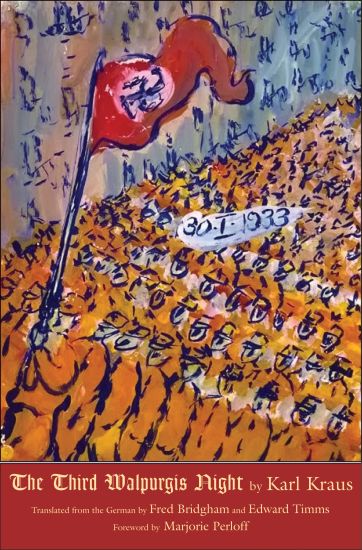
The first complete English translation of a far-seeing polemic, written in 1933 by the preeminent German-language satirist, unmasking the Nazi seizure of power"[A] drop-dead analysis of the rhetorical barbarities of the Hitler cult."—Bill Marx, Arts Fuse Austrian satirist and polemicist Karl Kraus’s Third Walpurgis Night was written in immediate response to the Nazi seizure of power in 1933 but was withheld from publication for fear of reprisals against Jews trapped in Germany. Acclaimed when finally published by Kösel Verlag in 1952, it is a devastatingly prescient exposure, giving special attention to the regime’s corruption of language as masterminded by Joseph Goebbels. Bertolt Brecht wrote to Kraus that, in his indictment of Nazism, “you have disclosed the atrocities of intonation and created an ethics of language.” This masterful translation, by the prizewinning translators of Kraus’s The Last Days of Mankind, aims for clarity where Kraus had good reason to be cautious and obscure. The Austrian Jewish author Karl Kraus (1874–1936) was the foremost German-language satirist of the twentieth century. As editor of the journal Die Fackel (The Torch) he single-handedly after 1912 conducted a sustained critique of propaganda and the press, expressed through polemical essays, satirical plays, witty aphorisms, and resonant poems.
Circling the Canon, Volume II

Circling the Canon, Volume II

Marjorie Perloff

University of New Mexico Press
2019
sidottu
One of our most important contemporary critics, Marjorie Perloff has been a widely published and influential reviewer, especially of poetry and poetics, for over fifty years. Circling the Canon, Volume II focuses on the second half of her prolific career, showcasing reviews from 1995 through her 2017 reconsiderations of Jonathan Culler's theory of the lyric and William Empson's classic Seven Types of Ambiguity. In this volume Perloff provides insight into the twenty-first-century literary landscape, from revaluations of its leading poets and translations of European poetry from Goethe to the Brazilian Noigandres group and interart studies and performance art. Key issues of the past few decades, such as the controversy over the role and function of poetry anthologies, receive extended treatment, and Perloff frequently voices a minority view, as in the case of the acclaimed British poet Philip Larkin.
Circling the Canon, Volume I

Circling the Canon, Volume I

Marjorie Perloff

University of New Mexico Press
2019
sidottu
One of our most important contemporary critics, Marjorie Perloff has been a widely published and influential reviewer, especially of poetry and poetics, for over fifty years. Circling the Canon, Volume I covers roughly the first half of Perloff's career, beginning with her first ever review, on Anthony Hecht's The Hard Hours. The reviews in this volume, culled from a wide range of scholarly journals, literary reviews, and national magazines, trace the evolution of poetry in the mid- to late twentieth century as well as the evolution of Perloff as a critic. Many of the authors whose works are reviewed in this volume are major figures, such as W. B. Yeats, Ezra Pound, Sylvia Plath, and Frank O'Hara. Others, including Mona Van Duyn and Richard Hugo, were widely praised in their day but are now all but forgotten. Still others--David Antin, Edward Dorn, or the Language poets--exemplify an avant-garde that was to come into its own.
Gunslinger

Gunslinger

Edward Dorn; Marjorie Perloff

Duke University Press
2018
pokkari
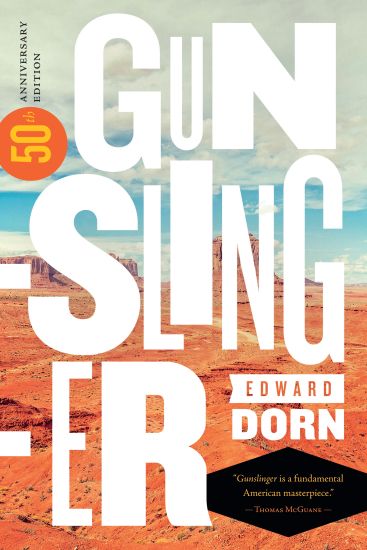
Fiftieth Anniversary Edition "Gunslinger is a fundamental American masterpiece."---Thomas McGuane This fiftieth anniversary edition commemorates Edward Dorn’s masterpiece, Gunslinger, a comic, anti-epic critique of American capitalism that still resonates today. Set in the American West, the Gunslinger, his talking horse Claude Lévi-Strauss, a saloon madam named Lil, and the narrator called “I” set out in search of the billionaire Howard Hughes. As they travel along the Rio Grande to Truth or Consequences, New Mexico, and finally on to Colorado, they are joined by a whole host of colorful characters: Dr. Jean Flamboyant, Kool Everything, and Taco Desoxin and his partner Tonto Pronto. During their adventures and hijinks, as captured in Dorn’s multilayered, absurd, and postmodern voice, they joke and smoke their way through debates about the meaning of existence. Put simply, Gunslinger is an American classic. In a new foreword Marjorie Perloff discusses Gunslinger's continued relevance to contemporary politics. This new edition also includes a critical essay by Michael Davidson and Charles Olson’s idiosyncratic “Bibliography on America for Ed Dorn,” which he wrote to provide guidance for Dorn's study of, and writing about, the American West.
Gunslinger

Gunslinger

Edward Dorn; Marjorie Perloff

Duke University Press
2018
sidottu
Fiftieth Anniversary Edition "Gunslinger is a fundamental American masterpiece."---Thomas McGuane This fiftieth anniversary edition commemorates Edward Dorn’s masterpiece, Gunslinger, a comic, anti-epic critique of American capitalism that still resonates today. Set in the American West, the Gunslinger, his talking horse Claude Lévi-Strauss, a saloon madam named Lil, and the narrator called “I” set out in search of the billionaire Howard Hughes. As they travel along the Rio Grande to Truth or Consequences, New Mexico, and finally on to Colorado, they are joined by a whole host of colorful characters: Dr. Jean Flamboyant, Kool Everything, and Taco Desoxin and his partner Tonto Pronto. During their adventures and hijinks, as captured in Dorn’s multilayered, absurd, and postmodern voice, they joke and smoke their way through debates about the meaning of existence. Put simply, Gunslinger is an American classic. In a new foreword Marjorie Perloff discusses Gunslinger's continued relevance to contemporary politics. This new edition also includes a critical essay by Michael Davidson and Charles Olson’s idiosyncratic “Bibliography on America for Ed Dorn,” which he wrote to provide guidance for Dorn's study of, and writing about, the American West.
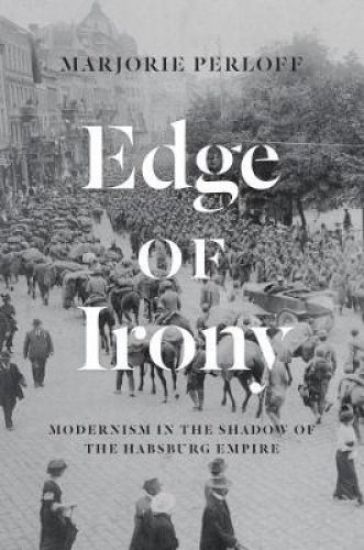
Edge of Irony

Edge of Irony

Marjorie Perloff

University of Chicago Press
2018
pokkari
Among the brilliant writers and thinkers who emerged from the multicultural and multilingual world of the Austro-Hungarian Empire were Joseph Roth, Robert Musil, and Ludwig Wittgenstein. For them, the trauma of World War I included the sudden loss of the geographical entity into which they had been born: in 1918, the empire was dissolved overnight, leaving Austria a small, fragile republic that would last only twenty years before being annexed by Hitler's Third Reich. In this major reconsideration of European modernism, Marjorie Perloff identifies and explores the aesthetic world that emerged from the rubble of Vienna and other former Habsburg territories--an "Austro-Modernism" that produced a major body of drama, fiction, poetry, and autobiography. Perloff explores works ranging from Karl Kraus's drama The Last Days of Mankind and Elias Canetti's memoir The Tongue Set Free to Ludwig Wittgenstein's notebooks and Paul Celan's lyric poetry. Throughout, she shows that Austro-Modernist literature is characterized less by the formal and technical inventions of a modernism familiar to us in the work of  Joyce and Pound, Dada and Futurism, than by a radical irony beneath a seemingly conventional surface, an acute sense of exile, and a sensibility more erotic and quixotic than that of its German contemporaries. Skeptical and disillusioned, Austro-Modernism prefers to ask questions rather than formulate answers.
Edge of Irony

Edge of Irony

Marjorie Perloff

University of Chicago Press
2016
sidottu
Among the brilliant writers and thinkers who emerged from the multicultural and multilingual world of the Austro-Hungarian Empire were Joseph Roth, Robert Musil, and Ludwig Wittgenstein. For them, the trauma of World War I included the sudden loss of the geographical entity into which they had been born: in 1918, the empire was dissolved overnight, leaving Austria a small, fragile republic that would last only twenty years before being annexed by Hitler’s Third Reich. In this major reconsideration of European modernism, Marjorie Perloff identifies and explores the aesthetic world that emerged from the rubble of Vienna and other former Habsburg territories—an “Austro-Modernism” that produced a major body of drama, fiction, poetry, and autobiography. Perloff explores works ranging from Karl Kraus’s drama The Last Days of Mankind and Elias Canetti’s memoir The Tongue Set Free to Ludwig Wittgenstein’s notebooks and Paul Celan’s lyric poetry. Throughout, she shows that Austro-Modernist literature is characterized less by the formal and technical inventions of a modernism familiar to us in the work of Joyce and Pound, Dada and Futurism, than by a radical irony beneath a seemingly conventional surface, an acute sense of exile, and a sensibility more erotic and quixotic than that of its German contemporaries. Skeptical and disillusioned, Austro-Modernism prefers to ask questions rather than formulate answers.
Poetics in a New Key

Poetics in a New Key

Marjorie Perloff

University of Chicago Press
2014
nidottu
Marjorie Perloff writes in her preface to Poetics in a New Key that when she learned David Jonathan Y. Bayot wanted to publish a collection of her interviews and essays, she was "at once honored and mystified." But to Perloff's surprise and her readers' delight, the resulting assembly not only presents an accessible and provocative introduction to Perloff's critical thought, but also highlights the wide range of her interests, and the energetic reassessments and new takes that have marked her academic career. The fourteen interviews in Poetics in a New Key - conducted by scholars, poets, and critics from the United States, Denmark, Norway, France, and Poland, including Charles Bernstein, Helene Aji, and Peter Nicholls - cover a broad spectrum of topics in the study of poetry: its nature as a literary genre, its current state, and its relationship to art, politics, language, theory, and technology. Also featured in the collection are three pieces by Perloff herself: an academic memoir, an exploration of poetry pedagogy, and an essay on twenty-first-century intellectuals. But across all the interviews and essays, Perloff's distinctive personality and approach to reading and talking resound, making this new collection an inspiring resource for scholars both of poetry and writing.
Los Angeles Review of Books Quarterly Journal Fall 2013

Los Angeles Review of Books Quarterly Journal Fall 2013

Marjorie Perloff; Tom Bissell; Maria Bustillos; Jacob Mikanowski; Rachel Kaadzi Ghansah

Los Angeles Review of Books
2013
pokkari
The Los Angeles Review of Books launched in April of 2011 as a humble Tumblr, with a 2600-word essay by Ben Ehrenreich entitled "The Death of the Book." The gesture was a bit tongue-in-cheek, but we meant it to be provocative, and to ask a genuine question: Was the book dying? Was the internet killing it? Or were we simply entering a new era, a new publishing ecosystem, where different media could coexist? Since then, we've been enormously gratified by the response that LARB has generated from readers, writers, academics, editors, publishers. We are a community of writers, critics, journalists, artists, filmmakers, and scholars dedicated to promoting and disseminating the best that is thought and written, with an enduring commitment to the intellectual rigor, the incisiveness, and the power of the written word.Today, we've created a new institution for writers and readers that is unlike anything else on the web. Our new LARB Quarterly Journal reflects the best that this institution has to bring to readers all over the world. One question these people have continually asked us, though, is: When are you going to put out a print edition? Even though we've been (and remain) committed to the internet as both a space of conversation and a place of commerce, we've always wanted to have something physical, tangible, to be able to show for our work. We never really believed that books would die, or magazines either. The LARB website currently publishes a minimum of two rigorously edited pieces a day, and we've cultivated a stable of regular contributors, both eminent (Jane Smiley, Mike Davis, Jonathan Lethem) and emerging (Jenny Hendrix, Colin Dickey, Rachel Kaadzi Ghansah). We've found our way to a certain tone that readers expect and enjoy: looser and more eclectic than our namesakes the New York and London Review of Books, grounded in literature but open to all varieties of cultural experience, far from the New York publishing hothouse atmosphere but not myopically focused on L.A. either. The new LARB print quarterly will build on the best aspects of the current website. As we do now, we'll publish book reviews that strive to do something more than recommend or discourage a purchase; we're most interested in pieces that push the form of the book review into other genres, such as memoir, polemic, or short story. We are excited to explore the possibilities of this new format, and feel confident that the audience we've attracted over the past two years on the web will follow us. We know that our peers at Harper's, Bookforum, n+1, The Believer, and the New York and London Review of Books -- all of whom have expressed support and goodwill for this latest venture -- welcome a new voice from the West, as will subscribers. The long form literary and cultural arts review is alive and well, and now, has a new home in Los Angeles.
Differentiell poetik

Differentiell poetik

Marjorie Perloff

OEI Editör
2013
sidottu
”Nu när det långa 1900-talet är bakom oss och många av våra heliga texter har blivit möjliga att omvärdera, samtidigt som nya texter fyller fältet, är det lägligt att rikta uppmärksamhet mot det som Marcel Duchamp kallade det infratunna.” Så beskriver Marjorie Perloff impulsen till vad hon kallar en differentiell läsning, en läsning som fokuserar (den poetiska) textens minimala materiella skillnader utan att bortse från en större estetisk och sociokulturell kontext. Detta är ett läsmodus som Perloff konsekvent, och ofta i opposition mot ett konservativt poesietablissemang, har praktiserat under de senaste 30 åren i kritiska studier av poeter och konstnärer som Pound, Eliot, Stein, Duchamp, Cage, Antin, Bernstein, Howe, Goldsmith, Bök, Bergvall, liksom av litterära ”rörelser” som futurism, dadaism, konkretism, oulipo, language och konceptuellt skrivande. Marjorie Perloff är professor emeritus vid Stanford University. Hon föddes 1931 som Gabriele Mintz i Wien, men kom på grund av nazisternas maktövertagande att växa upp i USA. Hon har publicerat 17 böcker och ett oräkneligt antal essäer och recensioner.
Unoriginal Genius

Unoriginal Genius

Marjorie Perloff

University of Chicago Press
2012
nidottu
In "Unoriginal Genius" Marjorie Perloff explores a new development in contemporary poetry: the repurposing of other people's words in order to make new works, by framing, citing, and recycling already existing phrases, sentences, and even full texts. Paradoxically, she argues, this 'unoriginal' poetry is more accessible and, in a sense, 'personal' than the hermetic poetry of the 1980s and '90s. Perloff traces this poetics of "Unoriginal Genius" from one of its paradigmatic works, Walter Benjamin's encyclopedic "Arcades Project", a book largely made up of citations. She discusses the processes of choice, framing, and reconfiguration in the work of Brazilian Concretism and Oulipo, two movements now understood to be precursors of such hybrid citational texts as Charles Bernstein's opera libretto "Shadowtime" and Susan Howe's documentary lyric sequence "The Midnight". "Unoriginal Genius" concludes with a discussion of Kenneth Goldsmith's conceptualist book "Traffic" - a seemingly "pure" transcript of one holiday weekend's worth of radio traffic reports. In these instances and many others, Perloff reveals 'poetry by other means' of great ingenuity, wit, and complexity.
Unoriginal Genius

Unoriginal Genius

Marjorie Perloff

University of Chicago Press
2010
sidottu
What is the place of individual genius in a global world of hyper-information - a world in which, as Walter Benjamin predicted more than seventy years ago, everyone is potentially an author? For poets in such a climate, 'originality' begins to take a back seat to what can be done with other people's words - framing, citing, recycling, and otherwise mediating available words and sentences, and sometimes entire texts. Marjorie Perloff here explores this intriguing development in contemporary poetry: the embrace of 'unoriginal' writing. Paradoxically, she argues, such citational and often constraint-based poetry is more accessible and, in a sense, 'personal' than was the hermetic poetry of the 1980s and '90s. Perloff traces this poetics of 'unoriginal genius' from its paradigmatic work, Benjamin's encyclopedic Arcades Project, a book largely made up of citations. She discusses the processes of choice, framing, and reconfiguration in the work of Brazilian Concretism and Oulipo, both movements now understood as precursors of such hybrid citational texts as Charles Bernstein's opera libretto "Shadowtime" and Susan Howe's documentary lyric sequence "The Midnight". Perloff also finds that the new syncretism extends to language: for example, to the French-Norwegian Caroline Bergvall writing in English and the Japanese Yoko Tawada in German. "Unoriginal Genius" concludes with a discussion of Kenneth Goldsmith's conceptualist book Traffic - a seemingly 'pure' radio transcript of one holiday weekend's worth of traffic reports. In these instances and many others, Perloff shows us 'poetry by other means' of great ingenuity, wit, and complexity.
Cellophane

Cellophane

Mac Wellman; Marjorie Perloff

PAJ Publications,U.S.
2005
pokkari
"He is James Joyce reborn as a rap artist."-Mel Gussow, The New York Times This collection includes Albanian Softshoe, Mister Original Bugg, Cleveland, Bad Penny, Cellophane, Three Americanisms, Fnu Lnu, Girl Gone, Hypatia, The Sandalwood Box and Cat's Paw. Written between 1983 and 1998, they showcase Wellman's ongoing exploration of the limits of language and the consequences of humanity in the postmodern world.
Differentials

Differentials

Marjorie Perloff

The University of Alabama Press
2004
sidottu
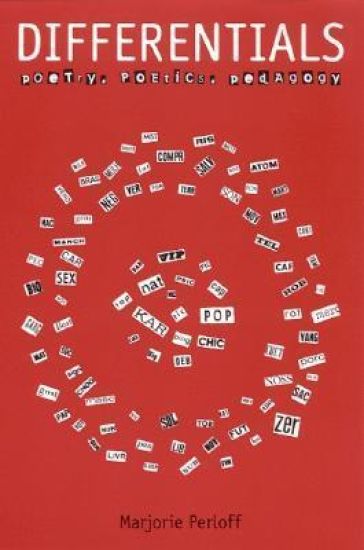
A new collection of essays from a distinguished critic of contemporary poetry. Marjorie Perloff is one of the foremost critics of contemporary American poetry writing today. Her works are credited by many with creating and sustaining new critical interest not only in the work of major modernist poets such as Yeats, Pound, Eliot, and Williams but also in the postwar tradition of American poetic innovation that ranges from the Black Mountain poets, through the New York School and concrete poetry, to the Language Poets of the 1980s and '90s. In Differentials, Perloff explores and defends her belief in the power of close reading, a strategy often maligned as reactionary in today's critical climate but which, when construed differentially, is vital, she believes, to any true understanding of a literary or poetic work, irrespective of how traditional or experimental it is. Perloff also examines key issues in modernism, from Eliot's conservative poetics and Pound's nominalism to translation theory (Wittgenstein, Eugene Jolas, Haroldo de Campos), and the contemporary avant garde, as represented by writers like Susan Howe, Tom Raworth, Rae Armantrout, Ron Silliman, Ronald Johnson, Caroline Bergvall, and Kenneth Goldsmith. Ultimately, Perloff's most important offerings in Differentials are her remarkably original reflections on the aesthetic process: on how poetry works, and what it means, in and for our time.