Kirjojen hintavertailu. Mukana 12 595 353 kirjaa ja 12 kauppaa.

Kirjailija

Mark A. Abramson

Kirjat ja teokset yhdessä paikassa: 12 kirjaa, julkaisuja vuosilta 2008-2018, suosituimpien joukossa Paths to Making a Difference. Vertaile teosten hintoja ja tarkista saatavuus suomalaisista kirjakaupoista.

12 kirjaa

Kirjojen julkaisuhaarukka 2008-2018.

Paths to Making a Difference

Paths to Making a Difference

Paul R. Lawrence; Mark A. Abramson

Rowman Littlefield
2012
nidottu
To understand the challenges of political leadership and how top executives succeed in accomplishing an administration's objectives, business in government experts Paul R. Lawrence and Mark A. Abramson present the findings of a two year's study of top political appointees in the Obama administration. The participants—deputy secretaries and agency heads—provide case studies of how each approaches the management challenges and achieves the mission of their organization. Full of behind-the-scenes insights and practical advice from government political executives on how they face management challenges in real time, Paths to Making a Difference: Leading in Government offers indispensable insights to current and prospective political appointees and everyone interested in understanding how leaders work to make government agencies more effective.

Paths to Making a Difference

Paths to Making a Difference

Paul R. Lawrence; Mark A. Abramson

Rowman Littlefield
2011
sidottu
To understand the challenges of political leadership and how top executives succeed in accomplishing an administration's objectives, business in government experts Paul R. Lawrence and Mark A. Abramson present the findings of a two year's study of top political appointees in the Obama administration. The participants—deputy secretaries and agency heads—provide case studies of how each approaches the management challenges and achieves the mission of their organization. Full of behind-the-scenes insights and practical advice from government political executives on how they face management challenges in real time, Paths to Making a Difference: Leading in Government offers indispensable insights to current and prospective political appointees and everyone interested in understanding how leaders work to make government agencies more effective.
Government for the Future

Government for the Future

Mark A. Abramson; Daniel J. Chenok; John M. Kamensky

Rowman Littlefield
2018
nidottu
In recognition of its 20th anniversary, The IBM Center for the Business of Government offers a retrospective of the most significant changes in government management during that period and looks forward over the next 20 years to offer alternative scenarios as to what government management might look like by the year 2040. Part I will discuss significant management improvements in the federal government over the past 20 years, based in part on a crowdsourced survey of knowledgeable government officials and public administration experts in the field. It will draw on themes and topics examined in the 350 IBM Center reports published over the past two decades. Part II will outline alternative scenarios of how government might change over the coming 20 years. The scenarios will be developed based on a series of envisioning sessions which are bringing together practitioners and academics to examine the future. The scenarios will be supplemented with short essays on various topics. Part II will also include essays by winners of the Center’s Challenge Grant competition. Challenge Grant winners will be awarded grants to identify futuristic visions of government in 2040. Contributions by Mark A. Abramson, David A. Bray, Daniel J. Chenok, Lee Feldman, Lora Frecks, Hollie Russon Gilman, Lori Gordon, John M. Kamensky, Michael J. Keegan, W. Henry Lambright, Tad McGalliard, Shelley H. Metzenbaum, Marc Ott, Sukumar Rao, and Darrell M. West.
Government for the Future

Government for the Future

Mark A. Abramson; Daniel J. Chenok; John M. Kamensky

Rowman Littlefield
2018
sidottu
In recognition of its 20th anniversary, The IBM Center for the Business of Government offers a retrospective of the most significant changes in government management during that period and looks forward over the next 20 years to offer alternative scenarios as to what government management might look like by the year 2040. Part I will discuss significant management improvements in the federal government over the past 20 years, based in part on a crowdsourced survey of knowledgeable government officials and public administration experts in the field. It will draw on themes and topics examined in the 350 IBM Center reports published over the past two decades. Part II will outline alternative scenarios of how government might change over the coming 20 years. The scenarios will be developed based on a series of envisioning sessions which are bringing together practitioners and academics to examine the future. The scenarios will be supplemented with short essays on various topics. Part II will also include essays by winners of the Center’s Challenge Grant competition. Challenge Grant winners will be awarded grants to identify futuristic visions of government in 2040. Contributions by Mark A. Abramson, David A. Bray, Daniel J. Chenok, Lee Feldman, Lora Frecks, Hollie Russon Gilman, Lori Gordon, John M. Kamensky, Michael J. Keegan, W. Henry Lambright, Tad McGalliard, Shelley H. Metzenbaum, Marc Ott, Sukumar Rao, and Darrell M. West.
Getting It Done

Getting It Done

Mark A. Abramson; Daniel Chenok; John M. Kamensky

Rowman Littlefield
2016
sidottu
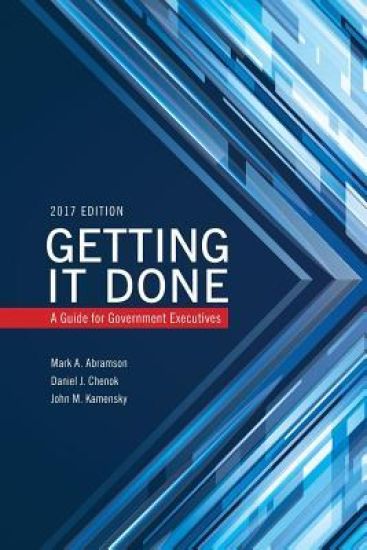
Getting It Done was written for those who have answered the call to public service. Now, in this 2017 edition, the editors of IBM’s Center for The Business of Government series have assembled a comprehensive guide to navigating the current environment of government, and what government leaders ought to know to survive and thrive with respect to the ways it’s evolved over the years. Concise analyses of the roles and responsibilities of those involved in any political decision accompany informative and instructional chapters, each highlighting a key step any public servant must take to ensure they do all they can for the people and causes they represent. From the patient and careful study of an issue, to the assembly of a trusted advisory team and the development and execution of a focused vision and agenda, leaders of all kinds will find some part of this book to incorporate into their own leadership strategies, for which this book’s expert and pragmatic insights prove a refreshing boon.
Getting It Done

Getting It Done

Mark A. Abramson; Daniel Chenok; John M. Kamensky

Rowman Littlefield
2016
nidottu
Getting It Done was written for those who have answered the call to public service. Now, in this 2017 edition, the editors of IBM’s Center for The Business of Government series have assembled a comprehensive guide to navigating the current environment of government, and what government leaders ought to know to survive and thrive with respect to the ways it’s evolved over the years. Concise analyses of the roles and responsibilities of those involved in any political decision accompany informative and instructional chapters, each highlighting a key step any public servant must take to ensure they do all they can for the people and causes they represent. From the patient and careful study of an issue, to the assembly of a trusted advisory team and the development and execution of a focused vision and agenda, leaders of all kinds will find some part of this book to incorporate into their own leadership strategies, for which this book’s expert and pragmatic insights prove a refreshing boon.
Succeeding as a Political Executive

Succeeding as a Political Executive

Mark A. Abramson; Paul R. Lawrence

Rowman Littlefield
2016
nidottu
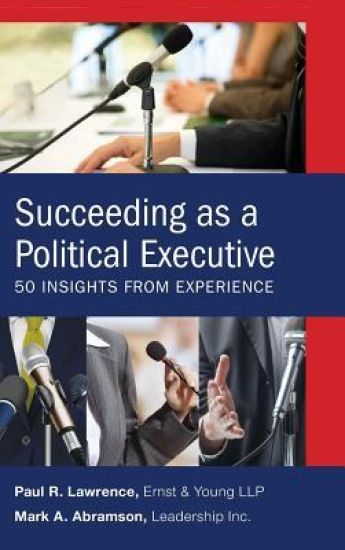
Succeeding as a Political Executive: Fifty Insights from Experience is based on the real-life experience of 64 high-level executives who served in the Obama Administration. Most were at the agency head level. From 2009 to 2015, the authors conducted a series of interviews with these individuals, gaining insights into running government organizations. This book is aimed at those interested in the transition of power to the next presidential administration starting in 2017.
Succeeding as a Political Executive

Succeeding as a Political Executive

Mark A. Abramson; Paul R. Lawrence

Rowman Littlefield
2016
sidottu
Succeeding as a Political Executive: Fifty Insights from Experience is based on the real-life experience of 64 high-level executives who served in the Obama Administration. Most were at the agency head level. From 2009 to 2015, the authors conducted a series of interviews with these individuals, gaining insights into running government organizations. This book is aimed at those interested in the transition of power to the next presidential administration starting in 2017.
What Government Does

What Government Does

Mark A. Abramson; Paul Lawrence

Rowman Littlefield
2014
sidottu
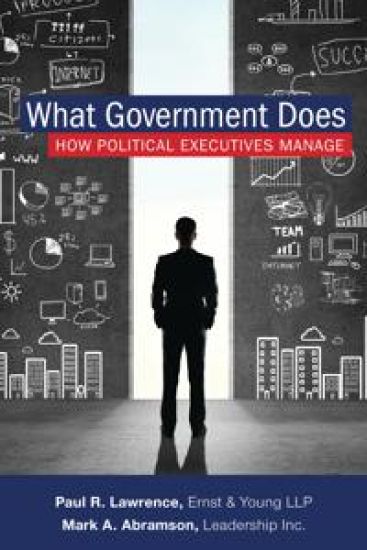
To understand the challenges of political leadership and how top executives succeed in accomplishing an Administration’s objectives, business-in-government experts Paul R. Lawrence and Mark A. Abramson present the findings of a four-year study of top political appointees in the Obama Administration. The 42 participants—Deputy Secretaries and agency heads—provide case studies of how each approaches the management challenges and achieves the mission of their organization. Full of behind-the-scenes insights and practical advice from government political executives on how they face management challenges in real time, What Government Does: How Political Executives Manage offers indispensable insights to current and prospective political appointees and everyone interested in understanding how leaders make government agencies more effective. The new book, a follow-up to their previous book, Paths to Making a Difference: Leading in Government, presents an insightful framework of what government does. Instead of thinking about government by policy area, the authors present an alternative approach in which government executives are categorized by the type of agency they are managing. The book includes chapters on Deputy Secretaries, producers, regulators, infrastructors, scientists, and collaborators.
What Government Does

What Government Does

Mark A. Abramson; Paul Lawrence

Rowman Littlefield
2014
nidottu
To understand the challenges of political leadership and how top executives succeed in accomplishing an Administration’s objectives, business-in-government experts Paul R. Lawrence and Mark A. Abramson present the findings of a four-year study of top political appointees in the Obama Administration. The 42 participants—Deputy Secretaries and agency heads—provide case studies of how each approaches the management challenges and achieves the mission of their organization. Full of behind-the-scenes insights and practical advice from government political executives on how they face management challenges in real time, What Government Does: How Political Executives Manage offers indispensable insights to current and prospective political appointees and everyone interested in understanding how leaders make government agencies more effective. The new book, a follow-up to their previous book, Paths to Making a Difference: Leading in Government, presents an insightful framework of what government does. Instead of thinking about government by policy area, the authors present an alternative approach in which government executives are categorized by the type of agency they are managing. The book includes chapters on Deputy Secretaries, producers, regulators, infrastructors, scientists, and collaborators.
The Operator's Manual for the New Administration

The Operator's Manual for the New Administration

Mark A. Abramson; Jonathan D. Breul; John M. Kamensky; Martin G. Wagner

Rowman Littlefield Publishers
2008
sidottu
The Operator's Manual for the New Administration explains how government works and how to make it work to advance policy goals and objectives. Bringing decades of experience in government administration, the authors have identified eight key tools-leadership, performance, people, money, contracting, technology, innovation, and collaboration-that executives must utilize in order to be successful.
The Operator's Manual for the New Administration

The Operator's Manual for the New Administration

Mark A. Abramson; Jonathan D. Breul; John M. Kamensky; Martin G. Wagner

Rowman Littlefield Publishers
2008
nidottu
The Operator's Manual for the New Administration explains how government works and how to make it work to advance policy goals and objectives. Bringing decades of experience in government administration, the authors have identified eight key tools-leadership, performance, people, money, contracting, technology, innovation, and collaboration-that executives must utilize in order to be successful.