Kirjojen hintavertailu. Mukana 12 390 323 kirjaa ja 12 kauppaa.

Kirjailija

Mark Bassin

Kirjat ja teokset yhdessä paikassa: 5 kirjaa, julkaisuja vuosilta 1999-2020, suosituimpien joukossa The Gumilev Mystique. Vertaile teosten hintoja ja tarkista saatavuus suomalaisista kirjakaupoista.

5 kirjaa

Kirjojen julkaisuhaarukka 1999-2020.

Geopolitical Imagination

Geopolitical Imagination

Mikhail Suslov; Mark Bassin

ibidem-Verlag, Jessica Haunschild u Christian Schon
2020
nidottu
In his timely book, Mikhail Suslov discusses contemporary Russian geopolitical culture and argues that a better knowledge of geopolitical concepts and fantasies is instrumental for understanding Russias policies. Specifically, he analyzes such concepts as Eurasianism, Holy Russia, Russian civilization, Russia as a continent, Novorossia, and others. He demonstrates that these concepts reached unprecedented ascendance in the Russian public debates, tending to overshadow other political and domestic discussions. Suslov argues that the geopolitical imagination, structured by these concepts, defines the identity of post-Soviet Russia, while this complex of geopolitical representations engages, at the same time, with the broader, international criticism of the Western liberal world order and aligns itself with the conservative defense of cultural authenticity across the globe. Geopolitical ideologies and utopias discussed in the book give the post-Soviet political mainstream the intellectual instruments to think about Russias exclusion -- imaginary or otherwise -- from the processes of a global world which is re-shaping itself after the end of the Cold War; they provide tools to construct the self-perception of Russia as a sovereign great-power, a self-sufficient civilisation, and as one of the poles in a multipolar world; and they help to establish the Messianic vision of Russia as the beacon of order, tradition, and morality in a sea of chaos and corruption.
The Gumilev Mystique

The Gumilev Mystique

Mark Bassin; Ronald Grigor Suny

Cornell University Press
2016
pokkari
Since the collapse of the Soviet Union, the legacy of the historian, ethnographer, and geographer Lev Nikolaevich Gumilev (1912–1992) has attracted extraordinary interest in Russia and beyond. The son of two of modern Russia's greatest poets, Nikolai Gumilev and Anna Akhmatova, Gumilev spent thirteen years in Stalinist prison camps, and after his release in 1956 remained officially outcast and professionally shunned. Out of the tumult of perestroika, however, his writings began to attract attention and he himself became a well-known and popular figure. Despite his highly controversial (and often contradictory) views about the meaning of Russian history, the nature of ethnicity, and the dynamics of interethnic relations, Gumilev now enjoys a degree of admiration and adulation matched by few if any other public intellectual figures in the former Soviet Union. He is freely compared to Albert Einstein and Karl Marx, and his works today sell millions of copies and have been adopted as official textbooks in Russian high schools. Universities and mountain peaks alike are named in his honor, and a statue of him adorns a prominent thoroughfare in a major city. Leading politicians, President Vladimir Putin very much included, are unstinting in their deep appreciation for his legacy, and one of the most important foreign-policy projects of the Russian government today is clearly inspired by his particular vision of how the Eurasian peoples formed a historical community. In The Gumilev Mystique, Mark Bassin presents an analysis of this remarkable phenomenon. He investigates the complex structure of Gumilev's theories, revealing how they reflected and helped shape a variety of academic as well as political and social discourses in the USSR, and he traces how his authority has grown yet greater across the former Soviet Union. The themes he highlights while untangling Gumilev's complicated web of influence are critical to understanding the political, intellectual, and ethno-national dynamics of Russian society from the age of Stalin to the present day.
The Gumilev Mystique

The Gumilev Mystique

Mark Bassin; Ronald Grigor Suny

Cornell University Press
2016
sidottu
Since the collapse of the Soviet Union, the legacy of the historian, ethnographer, and geographer Lev Nikolaevich Gumilev (1912–1992) has attracted extraordinary interest in Russia and beyond. The son of two of modern Russia's greatest poets, Nikolai Gumilev and Anna Akhmatova, Gumilev spent thirteen years in Stalinist prison camps, and after his release in 1956 remained officially outcast and professionally shunned. Out of the tumult of perestroika, however, his writings began to attract attention and he himself became a well-known and popular figure. Despite his highly controversial (and often contradictory) views about the meaning of Russian history, the nature of ethnicity, and the dynamics of interethnic relations, Gumilev now enjoys a degree of admiration and adulation matched by few if any other public intellectual figures in the former Soviet Union. He is freely compared to Albert Einstein and Karl Marx, and his works today sell millions of copies and have been adopted as official textbooks in Russian high schools. Universities and mountain peaks alike are named in his honor, and a statue of him adorns a prominent thoroughfare in a major city. Leading politicians, President Vladimir Putin very much included, are unstinting in their deep appreciation for his legacy, and one of the most important foreign-policy projects of the Russian government today is clearly inspired by his particular vision of how the Eurasian peoples formed a historical community. In The Gumilev Mystique, Mark Bassin presents an analysis of this remarkable phenomenon. He investigates the complex structure of Gumilev's theories, revealing how they reflected and helped shape a variety of academic as well as political and social discourses in the USSR, and he traces how his authority has grown yet greater across the former Soviet Union. The themes he highlights while untangling Gumilev's complicated web of influence are critical to understanding the political, intellectual, and ethno-national dynamics of Russian society from the age of Stalin to the present day.
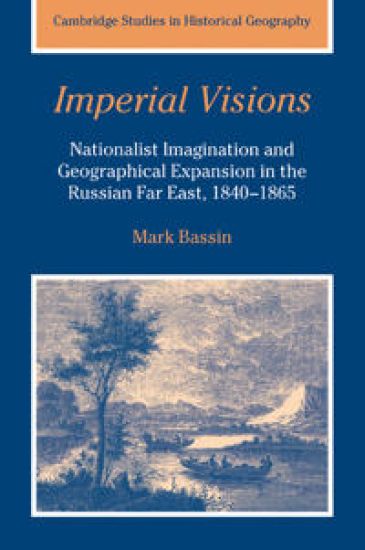
Imperial Visions

Imperial Visions

Mark Bassin

Cambridge University Press
2006
pokkari
In the middle of the nineteenth century, the Russian empire made a dramatic advance on the Pacific by annexing the vast regions of the Amur and Ussuri rivers. Although this remote realm was a virtual terra incognita for the Russian educated public, the acquisition of an 'Asian Mississippi' attracted great attention nonetheless, even stirring the dreams of Russia's most outstanding visionaries. Within a decade of its acquisition, however, the dreams were gone and the Amur region largely abandoned and forgotten. In an innovative examination of Russia's perceptions of the new territories in the Far East, Mark Bassin sets the Amur enigma squarely in the context of the Zeitgeist in Russia at the time. Imperial Visions demonstrates the fundamental importance of geographical imagination in the mentalité of imperial Russia. This 1999 work offers a truly novel perspective on the complex and ambivalent ideological relationship between Russian nationalism, geographical identity and imperial expansion.
Imperial Visions

Imperial Visions

Mark Bassin

Cambridge University Press
1999
sidottu
In the middle of the nineteenth century, the Russian empire made a dramatic advance on the Pacific by annexing the vast regions of the Amur and Ussuri rivers. Although this remote realm was a virtual terra incognita for the Russian educated public, the acquisition of an ‘Asian Mississippi’ attracted great attention nonetheless, even stirring the dreams of Russia’s most outstanding visionaries. Within a decade of its acquisition, however, the dreams were gone and the Amur region largely abandoned and forgotten. In an innovative examination of Russia’s perceptions of the new territories in the Far East, Mark Bassin sets the Amur enigma squarely in the context of the Zeitgeist in Russia at the time.Imperial Visions demonstrates the fundamental importance of geographical imagination in the mentalité of imperial Russia. The work offers a truly novel perspective on the complex and ambivalent ideological relationship between Russian nationalism, geographical identity, and imperial expansion.