Kirjojen hintavertailu. Mukana 12 595 353 kirjaa ja 12 kauppaa.
Kirjailija
Mark Bauerlein
Kirjat ja teokset yhdessä paikassa: 11 kirjaa, julkaisuja vuosilta 1997-2022, suosituimpien joukossa The Dumbest Generation Grows Up: From Stupefied Youth to Dangerous Adults. Vertaile teosten hintoja ja tarkista saatavuus suomalaisista kirjakaupoista.
From Stupefied Youth to Dangerous Adults Back in 2008, Mark Bauerlein was a voice crying in the wilderness. As experts greeted the new generation of "Digital Natives" with extravagant hopes for their high-tech future, he pegged them as the "Dumbest Generation." Today, their future doesn't look so bright, and their present is pretty grim. The twenty-somethings who spent their childhoods staring into a screen are lonely and purposeless, unfulfilled at work and at home. Many of them are even suicidal. The Dumbest Generation Grows Up is an urgently needed update on the Millennials, explaining their not-so-quiet desperation and, more important, the threat that their ignorance poses to the rest of us. Lacking skills, knowledge, religion, and a cultural frame of reference, Millennials are anxiously looking for something to fill the void. Their mentors have failed them. Unfortunately, they have turned to politics to plug the hole in their souls. Knowing nothing about history, they are convinced that it is merely a catalogue of oppression, inequality, and hatred. Why, they wonder, has the human race not ended all this injustice before now? And from the depths of their ignorance rises the answer: Because they are the first ones to care All that is needed is to tear down our inherited civilization and replace it with their utopian aspirations. For a generation unacquainted with the constraints of human nature, anything seems possible. Having diagnosed the malady before most people realized the patient was sick, Mark Bauerlein surveys the psychological and social wreckage and warns that we cannot afford to do this to another generation.

Medieval Studies is the critical study of Europe's self-identity. No understanding of Western civilization is possible without it. Inevitably, Left-wing academics want to introduce gender studies and race theory to the field--and punish those who refuse to conform. When one University of Chicago professor dared to publicly celebrate the Christian identity of the Middle Ages, she was branded a 'violent fascist' and 'white supremacist' by her colleagues. Now Medieval Studies scholars are tearing their own discipline apart with witch-hunts, name-calling, boycotts and intimidation. The damage done to academia could be incalculable. In this influential essay, originally published to widespread acclaim online, New York Times-bestselling author and award-winning journalist Milo Yiannopoulos explains why all Americans should care about the newest front in the cultural war, the academic battle for the Middle Ages.
Eberhard Arnold; Michael Plato; Alexi Sargeant; Susannah Black; Stephanie Bennett; Johann Christoph Arnold; Philip Britts; John Rhodes; Chico Fajardo-Heflin; Mark Bauerlein; Michael T. McRay; C. S. Lewis; Wendell Berry; Alfred Delp; Timothy Cardinal Dolan; Maureen Swinger
This issue of Plough Quarterly explores the effects of technology on human flourishing. Whether its artificial intelligence, genome editing, Big Tech monopolies, or social media–induced depression, we live in a world that is being reshaped by technology from the ground up. How do we stay human? This issue of Plough Quarterly addresses challenges ranging from the lure of transhumanism to the erosion of silence by the smartphone. Technophobia is no answer, our contributors agree, but neither is a refusal to tackle real dangers. They ask: Why not try living without a computer or a television? Why give tablets to children when Steve Jobs refused to give them to his kids? Why write using a keyboard when you could wield a fountain pen? Technological asceticism of this kind won’t solve society-wide dilemmas. But it can help us maintain the spiritual independence needed to respond to them rightly. Also in this issue: original poetry by Jacob Stratman; reviews of new books by Ian Johnson, Steve Roud, and Markus Rathey; insights from Wendell Berry, Viktor Frankl, Ivan Illich, Carl Sandburg, C. S. Lewis, Alfred Delp, and Christoph Blumhardt; and art by Pieter Bruegel the Elder, Jack Baumgartner, Nicholas Roerich, Rachel Newling, Kay Polk, Suellen McCrary, Stephen Scott Young, Jie Wei Zhou, Kiéra Malone, Torkel Pettersson, Mari Rast, Albrecht Dürer, René Magritte, and Kyle T. Webster. Plough Quarterly features stories, ideas, and culture for people eager to put their faith into action. Each issue brings you in-depth articles, interviews, poetry, book reviews, and art to help you put Jesus’ message into practice and find common cause with others.
From the author team of the discipline's most widely used literature anthology, this accessible and instructive guide introduces students to the language of literary study. Featuring an engaging and accessible writing style, this supplemental reference manual for the introductory student has over 400 entries and serves to demystify literature and the terms, techniques, and analysis tools that literary scholars use.
History and Women, Culture and Faith is a five-volume collection of eighty essays and journal articles spanning the extraordinary intellectual career of Elizabeth Fox-Genovese (1941-2007). A working scholar for more than three decades, Fox-Genovese made significant contributions to European and American southern history and became one of the most provocative scholars and educators of her time as she evolved from a Marxist to a feminist to a prolife Roman Catholic. Although she authored or coauthored ten well-received books, her prolific output as an essayist is less well known. This multivolume collection celebrates the scope of her scholarship and invites a fresh assessment of her legacy and influence. Written between the 1970s and the early twenty-first century, the fifteen pioneering essays in Volume II: Ghosts and Memories share in decoding and contextualizing the writings and history of white and black southern women. In these essays Fox-Genovese moves beyond literary criticism to give illuminating historical context to the ways that slavery, race, and gender shaped--and were shaped by--her subjects' lives and writings from the late-eighteenth century into the twentieth. As a result Fox-Genovese provides readers interpretations and perspectives that at once challenge and transform conventional stereotypes that frame our ideas about women's roles in southern history and about texts reflecting on those roles. Fox-Genovese's essays in this and other volumes provoke thought and insight with their combination of clarity and subtlety. Here she illuminates books out of the Harlem Renaissance by Zora Neale Hurston and out of Civil War-era Alabama by Augusta Jane Evans Wilson. And her keen assessments of autobiographies of white activist Katharine Du Pre Lumpkin and black poet and activist Maya Angelou still resonate as fresh and powerful readings. Even the fictional character Scarlett O'Hara looks strikingly different under Fox-Genovese's gaze. Scholars will find this volume a window on aspects of understudied subjects and also an opportunity to engage in the challenges of reading and interpreting powerful texts created from psychologically and historically fraught circumstances.
This shocking, surprisingly entertaining romp into the intellectual nether regions of today's underthirty set reveals the disturbing and, ultimately, incontrovertible truth: cyberculture is turning us into a society of know-nothings.
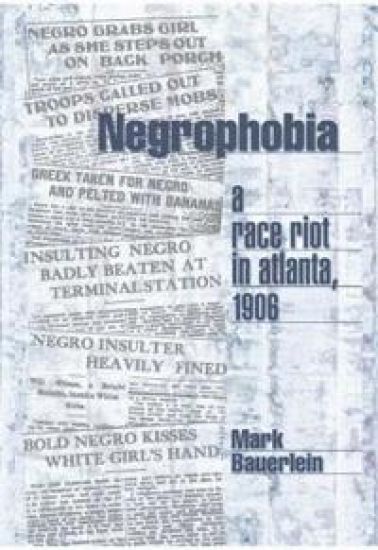
In 1906, in a bitter gubernatorial contest, Georgia politicians played the race card and white supremacists trumpeted a Negro crime scare. Drawing on new archival materials, Mark Bauerlein traces the origins, development and brutal climax of Atlanta's descent into hatred and violence in that fateful summer. Negrophobia is history at its best--a dramatic moment in time impeccably recreated in a suspenseful narrative.
At the beginning of the twentieth century, Atlanta was regarded as the gateway to the new, enlightened and racially progressive South. White business owners employed black workers and made their fortunes, while black leaders led congregations, edited periodicals, and taught classes. But in 1906, in a bitter gubernatorial contest, Georgia politicians played the race card and white supremacists trumpeted a "Negro crime" scare. Seizing on rumors of black predation against white women, they launched a campaign based on fears of miscegenation and white subservience. Atlanta slipped into a climate of racial phobia and sexual hysteria that culminated in a bloody riot, which stymied race relations for fifty years. Drawing on new archival materials, Mark Bauerlein traces the origins, development and brutal climax of Atlanta's descent into hatred and violence in the fateful summer of 1906. "Negrophobia" is history at its best--a dramatic moment in time impeccably recreated in a suspenseful narrative, focusing on figures such as Booker T. Washington and W. E. B. DuBois; author Margaret Mitchell and future NAACP leader Walter White; and an assortment of black victims and white politicians who witnessed and participated in this American tragedy.
The Pragmatic Mind is a study of the pragmatism of Emerson, James, and Peirce and its overlooked relevance for the neopragmatism of thinkers like Richard Rorty, Stanley Cavell, Stanley Fish, and Cornel West. Arguing that the "original" pragmatists are too-often cited casually and imprecisely as mere precursors to this contemporary group of American intellectuals, Mark Bauerlein explores the explicit consequences of the earlier group’s work for current debates among and around the neopragmatists. Bauerlein extracts from Emerson, James, and Peirce an intellectual focus that can be used to advance the broad social and academic reforms that the new pragmatists hail. He claims that, in an effort to repudiate the phony universalism of much contemporary theory, the new generation of theorists has ignored the fact that its visions of pragmatic action are grounded in this "old" school, not just in a way of doing things but also in a way of thinking about things. In other words, despite its inclination to regard psychological questions as irrelevant, Bauerlein shows that the pragmatic method demands a pragmatic mind-that is, a concept of cognition, judgment, habit, and belief. He shows that, in fact, such a concept of mind does exist, in the work of the "old" pragmatists.
As the study of literature has extended to cultural contexts, critics have developed a language all their own. Yet, argues Mark Bauerlein, scholars of literature today are so unskilled in pertinent sociohistorical methods that they compensate by adopting cliches and catchphrases that serve as substitutes for information and logic. Thus by labeling a set of ideas an "ideology" they avoid specifying those ideas, or by saying that someone "essentializes" a concept they convey the air of decisive refutation. As long as a paper is generously sprinkled with the right words, clarification is deemed superfluous. Bauerlein contends that such usages only serve to signal political commitments, prove membership in subgroups, or appeal to editors and tenure committees, and that current textual practices are inadequate to the study of culture and politics they presume to undertake. His book discusses 23 commonly encountered terms-from "deconstruction" and "gender" to "problematize" and "rethink"-and offers a diagnosis of contemporary criticism through their analysis. He examines the motives behind their usage and the circumstances under which they arose and tells why they continue to flourish. A self-styled "handbook of counterdisciplinary usage," Literary Criticism: An Autopsy shows how the use of illogical, unsound, or inconsistent terms has brought about a breakdown in disciplinary focus. It is an insightful and entertaining work that challenges scholars to reconsider their choice of words-and to eliminate many from critical inquiry altogether.