Kirjojen hintavertailu. Mukana 12 595 353 kirjaa ja 12 kauppaa.

Kirjailija

Mark Blaug

Kirjat ja teokset yhdessä paikassa: 53 kirjaa, julkaisuja vuosilta 1973-2022, suosituimpien joukossa The Early Mercantilists: Thomas Mun (1571–1641), Edward Misselden (1608–1634) and Gerard de Malynes (1586–1623). Vertaile teosten hintoja ja tarkista saatavuus suomalaisista kirjakaupoista.

53 kirjaa

Kirjojen julkaisuhaarukka 1973-2022.

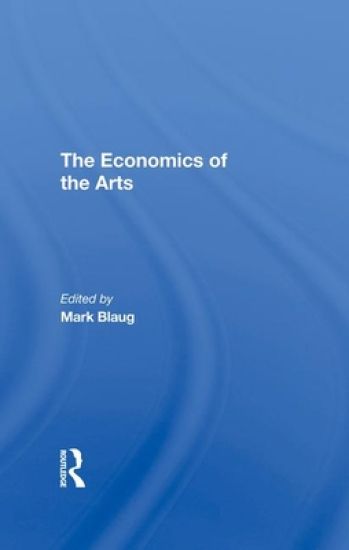
The Economics Of The Arts

The Economics Of The Arts

Mark Blaug

TAYLOR FRANCIS LTD
2022
nidottu
The economics of the Arts is a new field with a small but rapidly-growing literature, which has emerged in recent years out of the eagerness of economists to apply their techniques to hitherto untried areas and the recognition by Arts administrators of the rapidly increasing economic pressures on the Arts. This book of readings is the first of its kind. Of the 16 articles, 8 are directly concerned with the Arts in America; the other 8 deal with the British scene. What can economics say about so non-economic a subject as the Arts? Obviously, finance for the Arts involves economic considerations. But in addition, economics provides, among other things, a logic of rational choice, and the economists' style of thinking, therefore, is adaptable to any problem of choice in respect of any set of goals, whether they be economic goals or not. Then, there is the question of whether economics can provide a case for public support for the Arts, that is, whether the State should subsidize the Arts. This is a familiar problem in the economics of welfare but its application to the Arts raises novel questions and even economists are not agreed on whether economics can provide such a rationale. Also, there is the question of criteria for public expenditure on the Arts, assuming that the case for some public expenditure has been made. Can economists tell us how much the State should spend on the Arts? Surely, they can help us with a host of other questions: should museums and galleries charge fees; should museums ever sell off parts of their collections; can the Arts economize on their expenditures; how can modern music be most effectively encouraged by public funds; are ticket prices an important element in the demand for the Arts; and does the low pay of artists discourage individuals from taking up artistic occupations?
Ricardian Economics: a Historical Study

Ricardian Economics: a Historical Study

Mark Blaug

Hassell Street Press
2021
sidottu
This work has been selected by scholars as being culturally important and is part of the knowledge base of civilization as we know it.This work is in the public domain in the United States of America, and possibly other nations. Within the United States, you may freely copy and distribute this work, as no entity (individual or corporate) has a copyright on the body of the work.Scholars believe, and we concur, that this work is important enough to be preserved, reproduced, and made generally available to the public. To ensure a quality reading experience, this work has been proofread and republished using a format that seamlessly blends the original graphical elements with text in an easy-to-read typeface.We appreciate your support of the preservation process, and thank you for being an important part of keeping this knowledge alive and relevant.
Ricardian Economics: a Historical Study

Ricardian Economics: a Historical Study

Mark Blaug

Hassell Street Press
2021
nidottu
This work has been selected by scholars as being culturally important and is part of the knowledge base of civilization as we know it.This work is in the public domain in the United States of America, and possibly other nations. Within the United States, you may freely copy and distribute this work, as no entity (individual or corporate) has a copyright on the body of the work.Scholars believe, and we concur, that this work is important enough to be preserved, reproduced, and made generally available to the public. To ensure a quality reading experience, this work has been proofread and republished using a format that seamlessly blends the original graphical elements with text in an easy-to-read typeface.We appreciate your support of the preservation process, and thank you for being an important part of keeping this knowledge alive and relevant.
The Economics Of The Arts

The Economics Of The Arts

Mark Blaug

Routledge
2020
sidottu
The economics of the Arts is a new field with a small but rapidly-growing literature, which has emerged in recent years out of the eagerness of economists to apply their techniques to hitherto untried areas and the recognition by Arts administrators of the rapidly increasing economic pressures on the Arts. This book of readings is the first of its kind. Of the 16 articles, 8 are directly concerned with the Arts in America; the other 8 deal with the British scene. What can economics say about so non-economic a subject as the Arts? Obviously, finance for the Arts involves economic considerations. But in addition, economics provides, among other things, a logic of rational choice, and the economists' style of thinking, therefore, is adaptable to any problem of choice in respect of any set of goals, whether they be economic goals or not. Then, there is the question of whether economics can provide a case for public support for the Arts, that is, whether the State should subsidize the Arts. This is a familiar problem in the economics of welfare but its application to the Arts raises novel questions and even economists are not agreed on whether economics can provide such a rationale. Also, there is the question of criteria for public expenditure on the Arts, assuming that the case for some public expenditure has been made. Can economists tell us how much the State should spend on the Arts? Surely, they can help us with a host of other questions: should museums and galleries charge fees; should museums ever sell off parts of their collections; can the Arts economize on their expenditures; how can modern music be most effectively encouraged by public funds; are ticket prices an important element in the demand for the Arts; and does the low pay of artists discourage individuals from taking up artistic occupations?
Ricardian Economics: A Historical Study

Ricardian Economics: A Historical Study

Mark Blaug

Literary Licensing, LLC
2012
sidottu
Ricardian Economics: A Historical Study is a book written by Mark Blaug that delves into the economic theories of David Ricardo, one of the most influential economists of the 19th century. Ricardo's ideas on labor, rent, and international trade were groundbreaking and continue to influence economic thought today. Blaug's book provides a comprehensive analysis of Ricardo's theories, tracing their development and impact on economic theory over time. The book also examines the historical context in which Ricardo's ideas emerged and the debates that surrounded them. Blaug's approach is both rigorous and accessible, making this book an ideal resource for students and scholars of economics, as well as anyone interested in the history of economic thought.Yale Studies In Economics, No. 8.This scarce antiquarian book is a facsimile reprint of the old original and may contain some imperfections such as library marks and notations. Because we believe this work is culturally important, we have made it available as part of our commitment for protecting, preserving, and promoting the world's literature in affordable, high quality, modern editions, that are true to their original work.
Economic Theory in Retrospect

Economic Theory in Retrospect

Mark Blaug

Cambridge University Press
1997
pokkari
This is a history of economic thought from Adam Smith to John Maynard Keynes - but it is a history with a difference. Firstly, it is a history of economic theory, not of economic doctrines, that is, it is consistently focused on theoretical analysis, undiluted by entertaining historical digressions or biological colouring. Secondly, it includes detailed Reader’s Guides to nine of the major texts of economics, namely the works of Smith, Ricardo, Mill, Marx, Marshall, Wickstead, Wicksell, Walras and Keynes, in the effort to encourage students to become acquainted at first hand with the writings of all the great economists. This fifth edition adds new Reader’s Guides to Walras’s Elements of Pure Economics (1871–74) and Keynes’ General Theory to the previous seven Reader’s Guides of other great books in economics. There are significant and major additions to six chapters.
Harold Hotelling (1895–1973), Lionel Robbins (1898–1984), Clark Warburton (1896–1979), John Bates Clark (1847–1938) and Ludwig von Mises (1881–1973)
The fifth volume in the final section of the "Pioneers in Economics" series. This section of the series offers an assessment of significant economists of the 20th century, and this volume deals with Harold Hotelling, Lionel Robbins, Clark Warburton, John Bates Clark and Ludwig von Mises.
The Early Mercantilists: Thomas Mun (1571–1641), Edward Misselden (1608–1634) and Gerard de Malynes (1586–1623)
The Mercantilist School never presented a common front but is associated with a common outlook: the idea of specie or bullion as the essence of wealth and the notion that a positive balance of trade is an index of national welfare. It is also associated with an emphasis on population growth and low wages, a concern with full employment and the far reaching denial of foreign trade as a source of net gain to the world as a whole; that is, international trade was regarded as a zero-sum gain and particular nations were thought to benefit from international trade only at the expense of others. The underlying idea that a permanent balance of trade surplus should be beneficial to a nation has been a source of discussion right down to the present day.
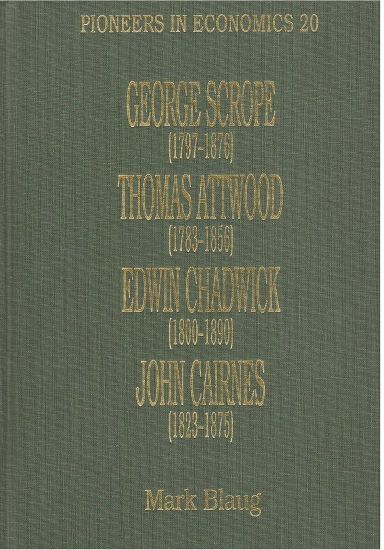
George Scrope (1797–1876), Thomas Attwood (1783–1856), Edwin Chadwick (1800–1890) and John Cairnes (1823–1875)
George Scrope was a prolific anti-Ricardian Tory economist, Member of Parliament and Fellow of the Royal Society. However, this was a highly eccentric toryism. Scrope opposed the Malthusian theory of population, favoured free trade and agitated for parliamentary reform. Thomas Attwood was the leading monetary crank of his day and was ridiculed for promoting the ideas of a paper standard currency. Although he presented the mammoth Chartist petition to parliament in 1839, even the Chartists would not contemplate his radical and futuristic monetary innovations.What McCulloch was to Ricardo, John Elliot Cairnes was to John Stuart Mill, a faithful disciple who did not always see eye to eye with his master. He has been called the last of the classical economists and the title is well deserved. Edwin Chadwick, a one time secretary to Bentham, was influential during the second quarter of the nineteenth century and much of his work, in particular his contributions to the 'Blue Books' of the period, helped to lay the foundations of the British Welfare State. Although a utilitarian in politics and a Ricardian in economics, he had a view of the problems of externalities which went way beyond anything dreamed of by Ricardo.This series of essays on these four maverick figures vividly conveys the flavour of the English Classical Political Economy in the heyday of the industrial revolution.
The Later Mercantilists: Josiah Child (1603–1699) and John Locke (1632–1704)
This volume presents critical writings on the work of the later mercantilists. Sir Josiah Child was elected a governor of the East India Company in 1681. His reputation as an economist rests on his book 'A New Discourse of Trade' published in 1693. His work stimulated a wide range of discussion of such topics as interest rates, population, wage policy, poor relief and colonization. Despite many liberal elements in his thinking, he was a typical Mercantilist in his preference for administrative solutions to economic problems. John Locke, best known for his work on political philosophy, made a major contribution to the debate on the rate of interest in his essay 'Some Considerations of the Consequences of the Lowering of Interest and Raising the Value of Money' (1692). The central theme of that pamphlet was that the rate of interest, being the price for the hire of money, is determined by the demand for and supply of money, which Parliament is powerless to affect. Locke's other major contribution to economic thought was the so called labour theory of private property contained in the 'Two Treaties on Government' (1690), a classic in the history of political philosophy.
The Historiography of Economics

The Historiography of Economics

Mark Blaug

Edward Elgar Publishing Ltd
1991
sidottu
This volume focuses on the importance of the history of economic thought as an intellectual discipline. It counters the arguments of some contemporary economists who describe it as studying the mistakes of the past. However, all the great economists - Smith, Ricardo, Marx, Marshall, Keynes and even Milton Friedman - have drawn on the history of economics to find an appropriate pedigree for their own theoretical innovations. This important volume contains high quality articles - written from different perspectives - demonstrating the importance of the history of economic thought.
Thomas Tooke (1774–1858), Mountifort Longfield (1802–1884) and Richard Jones (1790–1855)
Thomas Tooke was the founder of the contra-quantity theory of money - the view that monetary policy is powerless to influence prices because the supply of money depends on the flow of money expenditure and hence is the result and not the cause of price change. Yet his prominence within economic circles was also derived from his work as a lobbyist for free trade and the principal spokesman of the banking school, arguing against statutory control of the currency. Long neglected, Mountifort Longfield has now attracted the attention of modern economists who have praised him for, amongst other things, the discovery of the modern factor proportions theory of international trade and a theory of distribution which was a genuine alternative to Ricardo's. Modern readers have been amazed by his Lectures, a path-breaking book which sketches out a subjective theory of value and a marginal productivity theory of distribution - all this in 1834, only 11 years after the death of Ricardo. Richard Jones was the first institutionalist critic of Ricardo and a historically-minded economist years before the emergence of the British and German Schools. He launched himself into the task of reconstructing the whole of economics on historical and evolutionary grounds. However, not being able to carry this ambitious programme beyond the field of rent theory, and his great reluctance to make unsupported generalizations, caused his work to fall into oblivion. Only recently has modern scholarship begun to reassess his importance.
Pre-Classical Economists Volume I: Charles Davenant (1656–1714) and William Petty (1623–1687)
Charles Davenant was one of the leading economic pamphleteers of the 1690s. He frequently developed general principles, some of which sound almost like the early writings of Adam Smith. He was, however, a Mercantilist in the sense that he underlined the advantages of a favourable balance of trade as a source of political power, favoured population growth and decried luxury spending. William Petty focused on some practical questions of his times including war finance, monetary reform, relief for the poor. His work contains a veritable cornucopia of terms and concepts that came to dominate economic thinking for the next three centuries; 'full employment' and 'ceteris paribus', the idea of national income as identical to national expenditure, public works as a method of dealing with unemployment etc. However his greatest contribution was the invention of what he called 'political arithmetic', the quantitative estimation of both the stock of national wealth and the flow of national income to determine the appropriate base for taxation.
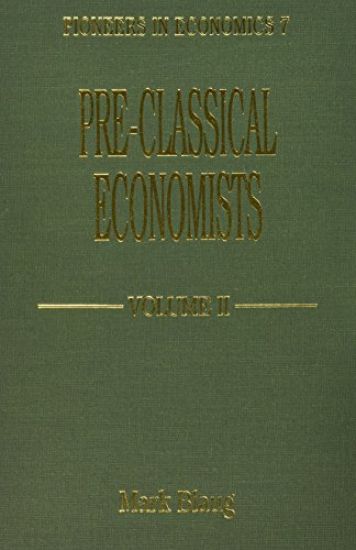
Pre-Classical Economists Volume II:

Pre-Classical Economists Volume II:

Mark Blaug

Edward Elgar Publishing Ltd
1991
sidottu
Pierre le Pesant Boisguilbert was considered by Marx as one of the founders of classical political economy. His writings contain a large number of concepts and ideas that reappear in the writings of Quesnay, Cantillon and Adam Smith. George Berkeley - a major figure in the history of philosophical idealism - was the author of 'The Querist', a treatise on the nature of Irish under-development and cures for Irish poverty. Baron de Montesquieu - one of the great 18th century polymaths - is author of the masterpiece 'The Spirit of the Laws' (1748) which, while ostensibly a treatise on law, is actually a study of political organization, types of government, national character and the determining ethos of different societies. It enjoyed enormous success in the 18th century and was almost certainly read and studied by Adam Smith. Ferdinando Galiani was a leading critic of physiocracy and a major 18th century proponent of the subjective theory of value. In 1751 he published 'Della Moneta' which contains some notable chapters on monetary theory, and some brilliant pages on the utility theory of value. James Anderson was a Scottish farmer and a prolific author of tracts on the agricultural development of Scotland and the outstanding policy issues of the last quarter of the 18th century. Dugald Stewart was author of 'Account of the Life and Writings of Adam Smith LLD' (1793) which is one of the earliest, extended commentaries on the works of Adam Smith by one who knew him well.
Pre-Classical Economists Volume III: John Law (1671–1729) and Bernard Mandeville (1660–1733)
John Law was one of those extraordinary personalities in which the 18th century seemed to abound. He held a demand-and-supply theory of value and treated the value of money or the determination of the average level of prices as only a special case of a general theory of value. Law eventually became Minister of Finance in France and was responsible for the greatest speculative frenzy in her history known as the Mississippi Bubble. When the boom collapsed in the closing months of 1720, Law was forced to flee France, permanently discredited, and spent his declining years as a professional gambler in Venice.In The Fable of the Bees: Private Vices, Public Benefits Bernard Mandeville argued that self-interest was a moral vice. Mandeville's satire was deliberately designed to give offence as if to encourage the re-examination of traditional beliefs : conspicuous consumption of luxury goods, the fashionable display of foreign imports, crime, and even natural disasters like the Fire of London all promote the 'division of labour' (Mandeville's term) and contribute to a brisk trade and fall in unemployment, whereas such supposed virtues as thrift and charity contribute to poverty and stagnation. The Fable of the Bees was widely read in the 18th century and criticized by all the leading thinkers of the day.
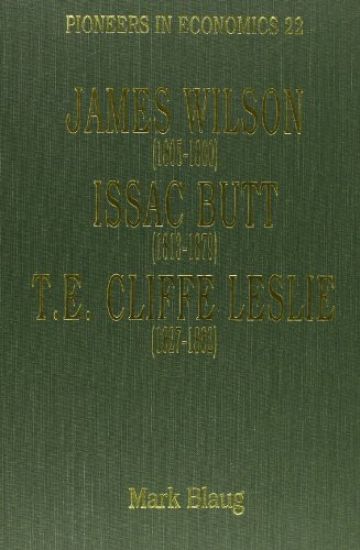
James Wilson (1805–1860), Issac Butt (1813–1879), T.E. Cliffe Leslie (1827–1882)
James Wilson was one of the first financial journalists in Britain who made a genuine contribution to economic doctrine by his staunch defence of free trade and the principles of the banking school. Above all, he was the founder of 'The Economist', a magazine specifically designed for businessmen. Issac Butt is best known as an early advocate of Irish Home Rule but, as Whatley Professor of Political Economy at Trinity College, Dublin, he was successful in creating something akin to an indigenous Irish brand of Classical Economics. T.E. Cliffe Leslie, Professor at Queen's College, Belfast, is notable for his rejection of the abstract-deductive methods of the English Classical Economists in favour of an institutional and historical approach. With Bagehot, Ingram and Toynbee, he was part of what amounted to an English historical school. In particular, Leslie's writings on the land question have been taken seriously by, amongst others, Marshall and Keynes.