
Kirjailija
Mark Casson
Kirjat ja teokset yhdessä paikassa: 29 kirjaa, julkaisuja vuosilta 1979-2025, suosituimpien joukossa The Entrepreneur. Vertaile teosten hintoja ja tarkista saatavuus suomalaisista kirjakaupoista.
29 kirjaa
Kirjojen julkaisuhaarukka 1979-2025.
Property, Power and the Growth of Towns
Catherine Casson; Mark Casson
TAYLOR FRANCIS LTD
2024
nidottu
Local enterprise, institutional quality and strategic location were of central importance in the growth of medieval towns. This book, comprising a study of 112 English towns, emphasises these key factors. Downstream locations on major rivers attracted international trade, and thereby stimulated the local processing of imports and exports, while the early establishment of richly endowed religious institutions funnelled agricultural rental income into a town, where it was spent on luxury goods produced by local craftsmen and artisans, and on expensive, long-running building schemes. Local entrepreneurs who recognised the economic potential of a town developed residential suburbs which attracted wealthy residents. Meanwhile town authorities invested in the building and maintenance of bridges, gates, walls and ditches, often with financial support from wealthy residents. Royal lordship was also an advantage to a town, as it gave the town authorities direct access to the king and bypassed local power-brokers such as bishops and earls. The legacy of medieval investment remains visible today in the streets of important towns. Drawing on rentals, deeds and surveys, this book also examines in detail the topography of seven key medieval towns: Bristol, Gloucester, Coventry, Cambridge, Birmingham, Shrewsbury and Hull. In each case, surviving records identify the location and value of urban properties, and their owners and tenants. Using statistical techniques, previously applied only to the early modern and modern periods, the book analyses the impact of location and type of property on property values. It shows that features of the modern property market, including spatial autocorrelation, were present in the middle ages. Property hot-spots of high rents are also identified; the most valuable properties were those situated between the market and other focal points such transport hubs and religious centres, convenient for both, but remote from noise and pollution.This book takes an interdisciplinary approach, drawing on expertise from the disciplines of economics and history. It will be of interest to historians and to social scientists looking for a long-run perspective on urban development.


Global Business
Mark Casson; Peter J. (CON) Buckley; Geoffrey (CON) Jones
Edward Elgar Pub
2023
sidottu
Property, Power and the Growth of Towns
Catherine Casson; Mark Casson
TAYLOR FRANCIS LTD
2023
sidottu
Local enterprise, institutional quality and strategic location were of central importance in the growth of medieval towns. This book, comprising a study of 112 English towns, emphasises these key factors. Downstream locations on major rivers attracted international trade, and thereby stimulated the local processing of imports and exports, while the early establishment of richly endowed religious institutions funnelled agricultural rental income into a town, where it was spent on luxury goods produced by local craftsmen and artisans, and on expensive, long-running building schemes. Local entrepreneurs who recognised the economic potential of a town developed residential suburbs which attracted wealthy residents. Meanwhile town authorities invested in the building and maintenance of bridges, gates, walls and ditches, often with financial support from wealthy residents. Royal lordship was also an advantage to a town, as it gave the town authorities direct access to the king and bypassed local power-brokers such as bishops and earls. The legacy of medieval investment remains visible today in the streets of important towns. Drawing on rentals, deeds and surveys, this book also examines in detail the topography of seven key medieval towns: Bristol, Gloucester, Coventry, Cambridge, Birmingham, Shrewsbury and Hull. In each case, surviving records identify the location and value of urban properties, and their owners and tenants. Using statistical techniques, previously applied only to the early modern and modern periods, the book analyses the impact of location and type of property on property values. It shows that features of the modern property market, including spatial autocorrelation, were present in the middle ages. Property hot-spots of high rents are also identified; the most valuable properties were those situated between the market and other focal points such transport hubs and religious centres, convenient for both, but remote from noise and pollution.This book takes an interdisciplinary approach, drawing on expertise from the disciplines of economics and history. It will be of interest to historians and to social scientists looking for a long-run perspective on urban development.
Business and Community in Medieval England
Catherine Casson; Mark Casson; John Lee; Katie Phillips
Bristol University Press
2020
sidottu
One of the most important manuscripts surviving from thirteenth-century England, the corpus of documents known as the Hundred Rolls for Cambridge have been incomplete until the recent discovery of an additional roll. This invaluable volume replaces the previous inaccurate transcription by the record commission of 1818 and provides new translations and additional appendices. Shedding new light on important facets of business activity in thirteenth-century Cambridge, this volume makes a significant contribution to our knowledge of the early phases of capitalism. This unique text will be of interest to anyone working in the fields of economic and business history, entrepreneurship, philanthropy and medieval studies. A research monograph based on recently discovered historical documents, Compassionate Capitalism: Business and Community in Medieval England, by Casson et al, is also now available from Bristol University Press.

Compassionate Capitalism
Catherine Casson; Mark Casson; John Lee; Katie Phillips
Bristol University Press
2020
sidottu
The idea of corporate social responsibility may seem like a recent trend, but the previously unpublished historical documents on Cambridge’s sophisticated urban property market reveal that businesses have been practicing what is sometimes referred to as “Compassionate Capitalism” for nearly a thousand years. This transdisciplinary study presents an invaluable contribution to our knowledge of the early phases of capitalism.

In The Multinational Enterprise, Mark Casson - an important thinker in international business for more than 40 years - provides a state-of-the art review of recent developments in the economic theory of the multinational enterprise. He shows how recent developments in theory shed new light on the historical emergence of multinational enterprises, and explains the different forms that multinationality has taken in different industries and different regions of the world.Mark Casson brings together his leading research on internalisation theory as a general theory of the multinational enterprise. He offers cutting-edge analysis across four distinct sections: marketing and brands, supply chain coordination, methodology and the theory of the firm, and risk management. The book also sets out an exciting new research agenda, which explores the future place of the multinational in the evolving 'knowledge economy' and in a politically uncertain world.This book will appeal to doctoral students and faculty in business schools in need of the latest theoretical developments and also those in economics departments that specialise in business and industrial economics.
Demonstrating why economic modelling is so important in understanding international business, this stimulating and highly original book sets out a new and exciting research agenda in international business studies. The author explains what economic models are, how they are constructed and the way in which they can be used. It illustrates how models clarify important issues in international business – explaining empirical anomalies, analyzing strategies and evaluating government policies towards multinational firms. There are detailed discussions of monopoly and competition in the global economy; the international division of labour; supply chain coordination; and the strategic implications of sunk costs in R&D. Based on this discussion, the book proposes a radical reformulation of the theory of the firm as applied to international business.

In The Multinational Enterprise, Mark Casson - an important thinker in international business for more than 40 years - provides a state-of-the art review of recent developments in the economic theory of the multinational enterprise. He shows how recent developments in theory shed new light on the historical emergence of multinational enterprises, and explains the different forms that multinationality has taken in different industries and different regions of the world.Mark Casson brings together his leading research on internalisation theory as a general theory of the multinational enterprise. He offers cutting-edge analysis across four distinct sections: marketing and brands, supply chain coordination, methodology and the theory of the firm, and risk management. The book also sets out an exciting new research agenda, which explores the future place of the multinational in the evolving 'knowledge economy' and in a politically uncertain world.This book will appeal to doctoral students and faculty in business schools in need of the latest theoretical developments and also those in economics departments that specialise in business and industrial economics.

Demonstrating why economic modelling is so important in understanding international business, this stimulating and highly original book sets out a new and exciting research agenda in international business studies. The author explains what economic models are, how they are constructed and the way in which they can be used. It illustrates how models clarify important issues in international business – explaining empirical anomalies, analyzing strategies and evaluating government policies towards multinational firms. There are detailed discussions of monopoly and competition in the global economy; the international division of labour; supply chain coordination; and the strategic implications of sunk costs in R&D. Based on this discussion, the book proposes a radical reformulation of the theory of the firm as applied to international business.

First published in 1986, this work reports the results of the Leverhulme project on mulitnationals and intermediate product trade based at the University of Reading during the academic year 1982/3. Chapter 1 summarises the main results of this project. Part I focusses upon the theoretical component of world trade, dealing with both the theories of division of labour and vertical integration. Part II presents a number of specially-commissioned case studies relating to the project, concerning the motor industry, the bearing industry, the synthetic fibre industry, the tin industry, the copper industry, the banana industry and the shipping industry.

First published in 1986, this work reports the results of the Leverhulme project on multinationals and intermediate product trade based at the University of Reading during the academic year 1982/3. Chapter 1 summaries the main results of this project. Part I focuses upon the theoretical component of world trade, dealing with both the theories of division of labour and vertical integration. Part II presents a number of specially-commissioned case studies relating to the project, concerning the motor industry, the bearing industry, the synthetic fibre industry, the tin industry, the copper industry, the banana industry and the shipping industry.

In this important new book, Mark Casson argues that the fundamental significance of entrepreneurship requires it be fully integrated into core social science disciplines such as economics and sociology, as well as into economic and business history. This book shows how this can be done. It formalises the role of the entrepreneur as innovator, risk-taker and judgemental decision-maker, and relates these functions to the size and growth of the firm. Mark Casson discusses entrepreneurship as a form of strategic networking, showing how entrepreneurs gain access to established networks in order to source information, and then create their own networks to exploit this information. Applying these insights to historical evidence leads to a radical re-interpretation of key issues in economic and business history, including the emergence of trading companies, the spread of empires, the rise of the modern corporation and the globalisation of the firm. This authoritative book by an established scholar is essential reading for economists, social scientists and historians, as well as business and management scholars.

The British railway network was a monument to Victorian private enterprise. Its masterpieces of civil engineering were emulated around the world. But its performance was controversial: praised for promoting a high density of lines, it was also criticised for wasteful duplication of routes. This is the first history of the British railway system written from a modern economic perspective. It uses conterfactual analysis to construct an alternaive network to represent the most efficient alternative rail network that could have been constructed given what was known at the time - the first time this has been done. It reveals how weaknesses in regulation and defects in government policy resulted in enormous inefficiency in the Victorian system that Britain lives with today. British railway companies developed into powerful regional monopolies, which then contested each other's territories. When denied access to existing lines in rival territories, they built duplicate lines instead. Plans for an integrated national system, sponsored by William Gladstone, were blocked by Members of Parliament because of a perceived conflict with the local interests they represented. Each town wanted more railways than its neighbours, and so too many lines were built. The costs of these surplus lines led ultimately to higher fares and freight charges, which impaired the performance of the economy. The book will be the definitive source of reference for those interested in the economic history of the British railway system. It makes use of a major new historical source, deposited railway plans, integrates transport and local history through its regional analysis of the railway system, and provides a comprehensive, classified bibliography.
This thoroughly revised and updated new edition of Mark Casson's modern classic The Entrepreneur presents a novel synthesis of the ideas of Joseph Schumpeter, Frank Knight and Friedrich Hayek, according to which the defining characteristic of the entrepreneur is the exercise of judgement in business decisions. This pathbreaking volume argues that good judgement is based on a unique combination of information, and that this information is typically exploited by founding a 'market-making' firm, which links customers and suppliers who could not otherwise make contact with each other. This assessment of entrepreneurship, Mark Casson contends, has important implications for the growth of firms, social mobility and 'enterprise culture'.This second edition is essential reading for scholars of economics, management, business history and economic history. Academics from a wide range of economic schools of thought, both orthodox and heterodox, will find the book to be an original and outstanding work.

This thoroughly revised and updated new edition of Mark Casson's modern classic The Entrepreneur presents a novel synthesis of the ideas of Joseph Schumpeter, Frank Knight and Friedrich Hayek, according to which the defining characteristic of the entrepreneur is the exercise of judgement in business decisions. This pathbreaking volume argues that good judgement is based on a unique combination of information, and that this information is typically exploited by founding a 'market-making' firm, which links customers and suppliers who could not otherwise make contact with each other. This assessment of entrepreneurship, Mark Casson contends, has important implications for the growth of firms, social mobility and 'enterprise culture'.This second edition is essential reading for scholars of economics, management, business history and economic history. Academics from a wide range of economic schools of thought, both orthodox and heterodox, will find the book to be an original and outstanding work.
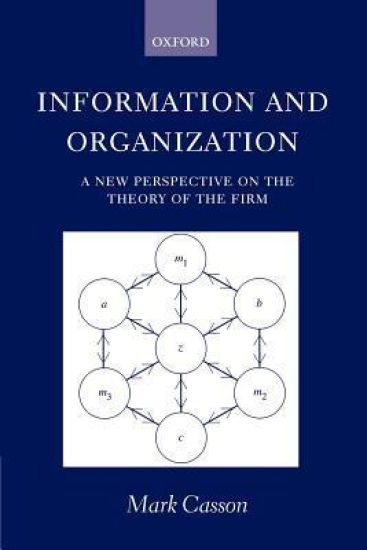
This book offers a vision of the economy as a system of structured information flow. The structuring is effected by institutions, and in particular by firms, which specialize in processing the information needed to allocate resources properly. Firms are the institutional embodiment of the visions of individual entrepreneurs who believe that they have found a better way of allocating resources. Entrepreneurial vision is only a partial vision, however, in the sense that it does not encompass the entire economy, but only a subset of it. Free market economies encourage the exploitation of such partial visions because they encourage intermediation---it is by mediating between potential buyers and potential sellers that entrepreneurial visions are realized. A legal framework of private property, coupled with a moral framework to control the incidence of cheating, allows very sophisticated structures of information processing to emerge. These structures effect an elaborate division of labour in the dimensions of information and control. Each firm is a small component of the overall structure of information flow. This structure is highly flexible and evolves continuously as circumstances change. Efficient adaptation is encouraged by rewarding entrepreneurs who create new firms to be slotted into the existing structure. This vision has evolved over the last fifteen years, during which the author has researched a variety of topics connected with the theory of the firm----entrepreneurship, business culture, multinational enterprise, joint ventures and the like. In each of these areas he has identified the ways in which the orthodox theory of the firm needs to be modified in order to make it work properly. This book represents a major intellectual synthesis of that work.
Economics of International Business sets out a new agenda for international business research. Mark Casson asserts that it is time to move the subject on from sterile debates about transaction cost economies and resource-based theories of the firm. Instead of focusing on the individual firm, the new agenda focuses on the global systems view of international business. A static view of the firm's environment is replaced by a dynamic view which highlights the volatility of the international business environment. Coping with volatility requires entrepreneurial skills, flexibility and the need to synthesize information on a global basis. To co-ordinate the global system properly, entrepreneurs must co-operate through social networks of trust, as well as competing. Constructing a network of joint ventures, it is argued, is simply not enough.Building on his previous book, The Organization of International Business, Mark Casson shows that with suitable modifications, the methods of economics can be used to analyse all of these issues in a rigorous way. The tools of 'business strategy' are too clumsy to address the more subtle issues, whilst descriptive approaches fail to bring key issues into sharp relief. This book is indispensable reading for all researchers and practitioners in the international business field as well as economists and academics alike.
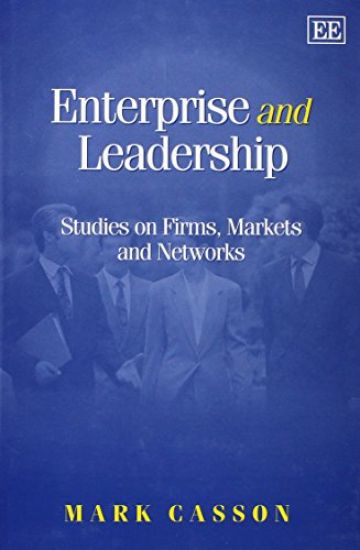
Economic institutions such as firms, markets, governments and voluntary organizations have a crucial impact on the competitiveness of national economies. Research on economic institutions is growing rapidly, but unfortunately it often focuses on narrow issues concerning legal systems and transaction costs. This book offers a broader perspective and important practical insights into economic institutions, focusing on dynamic issues such as entrepreneurship and ethical leadership, which are crucial to institutional growth.Extending the work of his previous books, The Entrepreneur and The Economics of Business Culture, Mark Casson analyses economic institutions from an integrated social science perspective. This perspective is based on the rational action principle of mainstream economics, modified to allow for endogenous preferences and information costs. Combining plausible assumptions with analytical rigour, the integrated approach offers important new insights into a wide range of issues, including the growth of firms, family business, regional business networks, international business elites, and the influence of cultural values on long-run economic growth. The integrated social science approach has implications for all the social sciences, and so the book is addressed to both business and management practitioners as well as scholars from a wide range of disciplines.