Kirjojen hintavertailu. Mukana 12 595 353 kirjaa ja 12 kauppaa.

Kirjailija

Mark Chang

Kirjat ja teokset yhdessä paikassa: 22 kirjaa, julkaisuja vuosilta 2008-2025, suosituimpien joukossa Principles of Scientific Methods. Vertaile teosten hintoja ja tarkista saatavuus suomalaisista kirjakaupoista.

22 kirjaa

Kirjojen julkaisuhaarukka 2008-2025.

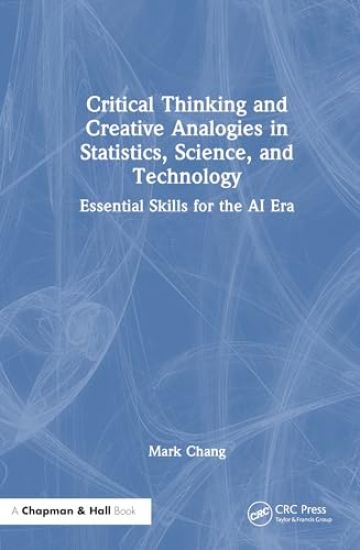
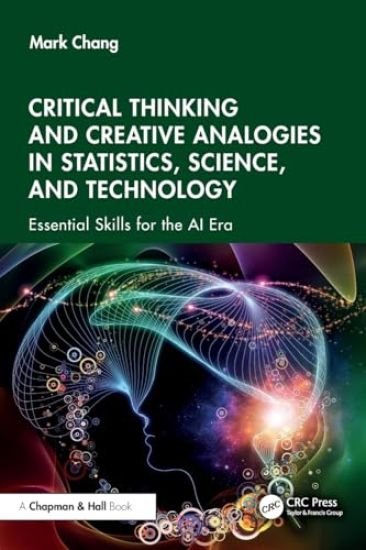
Critical Thinking and Creative Analogies in Statistics, Science, and Technology
Through the lens of critical thinking and creative analogy, this book skillfully blends mainstream perspectives with bold, thought-provoking personal insights, offering readers a fresh and engaging perspective on complex topics. By leveraging critical thinking, creative analogies, and practical examples from statistics, medicine, socioeconomics, education, and technology, it bridges the gap between abstract theory and real-world applications. Each chapter is concise and impactful, cutting straight to the essence of the subject. Thought experiments and vivid examples illuminate key concepts, making them both accessible and actionable. Whether you're seeking clarity, inspiration, or a deeper understanding, this book delivers powerful, thought-provoking content that will leave a lasting impression. Key Features A harmonious balance of mainstream views and provocative personal insights. Creative analogies paired with practical examples from medicine and other fields. Concise, clear, and practical chapters that focus on core ideas, enriched with thought experiments and real-world applications. A progressive approach, moving from simple daily decision-making to the development of integrated, humanized AI. Chapter exercises designed to reinforce concepts through hands-on practice.
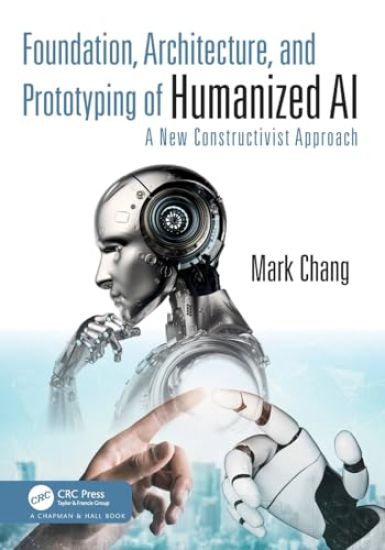
Foundation, Architecture, and Prototyping of Humanized AI
Humanized AI (HAI), emerging as the next of the AI waves, refers to artificial social beings that are very close to humans in various aspects, beings who are machine-race humans, not digital slaves. Foundation, Architecture, and Prototyping of HAI deploy a novel smalldata approach to vertically explore the spectrum of HAI. Different from the popular big-data philosophy that is based on the rigid notion that the connotation of each concept is fixed and the same to everyone, this book treats understanding as a process from simple to complex, and uses the similarity principle to effectively deal with novelties. Combining the efficiency of the Behaviorists’ goal-driven approach and the flexibility of a Constructivists’ approach, both the architecture of HAI and the philosophical discussions arising from it are elaborated upon. Advancing a unique approach to the concept of HAI, this book appeals to professors and students of both AI and philosophy, as well as industry professionals looking to stay at the forefront of developments within the field.
Innovative Strategies, Statistical Solutions and Simulations for Modern Clinical Trials

Innovative Strategies, Statistical Solutions and Simulations for Modern Clinical Trials

Mark Chang; John Balser; Jim Roach; Robin Bliss

Taylor Francis Ltd
2021
nidottu
"This is truly an outstanding book. [It] brings together all of the latest research in clinical trials methodology and how it can be applied to drug development…. Chang et al provide applications to industry-supported trials. This will allow statisticians in the industry community to take these methods seriously." Jay Herson, Johns Hopkins UniversityThe pharmaceutical industry's approach to drug discovery and development has rapidly transformed in the last decade from the more traditional Research and Development (R & D) approach to a more innovative approach in which strategies are employed to compress and optimize the clinical development plan and associated timelines. However, these strategies are generally being considered on an individual trial basis and not as part of a fully integrated overall development program. Such optimization at the trial level is somewhat near-sighted and does not ensure cost, time, or development efficiency of the overall program. This book seeks to address this imbalance by establishing a statistical framework for overall/global clinical development optimization and providing tactics and techniques to support such optimization, including clinical trial simulations. Provides a statistical framework for achieve global optimization in each phase of the drug development process. Describes specific techniques to support optimization including adaptive designs, precision medicine, survival-endpoints, dose finding and multiple testing. Gives practical approaches to handling missing data in clinical trials using SAS. Looks at key controversial issues from both a clinical and statistical perspective. Presents a generous number of case studies from multiple therapeutic areas that help motivate and illustrate the statistical methods introduced in the book. Puts great emphasis on software implementation of the statistical methods with multiple examples of software code (both SAS and R). It is important for statisticians to possess a deep knowledge of the drug development process beyond statistical considerations. For these reasons, this book incorporates both statistical and "clinical/medical" perspectives.
Monte Carlo Simulation for the Pharmaceutical Industry
Helping you become a creative, logical thinker and skillful "simulator," Monte Carlo Simulation for the Pharmaceutical Industry: Concepts, Algorithms, and Case Studies provides broad coverage of the entire drug development process, from drug discovery to preclinical and clinical trial aspects to commercialization. It presents the theories and methods needed to carry out computer simulations efficiently, covers both descriptive and pseudocode algorithms that provide the basis for implementation of the simulation methods, and illustrates real-world problems through case studies.The text first emphasizes the importance of analogy and simulation using examples from a variety of areas, before introducing general sampling methods and the different stages of drug development. It then focuses on simulation approaches based on game theory and the Markov decision process, simulations in classical and adaptive trials, and various challenges in clinical trial management and execution. The author goes on to cover prescription drug marketing strategies and brand planning, molecular design and simulation, computational systems biology and biological pathway simulation with Petri nets, and physiologically based pharmacokinetic modeling and pharmacodynamic models. The final chapter explores Monte Carlo computing techniques for statistical inference.This book offers a systematic treatment of computer simulation in drug development. It not only deals with the principles and methods of Monte Carlo simulation, but also the applications in drug development, such as statistical trial monitoring, prescription drug marketing, and molecular docking.
Introductory Adaptive Trial Designs

Introductory Adaptive Trial Designs

Mark Chang

Productivity Press
2015
sidottu
All the Essentials to Start Using Adaptive Designs in No TimeCompared to traditional clinical trial designs, adaptive designs often lead to increased success rates in drug development at reduced costs and time. Introductory Adaptive Trial Designs: A Practical Guide with R motivates newcomers to quickly and easily grasp the essence of adaptive designs as well as the foundations of adaptive design methods.The book reduces the mathematics to a minimum and makes the material as practical as possible. Instead of providing general, black-box commercial software packages, the author includes open-source R functions that enable readers to better understand the algorithms and customize the designs to meet their needs. Readers can run the simulations for all the examples and change the input parameters to see how each input parameter affects the simulation outcomes or design operating characteristics.Taking a learning-by-doing approach, this tutorial-style book guides readers on planning and executing various types of adaptive designs. It helps them develop the skills to begin using the designs immediately.
Principles of Scientific Methods

Principles of Scientific Methods

Mark Chang

Apple Academic Press Inc.
2014
nidottu
Principles of Scientific Methods focuses on the fundamental principles behind scientific methods. The book refers to "science" in a broad sense, including natural science, physics, mathematics, statistics, social science, political science, and engineering science. A principle is often abstract and has broad applicability while a method is usually concrete and specific. The author uses many concrete examples to explain principles and presents analogies to connect different methods or problems to arrive at a general principle or a common notion. He mainly discusses a particular method to address the great idea behind the method, not the method itself. The book shows how the principles are not only applicable to scientific research but also to our daily lives. The author explains how scientific methods are used for understanding how and why things happen, making predictions, and learning how to prevent mistakes and solve problems. Studying the principles of scientific methods is to think about thinking and to enlighten our understanding of scientific research.Scientific principles are the foundation of scientific methods. In this book, you’ll see how the principles reveal the big ideas behind our scientific discoveries and reflect the fundamental beliefs and wisdoms of scientists. The principles make the scientific methods coherent and constitute the source of creativity.
Monte Carlo Simulation for the Pharmaceutical Industry
Helping you become a creative, logical thinker and skillful "simulator," Monte Carlo Simulation for the Pharmaceutical Industry: Concepts, Algorithms, and Case Studies provides broad coverage of the entire drug development process, from drug discovery to preclinical and clinical trial aspects to commercialization. It presents the theories and methods needed to carry out computer simulations efficiently, covers both descriptive and pseudocode algorithms that provide the basis for implementation of the simulation methods, and illustrates real-world problems through case studies.The text first emphasizes the importance of analogy and simulation using examples from a variety of areas, before introducing general sampling methods and the different stages of drug development. It then focuses on simulation approaches based on game theory and the Markov decision process, simulations in classical and adaptive trials, and various challenges in clinical trial management and execution. The author goes on to cover prescription drug marketing strategies and brand planning, molecular design and simulation, computational systems biology and biological pathway simulation with Petri nets, and physiologically based pharmacokinetic modeling and pharmacodynamic models. The final chapter explores Monte Carlo computing techniques for statistical inference.This book offers a systematic treatment of computer simulation in drug development. It not only deals with the principles and methods of Monte Carlo simulation, but also the applications in drug development, such as statistical trial monitoring, prescription drug marketing, and molecular docking.
Classical and Adaptive Clinical Trial Designs Using ExpDesign Studio
ExpDesign Studio facilitates more efficient clinical trial design This book introduces pharmaceutical statisticians, scientists, researchers, and others to ExpDesign Studio software for classical and adaptive designs of clinical trials. It includes the Professional Version 5.0 of ExpDesign Studio software that frees pharmaceutical professionals to focus on drug development and related challenges while the software handles the essential calculations and computations. After a hands-on introduction to the software and an overview of clinical trial designs encompassing numerous variations, Classical and Adaptive Clinical Trial Designs Using ExpDesign Studio: Covers both classical and adaptive clinical trial designs, monitoring, and analysesExplains various classical and adaptive designs including groupsequential, sample-size reestimation, dropping-loser, biomarker-adaptive, and response-adaptive randomization designsIncludes instructions for over 100 design methods that have been implemented in ExpDesign Studio and step-by-step demos as well as real-world examplesEmphasizes applications, yet covers key mathematical formulationsIntroduces readers to additional toolkits in ExpDesign Studio that help in designing, monitoring, and analyzing trials, such as the adaptive monitor, graphical calculator, the probability calculator, the confidence interval calculator, and morePresents comprehensive technique notes for sample-size calculation methods, grouped by the number of arms, the trial endpoint, and the analysis basis Written with practitioners in mind, this is an ideal self-study guide for not only statisticians, but also scientists, researchers, and professionals in the pharmaceutical industry, contract research organizations (CROs), and regulatory bodies. It's also a go-to reference for biostatisticians, pharmacokinetic specialists, and principal investigators involved in clinical trials. ERRATUM Classical and Adaptive Clinical Trial Designs Using ExpDesign Studio By Mark Chang The license for the ExpDesign Studio software on the CD included with this book is good for one-year after installation of the software. Prior to the expiration of this period, the software will generate a reminder about renewal for the license. The user should contact CTriSoft International (the owners of ExpDesign Studio) at www.CTriSoft.net or by email at [email protected], about renewal for the license. This should have been made clear in the first printing of this book. We apologize for this error.
Critical Thinking and Creative Analogies in Statistics, Science, and Technology
Through the lens of critical thinking and creative analogy, this book skillfully blends mainstream perspectives with bold, thought-provoking personal insights, offering readers a fresh and engaging perspective on complex topics. By leveraging critical thinking, creative analogies, and practical examples from statistics, medicine, socioeconomics, education, and technology, it bridges the gap between abstract theory and real-world applications. Each chapter is concise and impactful, cutting straight to the essence of the subject. Thought experiments and vivid examples illuminate key concepts, making them both accessible and actionable. Whether you're seeking clarity, inspiration, or a deeper understanding, this book delivers powerful, thought-provoking content that will leave a lasting impression. Key Features A harmonious balance of mainstream views and provocative personal insights. Creative analogies paired with practical examples from medicine and other fields. Concise, clear, and practical chapters that focus on core ideas, enriched with thought experiments and real-world applications. A progressive approach, moving from simple daily decision-making to the development of integrated, humanized AI. Chapter exercises designed to reinforce concepts through hands-on practice.
Foundation, Architecture, and Prototyping of Humanized AI
Humanized AI (HAI), emerging as the next of the AI waves, refers to artificial social beings that are very close to humans in various aspects, beings who are machine-race humans, not digital slaves. Foundation, Architecture, and Prototyping of HAI deploy a novel smalldata approach to vertically explore the spectrum of HAI. Different from the popular big-data philosophy that is based on the rigid notion that the connotation of each concept is fixed and the same to everyone, this book treats understanding as a process from simple to complex, and uses the similarity principle to effectively deal with novelties. Combining the efficiency of the Behaviorists’ goal-driven approach and the flexibility of a Constructivists’ approach, both the architecture of HAI and the philosophical discussions arising from it are elaborated upon. Advancing a unique approach to the concept of HAI, this book appeals to professors and students of both AI and philosophy, as well as industry professionals looking to stay at the forefront of developments within the field.
Artificial Intelligence for Drug Development, Precision Medicine, and Healthcare
Artificial Intelligence for Drug Development, Precision Medicine, and Healthcare covers exciting developments at the intersection of computer science and statistics. While much of machine-learning is statistics-based, achievements in deep learning for image and language processing rely on computer science’s use of big data. Aimed at those with a statistical background who want to use their strengths in pursuing AI research, the book:· Covers broad AI topics in drug development, precision medicine, and healthcare.· Elaborates on supervised, unsupervised, reinforcement, and evolutionary learning methods.· Introduces the similarity principle and related AI methods for both big and small data problems.· Offers a balance of statistical and algorithm-based approaches to AI.· Provides examples and real-world applications with hands-on R code.· Suggests the path forward for AI in medicine and artificial general intelligence.As well as covering the history of AI and the innovative ideas, methodologies and software implementation of the field, the book offers a comprehensive review of AI applications in medical sciences. In addition, readers will benefit from hands on exercises, with included R code.
Introductory Adaptive Trial Designs
All the Essentials to Start Using Adaptive Designs in No TimeCompared to traditional clinical trial designs, adaptive designs often lead to increased success rates in drug development at reduced costs and time. Introductory Adaptive Trial Designs: A Practical Guide with R motivates newcomers to quickly and easily grasp the essence of adaptive designs as well as the foundations of adaptive design methods.The book reduces the mathematics to a minimum and makes the material as practical as possible. Instead of providing general, black-box commercial software packages, the author includes open-source R functions that enable readers to better understand the algorithms and customize the designs to meet their needs. Readers can run the simulations for all the examples and change the input parameters to see how each input parameter affects the simulation outcomes or design operating characteristics.Taking a learning-by-doing approach, this tutorial-style book guides readers on planning and executing various types of adaptive designs. It helps them develop the skills to begin using the designs immediately.
Innovative Strategies, Statistical Solutions and Simulations for Modern Clinical Trials

Innovative Strategies, Statistical Solutions and Simulations for Modern Clinical Trials

Mark Chang; John Balser; Jim Roach; Robin Bliss

CRC Press Inc
2019
sidottu
"This is truly an outstanding book. [It] brings together all of the latest research in clinical trials methodology and how it can be applied to drug development…. Chang et al provide applications to industry-supported trials. This will allow statisticians in the industry community to take these methods seriously." Jay Herson, Johns Hopkins UniversityThe pharmaceutical industry's approach to drug discovery and development has rapidly transformed in the last decade from the more traditional Research and Development (R & D) approach to a more innovative approach in which strategies are employed to compress and optimize the clinical development plan and associated timelines. However, these strategies are generally being considered on an individual trial basis and not as part of a fully integrated overall development program. Such optimization at the trial level is somewhat near-sighted and does not ensure cost, time, or development efficiency of the overall program. This book seeks to address this imbalance by establishing a statistical framework for overall/global clinical development optimization and providing tactics and techniques to support such optimization, including clinical trial simulations. Provides a statistical framework for achieve global optimization in each phase of the drug development process. Describes specific techniques to support optimization including adaptive designs, precision medicine, survival-endpoints, dose finding and multiple testing. Gives practical approaches to handling missing data in clinical trials using SAS. Looks at key controversial issues from both a clinical and statistical perspective. Presents a generous number of case studies from multiple therapeutic areas that help motivate and illustrate the statistical methods introduced in the book. Puts great emphasis on software implementation of the statistical methods with multiple examples of software code (both SAS and R).It is important for statisticians to possess a deep knowledge of the drug development process beyond statistical considerations. For these reasons, this book incorporates both statistical and "clinical/medical" perspectives.
Principles of Scientific Methods
Principles of Scientific Methods focuses on the fundamental principles behind scientific methods. The book refers to "science" in a broad sense, including natural science, physics, mathematics, statistics, social science, political science, and engineering science. A principle is often abstract and has broad applicability while a method is usually concrete and specific. The author uses many concrete examples to explain principles and presents analogies to connect different methods or problems to arrive at a general principle or a common notion. He mainly discusses a particular method to address the great idea behind the method, not the method itself. The book shows how the principles are not only applicable to scientific research but also to our daily lives. The author explains how scientific methods are used for understanding how and why things happen, making predictions, and learning how to prevent mistakes and solve problems. Studying the principles of scientific methods is to think about thinking and to enlighten our understanding of scientific research. Scientific principles are the foundation of scientific methods. In this book, you‘ll see how the principles reveal the big ideas behind our scientific discoveries and reflect the fundamental beliefs and wisdoms of scientists. The principles make the scientific methods coherent and constitute the source of creativity.
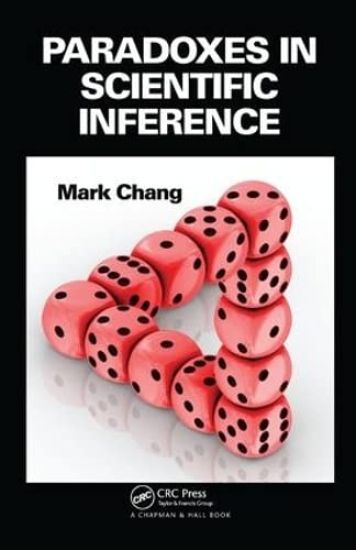
Paradoxes in Scientific Inference
Paradoxes are poems of science and philosophy that collectively allow us to address broad multidisciplinary issues within a microcosm. A true paradox is a source of creativity and a concise expression that delivers a profound idea and provokes a wild and endless imagination. The study of paradoxes leads to ultimate clarity and, at the same time, indisputably challenges your mind. Paradoxes in Scientific Inference analyzes paradoxes from many different perspectives: statistics, mathematics, philosophy, science, artificial intelligence, and more. The book elaborates on findings and reaches new and exciting conclusions. It challenges your knowledge, intuition, and conventional wisdom, compelling you to adjust your way of thinking. Ultimately, you will learn effective scientific inference through studying the paradoxes.
Adaptive Design Theory and Implementation Using SAS and R
Get Up to Speed on Many Types of Adaptive DesignsSince the publication of the first edition, there have been remarkable advances in the methodology and application of adaptive trials. Incorporating many of these new developments, Adaptive Design Theory and Implementation Using SAS and R, Second Edition offers a detailed framework to understand the use of various adaptive design methods in clinical trials. New to the Second EditionTwelve new chapters covering blinded and semi-blinded sample size reestimation design, pick-the-winners design, biomarker-informed adaptive design, Bayesian designs, adaptive multiregional trial design, SAS and R for group sequential design, and much moreMore analytical methods for K-stage adaptive designs, multiple-endpoint adaptive design, survival modeling, and adaptive treatment switchingNew material on sequential parallel designs with rerandomization and the skeleton approach in adaptive dose-escalation trialsTwenty new SAS macros and R functionsEnhanced end-of-chapter problems that give readers hands-on practice addressing issues encountered in designing real-life adaptive trialsCovering even more adaptive designs, this book provides biostatisticians, clinical scientists, and regulatory reviewers with up-to-date details on this innovative area in pharmaceutical research and development. Practitioners will be able to improve the efficiency of their trial design, thereby reducing the time and cost of drug development.
Adaptive Design Theory and Implementation Using SAS and R
Get Up to Speed on Many Types of Adaptive DesignsSince the publication of the first edition, there have been remarkable advances in the methodology and application of adaptive trials. Incorporating many of these new developments, Adaptive Design Theory and Implementation Using SAS and R, Second Edition offers a detailed framework to understand the use of various adaptive design methods in clinical trials. New to the Second EditionTwelve new chapters covering blinded and semi-blinded sample size reestimation design, pick-the-winners design, biomarker-informed adaptive design, Bayesian designs, adaptive multiregional trial design, SAS and R for group sequential design, and much moreMore analytical methods for K-stage adaptive designs, multiple-endpoint adaptive design, survival modeling, and adaptive treatment switchingNew material on sequential parallel designs with rerandomization and the skeleton approach in adaptive dose-escalation trialsTwenty new SAS macros and R functionsEnhanced end-of-chapter problems that give readers hands-on practice addressing issues encountered in designing real-life adaptive trialsCovering even more adaptive designs, this book provides biostatisticians, clinical scientists, and regulatory reviewers with up-to-date details on this innovative area in pharmaceutical research and development. Practitioners will be able to improve the efficiency of their trial design, thereby reducing the time and cost of drug development.
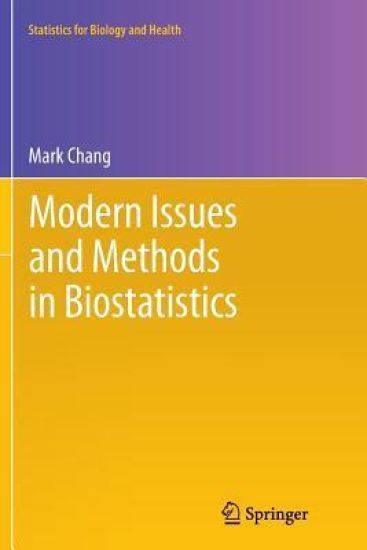
Modern Issues and Methods in Biostatistics

Modern Issues and Methods in Biostatistics

Mark Chang

Springer-Verlag New York Inc.
2013
nidottu
Classic biostatistics, a branch of statistical science, has as its main focus the applications of statistics in public health, the life sciences, and the pharmaceutical industry. Modern biostatistics, beyond just a simple application of statistics, is a confluence of statistics and knowledge of multiple intertwined fields. The application demands, the advancements in computer technology, and the rapid growth of life science data (e.g., genomics data) have promoted the formation of modern biostatistics. There are at least three characteristics of modern biostatistics: (1) in-depth engagement in the application fields that require penetration of knowledge across several fields, (2) high-level complexity of data because they are longitudinal, incomplete, or latent because they are heterogeneous due to a mixture of data or experiment types, because of high-dimensionality, which may make meaningful reduction impossible, or because of extremely small or large size; and (3) dynamics, the speed of development in methodology and analyses, has to match the fast growth of data with a constantly changing face. This book is written for researchers, biostatisticians/statisticians, and scientists who are interested in quantitative analyses. The goal is to introduce modern methods in biostatistics and help researchers and students quickly grasp key concepts and methods. Many methods can solve the same problem and many problems can be solved by the same method, which becomes apparent when those topics are discussed in this single volume.
Paradoxes in Scientific Inference

Paradoxes in Scientific Inference

Mark Chang

CRC Press Inc
2012
nidottu
Paradoxes are poems of science and philosophy that collectively allow us to address broad multidisciplinary issues within a microcosm. A true paradox is a source of creativity and a concise expression that delivers a profound idea and provokes a wild and endless imagination. The study of paradoxes leads to ultimate clarity and, at the same time, indisputably challenges your mind.Paradoxes in Scientific Inference analyzes paradoxes from many different perspectives: statistics, mathematics, philosophy, science, artificial intelligence, and more. The book elaborates on findings and reaches new and exciting conclusions. It challenges your knowledge, intuition, and conventional wisdom, compelling you to adjust your way of thinking. Ultimately, you will learn effective scientific inference through studying the paradoxes.
Adaptive Design Methods in Clinical Trials

Adaptive Design Methods in Clinical Trials

Shein-Chung Chow; Mark Chang

Taylor Francis Inc
2011
sidottu
With new statistical and scientific issues arising in adaptive clinical trial design, including the U.S. FDA’s recent draft guidance, a new edition of one of the first books on the topic is needed. Adaptive Design Methods in Clinical Trials, Second Edition reflects recent developments and regulatory positions on the use of adaptive designs in clinical trials. It unifies the vast and continuously growing literature and research activities on regulatory requirements, scientific and practical issues, and statistical methodology.New to the Second EditionAlong with revisions throughout the text, this edition significantly updates the chapters on protocol amendment and clinical trial simulation to incorporate the latest changes. It also includes five entirely new chapters on two-stage adaptive design, biomarker adaptive trials, target clinical trials, sample size and power estimation, and regulatory perspectives.Following in the tradition of its acclaimed predecessor, this second edition continues to offer an up-to-date resource for clinical scientists and researchers in academia, regulatory agencies, and the pharmaceutical industry. Written in an intuitive style at a basic mathematical and statistical level, the book maintains its practical approach with an emphasis on concepts via numerous examples and illustrations.