Kirjojen hintavertailu. Mukana 12 595 353 kirjaa ja 12 kauppaa.

Kirjailija

Mark Changizi

Kirjat ja teokset yhdessä paikassa: 5 kirjaa, julkaisuja vuosilta 2010-2025, suosituimpien joukossa Motorcycle Mind. Vertaile teosten hintoja ja tarkista saatavuus suomalaisista kirjakaupoista.

5 kirjaa

Kirjojen julkaisuhaarukka 2010-2025.

Motorcycle Mind

Motorcycle Mind

Mark Changizi

Ukiyoto Publishing
2025
sidottu
"Motorcycle Mind takes you beyond the handlebars and into the fascinating cognitive and perceptual world of motorcycling-a ride that's more than just transportation; it's a transformative way of being. Unlike car drivers, motorcyclists become one with their machine, immersed in the road, the wind, and the rhythm of the ride. This unique connection turns every journey into an art form, deeply engaging the mind and body.In this groundbreaking book, evolutionary neuroscientist and acclaimed author Mark Changizi reveals the science behind why motorcycling feels so exhilarating. From the dynamics of human perception and emotion to the physical symbiosis between rider and machine, Motorcycle Mind uncovers how the ride transforms us into something primal-instinctive, expressive, and alive.With a narrative style that bridges cutting-edge science and the thrill of the open road, Changizi brings his expertise to bear, drawing on years of research and collaborations with Yamaha Motors. This is the first book of its kind to explore the neuroscience and psychology of motorcycling, offering insights that will captivate riders and enthusiasts alike.Whether you're a seasoned rider or simply curious about the allure of two wheels, Motorcycle Mind will leave you with a deeper appreciation for the science, emotion, and artistry that make the motorcycle experience unparalleled."

Motorcycle Mind

Motorcycle Mind

Mark Changizi

Ukiyoto Publishing
2025
nidottu
"Motorcycle Mind takes you beyond the handlebars and into the fascinating cognitive and perceptual world of motorcycling-a ride that's more than just transportation; it's a transformative way of being. Unlike car drivers, motorcyclists become one with their machine, immersed in the road, the wind, and the rhythm of the ride. This unique connection turns every journey into an art form, deeply engaging the mind and body.In this groundbreaking book, evolutionary neuroscientist and acclaimed author Mark Changizi reveals the science behind why motorcycling feels so exhilarating. From the dynamics of human perception and emotion to the physical symbiosis between rider and machine, Motorcycle Mind uncovers how the ride transforms us into something primal-instinctive, expressive, and alive.With a narrative style that bridges cutting-edge science and the thrill of the open road, Changizi brings his expertise to bear, drawing on years of research and collaborations with Yamaha Motors. This is the first book of its kind to explore the neuroscience and psychology of motorcycling, offering insights that will captivate riders and enthusiasts alike.Whether you're a seasoned rider or simply curious about the allure of two wheels, Motorcycle Mind will leave you with a deeper appreciation for the science, emotion, and artistry that make the motorcycle experience unparalleled."
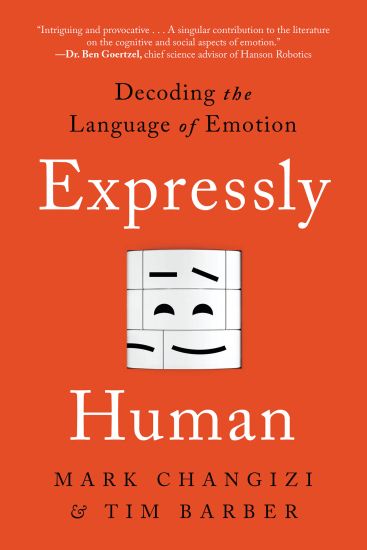
Expressly Human

Expressly Human

Mark Changizi; Tim Barber

Benbella Books
2022
pokkari
Good communication, conventional wisdom suggests, is calm, logical, rational. Emotions, we’re told, just get in the way. But what if this is backwards? What if those emotional overtones are the main messages we’re sending to one another, and all that logical language is just window dressing?Over billions of years of evolution, animals have become increasingly sophisticated and increasingly sentient. In the process, they evolved emotions, which helped improve their odds of survival in complex situations. These emotions were, at first, purely internal. But at some point, social animals began expressing their emotions, in increasingly dramatic ways. These emotional expressions could accurately reflect internal emotions (smiling to express happiness)—or they could be quite different (smiling to cover up that you’re actually furious, but can’t tell your boss that). Why did once-stone-faced animals evolve to be so emotionally expressive—to be us? The answer, as evolutionary neurobiologist Mark Changizi and mathematician Tim Barber reveal, is that emotional expressions are our first and most important language—one that allows us, as social animals, to engage in highly sophisticated communications and negotiations. Expressly Human introduces an original theory that explains, from first principles, how the broad range of emotional expressions evolved, and provides a Rosetta Stone for human communication. It will revolutionize the way you see every social interaction, from deciding who gets the last slice of pizza to multimillion-dollar business negotiations, and change your definition of what makes us human.
Harnessed

Harnessed

Mark Changizi

BenBella Books
2011
nidottu
The scientific consensus is that our ability to understand human speech has evolved over hundreds of thousands of years. After all, there are whole portions of the brain devoted to human speech. We learn to understand speech before we can even walk, and can seamlessly absorb enormous amounts of information simply by hearing it. Surely we evolved this capability over thousands of generations. Or did we? Portions of the human brain are also devoted to reading. Children learn to read at a very young age and can seamlessly absorb information even more quickly through reading than through hearing. We know that we didn't evolve to read because reading is only a few thousand years old. In Harnessed, cognitive scientist Mark Changizi demonstrates that human speech has been very specifically "designed" to harness the sounds of nature, sounds we've evolved over millions of years to readily understand. Long before humans evolved, mammals have learned to interpret the sounds of nature to understand both threats and opportunities. Our speech--regardless of language--is very clearly based on the sounds of nature. Even more fascinating, Changizi shows that music itself is based on natural sounds. Music--seemingly one of the most human of inventions--is literally built on sounds and patterns of sound that have existed since the beginning of time. From Library Journal: "Many scientists believe that the human brain's capacity for language is innate, that the brain is actually "hard-wired" for this higher-level functionality. But theoretical neurobiologist Changizi (director of human cognition, 2AI Labs; The Vision Revolution) brilliantly challenges this view, claiming that language (and music) are neither innate nor instinctual to the brain but evolved culturally to take advantage of what the most ancient aspect of our brain does best: process the sounds of nature ...it will certainly intrigue evolutionary biologists, linguists, and cultural anthropologists and is strongly recommended for libraries that have Changizi's previous book." From Forbes: "In his latest book, Harnessed, neuroscientist Mark Changizi manages to accomplish the extraordinary: he says something compellingly new about evolution...Instead of tackling evolution from the usual position and become mired in the usual arguments, he focuses on one aspect of the larger story so central to who we are, it may very well overshadow all others except the origin of life itself: communication. "
The Vision Revolution

The Vision Revolution

Mark Changizi

BenBella Books
2010
pokkari
In The Vision Revolution, Mark Changizi, prominent neuroscientist and vision expert, addresses four areas of human vision and provides explanations for why we have those particular abilities, complete with a number of full-color illustrations to demonstrate his conclusions and to engage the reader. Written for both the casual reader and the science buff hungry for new information, The Vision Revolution is a resource that dispels commonly believed perceptions about sight and offers answers drawn from the field's most recent research. Changizi focuses on four "why" questions: 1. Why do we see in color? 2. Why do our eyes face forward? 3. Why do we see illusions? 4. Why does reading come so naturally to us? The Vision Revolution explores phenomena such as cyclopses, peeking and many more you hadn't even thought to wonder about. Changizi shows how deeply involved these evolutionary aspects of our vision are in why we see the way we do--and what the future holds for us. The Vision Revolution is a book that finally gives attention to what before has been largely neglected by other works on human vision--a book that looks at the "why."