Kirjojen hintavertailu. Mukana 12 390 323 kirjaa ja 12 kauppaa.

Kirjailija

Mark D. Jordan

Kirjat ja teokset yhdessä paikassa: 22 kirjaa, julkaisuja vuosilta 1998-2025, suosituimpien joukossa Queer Callings. Vertaile teosten hintoja ja tarkista saatavuus suomalaisista kirjakaupoista.

Mukana myös kirjoitusasut: Mark D Jordan

22 kirjaa

Kirjojen julkaisuhaarukka 1998-2025.

Queer Callings

Queer Callings

Mark D. Jordan

FORDHAM UNIVERSITY PRESS
2023
sidottu
CHOICE: OUTSTANDING ACADEMIC TITLE FINALIST, THE RANDY SHILTS AWARD FOR GAY NONFICTION, THE PUBLISHING TRIANGLE AWARDS A passionate exhortation to expand the ways we talk about human sex, sexuality, and gender. Twenty-five years ago, Mark D. Jordan published his landmark book on the invention and early history of the category "sodomy," one that helped to decriminalize certain sexual acts in the United States and to remove the word sodomy from the updated version of a standard English translation of the Christian Bible. In Queer Callings, Jordan extends the same kind of illuminating critical analysis to present uses of "identity" with regard to sexual difference. While the stakes might not seem as high, he acknowledges, his newest history of sexuality is just as vital to a better present and future. Shaking up current conversations that focus on "identity language," this essential new book seeks to restore queer languages of desire by inviting readers to consider how understandings of "sexual identity" have shifted—and continue to shift—over time. Queer Callings re-reads texts in various genres—literary and political, religious and autobiographical—that have been preoccupied with naming sex/gender diversity beyond a scheme of LGBTQ+ identities. Engaging a wide range of literary and critical works concerned with sex/gender self-understanding in relation to "spirituality," Jordan takes up the writings of Oscar Wilde, Marcel Proust, Djuna Barnes, Samuel R. Delany, Audre Lorde, Geoff Mains, Eve Kosofsky Sedgwick, Gloria Anzaldúa, Maggie Nelson, and others. Before it's possible to perceive sexual identities differently, Jordan argues, current habits for classifying them have to be disrupted. In this way, Queer Callings asks us to reach beyond identity language and invites us to re-perform a selection of alternate languages—some from before the invention of phrases like "sexual identity," others more recent. Tracing a partial genealogy for "sexual identity" and allied phrases, Jordan reveals that the terms are newer than we might imagine. Many queer folk now counted as literary or political ancestors didn't claim a sexual or gender identity: They didn't know they were supposed to have one. Finally, Queer Callings joins the writers it has evoked to resist any remaining confidence that it's possible to give neatly contained accounts of human desire. Reaching into the past to open our eyes to extraordinary opportunities in our present and future, Queer Callings is a generatively destabilizing and essential read.
Blessing Same-Sex Unions

Blessing Same-Sex Unions

Mark D. Jordan

University of Chicago Press
2005
sidottu
At most church weddings, the person presiding over the ritual is not a priest or a pastor, but the wedding planner, followed by the photographer, the florist, and the caterer. And in this day and age, more wedding theology is supplied by Modern Bride magazine or reality television than by any of the Christian treatises on holy matrimony. Indeed, church weddings have strayed long and far from distinctly Christian aspirations. The costumes and gestures might still be right, but the intentions are hardly religious. Why then, asks noted gay commentator Mark D. Jordan, are so many churches vehemently opposed to blessing same-sex unions? In this incisive work, Jordan shows how carefully selected ideals of Christian marriage have come to dominate recent debates over same-sex unions. Opponents of gay marriage, he reveals, too often confuse simplified ideals of matrimony with historical facts. They suppose, for instance, that there has been a stable Christian tradition of marriage across millennia, when in reality Christians have quarreled among themselves for centuries about even the most basic elements of marital theology, authorizing experiments like polygamy and divorce. Jordan also argues that no matter what the courts do, Christian churches will have to decide for themselves whether to bless same-sex unions. No civil compromise can settle the religious questions surrounding gay marriage. And queer Christians, he contends, will have to discover for themselves what they really want out of marriage. If they are not just after legal recognition as a couple or a place at the social table, do they really seek the blessing of God? Or just the garish melodrama of a white wedding? Posing trenchant questions such as these, Blessing Same-Sex Unions will be a must-read for both sides of the debate over gay marriage in America today.
Queer Callings

Queer Callings

Mark D. Jordan

FORDHAM UNIVERSITY PRESS
2025
pokkari
CHOICE: OUTSTANDING ACADEMIC TITLE FINALIST, THE RANDY SHILTS AWARD FOR GAY NONFICTION, THE PUBLISHING TRIANGLE AWARDS A passionate exhortation to expand the ways we talk about human sex, sexuality, and gender. Twenty-five years ago, Mark D. Jordan published his landmark book on the invention and early history of the category "sodomy," one that helped to decriminalize certain sexual acts in the United States and to remove the word sodomy from the updated version of a standard English translation of the Christian Bible. In Queer Callings, Jordan extends the same kind of illuminating critical analysis to present uses of "identity" with regard to sexual difference. While the stakes might not seem as high, he acknowledges, his newest history of sexuality is just as vital to a better present and future. Shaking up current conversations that focus on "identity language," this essential new book seeks to restore queer languages of desire by inviting readers to consider how understandings of "sexual identity" have shifted—and continue to shift—over time. Queer Callings re-reads texts in various genres—literary and political, religious and autobiographical—that have been preoccupied with naming sex/gender diversity beyond a scheme of LGBTQ+ identities. Engaging a wide range of literary and critical works concerned with sex/gender self-understanding in relation to "spirituality," Jordan takes up the writings of Oscar Wilde, Marcel Proust, Djuna Barnes, Samuel R. Delany, Audre Lorde, Geoff Mains, Eve Kosofsky Sedgwick, Gloria Anzaldúa, Maggie Nelson, and others. Before it's possible to perceive sexual identities differently, Jordan argues, current habits for classifying them have to be disrupted. In this way, Queer Callings asks us to reach beyond identity language and invites us to re-perform a selection of alternate languages—some from before the invention of phrases like "sexual identity," others more recent. Tracing a partial genealogy for "sexual identity" and allied phrases, Jordan reveals that the terms are newer than we might imagine. Many queer folk now counted as literary or political ancestors didn't claim a sexual or gender identity: They didn't know they were supposed to have one. Finally, Queer Callings joins the writers it has evoked to resist any remaining confidence that it's possible to give neatly contained accounts of human desire. Reaching into the past to open our eyes to extraordinary opportunities in our present and future, Queer Callings is a generatively destabilizing and essential read.
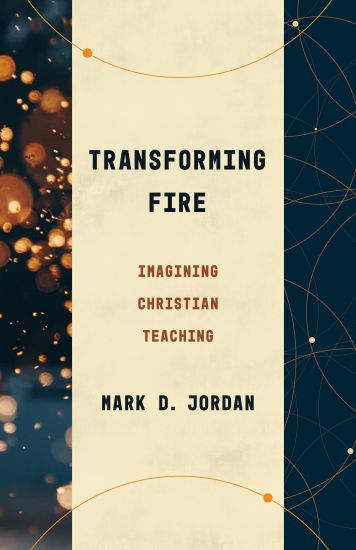
Transforming Fire

Transforming Fire

Mark D Jordan

William B Eerdmans Publishing Co
2021
pokkari
"We don't need books about teaching so much as books that teach." Considering Jesus himself taught in a variety of ways--parable, discussion, miracle performance, ritual observance--it seems that there can be no single, definitive, Christian method of teaching. How then should Christian teaching happen, especially in this time of significant change to theological education as an institution? Mark Jordan addresses this question by first allowing various depictions and instances of Christian teaching from literature to speak for themselves before meditating on what these illustrative examples might mean for Christian pedagogy. Each textual scene he shares is juxtaposed with a contrasting scene to capture the pluralistic possibilities in the art of teaching a faith that is so often rooted in paradox. He exemplifies forms of teaching that operate beyond the boundaries of scholarly books and discursive lectures to disrupt the normative Western academic approach of treating theology as a body of knowledge to be transmitted merely through language. Transforming Fire consults writers ranging from Gregory of Nyssa to C. S. Lewis, and from John Bunyan to Octavia Butler, cutting across historical distance and boundaries of identity. Rather than offering solutions or systems, Jordan seeks in these texts new shelters for theological education where powerful teaching can happen and--even as traditional institutions shrink or vanish--the hearts of students can catch fire once again.
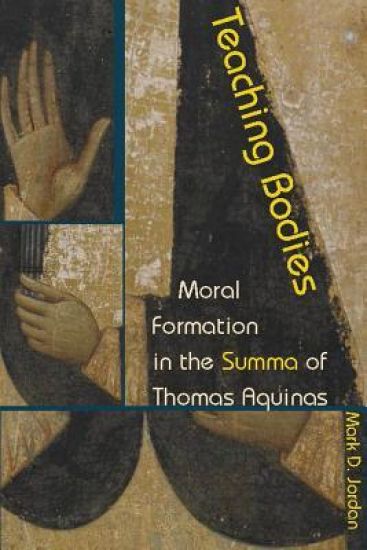
Teaching Bodies

Teaching Bodies

Mark D. Jordan

Fordham University Press
2016
pokkari
In Teaching Bodies, leading scholar of Christian thought Mark D. Jordan offers an original reading of the Summa of Theology of Thomas Aquinas. Reading backward, Jordan interprets the main parts of the Summa, starting from the conclusion, to reveal how Thomas teaches morals by directing attention to the way God teaches morals, namely through embodied scenes: the incarnation, the gospels, and the sacraments. It is Thomas's confidence in bodily scenes of instruction that explains the often overlooked structure of the middle part of the Summa, which begins and ends with Christian revisions of classical exhortations of the human body as a pathway to the best human life. Among other things, Jordan argues, this explains Thomas's interest in the stages of law and the limits of virtue as the engine of human life. Rather than offer a synthesis of Thomistic ethics, Jordan insists that we read Thomas as theology to discover the unification of Christian wisdom in a pattern of ongoing moral formation. Jordan supplements his close readings of the Summa with reflections on Thomas's place in the history of Christian moral teaching—and thus his relevance for teaching and writing in the present. What remains a puzzle is why Thomas chose to stage this incarnational moral teaching within the then-new genres of university disputation—the genres we think of as "Scholastic." Yet here again the structure of the Summa provides an answer. In Jordan's deft analysis, Thomas's minimalist refusal to tell a new story except by juxtaposing selections from inherited philosophical and theological traditions is his way of opening room for God's continuing narration in the development of the human soul. The task of writing theology, as Thomas understands it, is to open a path through the inherited languages of classical thought so that divine pedagogy can have its effect on the reader. As such, the task of the Summa, in Mark Jordan's hands, is a crucial and powerful way to articulate Christian morals today.
Teaching Bodies

Teaching Bodies

Mark D. Jordan

Fordham University Press
2016
sidottu
In Teaching Bodies, leading scholar of Christian thought Mark D. Jordan offers an original reading of the Summa of Theology of Thomas Aquinas. Reading backward, Jordan interprets the main parts of the Summa, starting from the conclusion, to reveal how Thomas teaches morals by directing attention to the way God teaches morals, namely through embodied scenes: the incarnation, the gospels, and the sacraments. It is Thomas's confidence in bodily scenes of instruction that explains the often overlooked structure of the middle part of the Summa, which begins and ends with Christian revisions of classical exhortations of the human body as a pathway to the best human life. Among other things, Jordan argues, this explains Thomas's interest in the stages of law and the limits of virtue as the engine of human life. Rather than offer a synthesis of Thomistic ethics, Jordan insists that we read Thomas as theology to discover the unification of Christian wisdom in a pattern of ongoing moral formation. Jordan supplements his close readings of the Summa with reflections on Thomas's place in the history of Christian moral teaching—and thus his relevance for teaching and writing in the present. What remains a puzzle is why Thomas chose to stage this incarnational moral teaching within the then-new genres of university disputation—the genres we think of as "Scholastic." Yet here again the structure of the Summa provides an answer. In Jordan's deft analysis, Thomas's minimalist refusal to tell a new story except by juxtaposing selections from inherited philosophical and theological traditions is his way of opening room for God's continuing narration in the development of the human soul. The task of writing theology, as Thomas understands it, is to open a path through the inherited languages of classical thought so that divine pedagogy can have its effect on the reader. As such, the task of the Summa, in Mark Jordan's hands, is a crucial and powerful way to articulate Christian morals today.
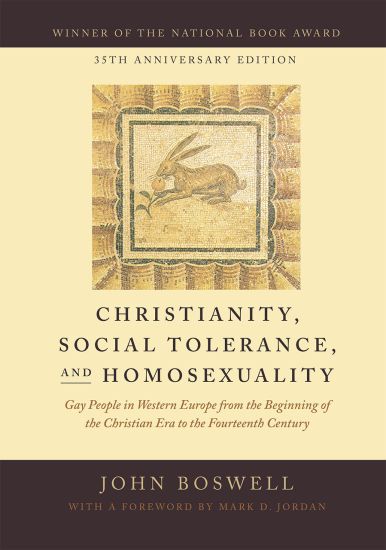
Christianity, Social Tolerance, and Homosexuality

Christianity, Social Tolerance, and Homosexuality

John Boswell; Mark D. Jordan

University of Chicago Press
2015
nidottu
John Boswell's National Book Award-winning study of the history of attitudes toward homosexuality in the early Christian West was a groundbreaking work that challenged preconceptions about the Church's past relationship to its gay members-among them priests, bishops, and even saints-when it was first published thirty-five years ago. The historical breadth of Boswell's research (from the Greeks to Aquinas) and the variety of sources consulted make this one of the most extensive treatments of any single aspect of Western social history. Now in this thirty-fifth anniversary edition with a new foreword by leading queer and religious studies scholar Mark D. Jordan, Christianity, Social Tolerance, and Homosexuality is still fiercely relevant. This landmark book helped form the disciplines of gay and gender studies, and it continues to illuminate the origins and operations of intolerance as a social force.
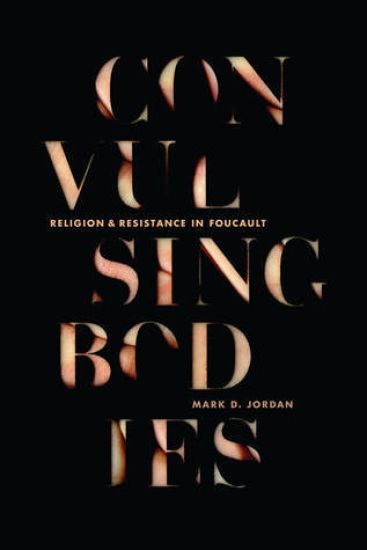
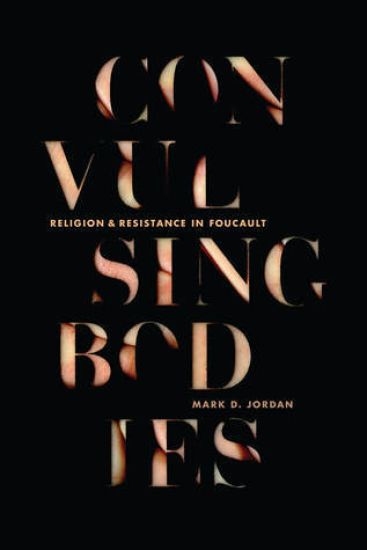
Convulsing Bodies

Convulsing Bodies

Mark D. Jordan

Stanford University Press
2014
sidottu
By using religion to get at the core concepts of Michel Foucault's thinking, this book offers a strong alternative to the way that the philosopher's work is read across the humanities. Foucault was famously interested in Christianity as both the rival to ancient ethics and the parent of modern discipline and was always alert to the hypocrisy and the violence in churches. Yet many readers have ignored how central religion is to his thought, particularly with regard to human bodies and how they are shaped. The point is not to turn Foucault into some sort of believer or to extract from him a fixed thesis about religion as such. Rather, it is to see how Foucault engages religious rhetoric page after page—even when religion is not his main topic. When readers follow his allusions, they can see why he finds in religion not only an object of critique, but a perennial provocation to think about how speech works on bodies—and how bodies resist. Arguing that Foucault conducts experiments in writing to frustrate academic expectations about history and theory, Mark Jordan gives equal weight to the performative and theatrical aspects of Foucault's writing or lecturing. How does Foucault stage possibilities of self-transformation? How are his books or lectures akin to the rituals and liturgies that he dissects in them? Convulsing Bodies follows its own game of hide-and-seek with the agents of totalizing systems (not least in the academy) and gives us a Foucault who plays with his audiences as he plays for them—or teaches them.
Convulsing Bodies

Convulsing Bodies

Mark D. Jordan

Stanford University Press
2014
pokkari
By using religion to get at the core concepts of Michel Foucault's thinking, this book offers a strong alternative to the way that the philosopher's work is read across the humanities. Foucault was famously interested in Christianity as both the rival to ancient ethics and the parent of modern discipline and was always alert to the hypocrisy and the violence in churches. Yet many readers have ignored how central religion is to his thought, particularly with regard to human bodies and how they are shaped. The point is not to turn Foucault into some sort of believer or to extract from him a fixed thesis about religion as such. Rather, it is to see how Foucault engages religious rhetoric page after page—even when religion is not his main topic. When readers follow his allusions, they can see why he finds in religion not only an object of critique, but a perennial provocation to think about how speech works on bodies—and how bodies resist. Arguing that Foucault conducts experiments in writing to frustrate academic expectations about history and theory, Mark Jordan gives equal weight to the performative and theatrical aspects of Foucault's writing or lecturing. How does Foucault stage possibilities of self-transformation? How are his books or lectures akin to the rituals and liturgies that he dissects in them? Convulsing Bodies follows its own game of hide-and-seek with the agents of totalizing systems (not least in the academy) and gives us a Foucault who plays with his audiences as he plays for them—or teaches them.
Blessing Same-Sex Unions

Blessing Same-Sex Unions

Mark D. Jordan

University of Chicago Press
2013
nidottu
Why are so many churches vehemently opposed to blessing same-sex unions? In this incisive work, Mark D. Jordan shows how carefully selected ideals of Christian marriage have come to dominate recent debates over same-sex unions. Opponents of gay marriage, he reveals, too often confuse simplified ideals of matrimony with historical facts, purporting that there has been a stable Christian tradition of marriage across millennia, when the reality has been anything but. Raising trenchant questions about social obligations, impulses, intentions, and determination, Blessing Same-Sex Unions is a must-read for both sides of the ongoing American debate over gay marriage.
Recruiting Young Love

Recruiting Young Love

Mark D. Jordan

University of Chicago Press
2011
sidottu
In the view of many Christians, the teenage years are simultaneously the most dangerous and the most promising. At the very moment when teens are trying to establish a sense of identity and belonging, they are beset by temptation on all sides - from the pressure of their peers to the nihilism and materialism of popular culture. Add the specter of homosexuality to the mix, and you've got a situation ripe for worry, sermonizing, and exploitation. In "Recruiting Young Love", Mark D. Jordan explores more than a half century of American church debate about homosexuality to show that even as the main lesson - homosexuality is bad, teens are vulnerable - has remained constant, the arguments and assumptions have changed remarkably. At the time of the first Kinsey Report, in 1948, homosexuality was simultaneously condemned and little discussed - a teen struggling with same-sex desire would have found little specific guidance. Sixty years later, church rhetoric has undergone a radical shift, as silence has given way to frequent, public, detailed discussion of homosexuality and its perceived dangers. Along the way, churches have quietly adopted much of the language and ideas of modern sexology, psychiatry, and social reformers-deploying it, for example, to buttress the credentials of anti-gay 'deprogramming' centers and traditional gender roles. Jordan tells this story through a wide variety of sources, including oral histories, interviews, memoirs, and even pulp novels; the result is a fascinating window onto the never-ending battle for the teenage soul.
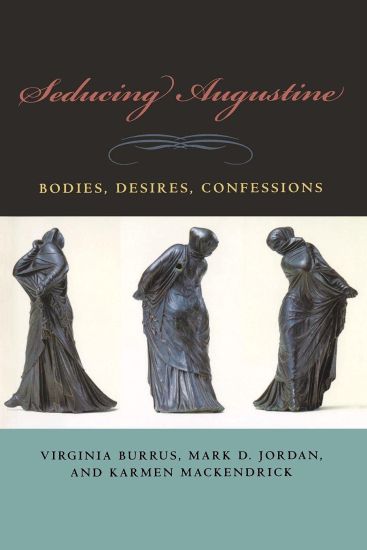
Seducing Augustine

Seducing Augustine

Virginia Burrus; Mark D. Jordan; Karmen MacKendrick

Fordham University Press
2010
pokkari
Augustine's Confessions is a text that seduces. But how often do its readers respond in kind? Here three scholars who share a longstanding fascination with sexuality and Christian discourse attempt to do just that. Where prior interpreters have been inclined either to defend or to criticize Augustine's views, Virginia Burrus, Mark Jordan, and Karmen MacKendrick set out both to seduce and to be seduced by his text. Often ambivalent but always passionately engaged, their readings of the Confessions center on four sets of intertwined themes—secrecy and confession, asceticism and eroticism, constraint and freedom, and time and eternity. Rather than expose Augustine's sexual history, they explore how the Confessions conjoins the erotic with the hidden, the imaginary, and the fictional. Rather than bemoan the repressiveness of his text, they uncover the complex relationship between seductive flesh and persuasive words that pervades all of its books. Rather than struggle to escape the control of the author, they embrace the painful pleasure of willed submission that lies at the erotic heart not only of the Confessions but also of Augustine's broader understanding of sin and salvation. Rather than mourn the fateful otherworldliness of his theological vision, they plumb the bottomless depths of beauty that Augustine discovers within creation, thereby extending desire precisely by refusing satisfaction. In unfolding their readings, the authors draw upon other works in Augustine's corpus while building on prior Augustinian scholarship in their own overlapping fields of history, theology, and philosophy. They also press well beyond the conventional boundaries of scholarly disciplines, conversing with such wide-ranging theorists of eroticism as Barthes, Baudrillard, Klossowski, Foucault, and Harpham. In the end, they offer not only a fresh interpretation of Augustine's famous work but also a multivocal literary-philosophical meditation on the seductive elusiveness of desire, bodies, language, and God.
Seducing Augustine

Seducing Augustine

Virginia Burrus; Mark D. Jordan; Karmen MacKendrick

Fordham University Press
2010
sidottu
Augustine's Confessions is a text that seduces. But how often do its readers respond in kind? Here three scholars who share a longstanding fascination with sexuality and Christian discourse attempt to do just that. Where prior interpreters have been inclined either to defend or to criticize Augustine's views, Virginia Burrus, Mark Jordan, and Karmen MacKendrick set out both to seduce and to be seduced by his text. Often ambivalent but always passionately engaged, their readings of the Confessions center on four sets of intertwined themes—secrecy and confession, asceticism and eroticism, constraint and freedom, and time and eternity. Rather than expose Augustine's sexual history, they explore how the Confessions conjoins the erotic with the hidden, the imaginary, and the fictional. Rather than bemoan the repressiveness of his text, they uncover the complex relationship between seductive flesh and persuasive words that pervades all of its books. Rather than struggle to escape the control of the author, they embrace the painful pleasure of willed submission that lies at the erotic heart not only of the Confessions but also of Augustine's broader understanding of sin and salvation. Rather than mourn the fateful otherworldliness of his theological vision, they plumb the bottomless depths of beauty that Augustine discovers within creation, thereby extending desire precisely by refusing satisfaction. In unfolding their readings, the authors draw upon other works in Augustine's corpus while building on prior Augustinian scholarship in their own overlapping fields of history, theology, and philosophy. They also press well beyond the conventional boundaries of scholarly disciplines, conversing with such wide-ranging theorists of eroticism as Barthes, Baudrillard, Klossowski, Foucault, and Harpham. In the end, they offer not only a fresh interpretation of Augustine's famous work but also a multivocal literary-philosophical meditation on the seductive elusiveness of desire, bodies, language, and God.
Rewritten Theology

Rewritten Theology

Mark D. Jordan

Wiley-Blackwell (an imprint of John Wiley Sons Ltd)
2005
sidottu
Responding to the recent upsurge of interest in Thomas Aquinas, this book goes straight to the heart of the contemporary debates about Thomism. Focuses on the concept of authority, both in terms of Aquinas’s own attitude to authority, and how the Church authorities have used Aquinas’s texts. Engages with appropriations of Aquinas’s work by a range of theologians, from liberal Catholics to the creators of radical orthodoxy. Argues for future readings of Aquinas which are substantially different from those which have gone before.
Rewritten Theology

Rewritten Theology

Mark D. Jordan

Wiley-Blackwell (an imprint of John Wiley Sons Ltd)
2005
nidottu
Responding to the recent upsurge of interest in Thomas Aquinas, this book goes straight to the heart of the contemporary debates about Thomism. Focuses on the concept of authority, both in terms of Aquinas’s own attitude to authority, and how the Church authorities have used Aquinas’s texts. Engages with appropriations of Aquinas’s work by a range of theologians, from liberal Catholics to the creators of radical orthodoxy. Argues for future readings of Aquinas which are substantially different from those which have gone before.
Telling Truths in Church

Telling Truths in Church

Mark D. Jordan

Beacon Press
2004
pokkari
Is the reform we have seen in the wake of the pedophilia scandals in the Catholic Church meaningful? Have our conversations about the causes of these scandals delved as deeply as they need to? For those questioning the relations between hierarchical power, secrecy, and sexuality in institutional religion, Mark D. Jordan's eloquent meditations on what truths about sexuality need to be told in church-and the difficulty of telling any truths-will be a balm and a revelation.
The Silence of Sodom

The Silence of Sodom

Mark D. Jordan

University of Chicago Press
2002
nidottu
Sexual scandals in the Roman Catholic Church have been highly public in recent years, and increasingly shrill directives from the Vatican about homosexuality have become commonplace. The visibility of these issues begs the question of how the Catholic Church can be at once so homophobic and so homoerotic. Mark D. Jordan, the authors of the award-winning "The Invention of Sodomy in Christian Theology", takes up this fundamental question in a deeply learned yet readable study of the relationship between male homosexuality and Catholicism. "The Silence of Sodom" is devoted, first, to teasing out the Church's complex bureaucratic language about sexual morality. Rather than trying to point out that official Catholic documents are simply wrong in their discussions and directives regarding homosexuality, Jordan examines the rhetorical devices used by the Church throughout its history to actively produce silence around the topic of male homosexuality. Arguing that we cannot find the Church's knowledge of homosexuality in its documents, Jordan looks to the unspoken but widely known features of clerical culture to illuminate the striking analogies between clerical institutions and contemporary gay culture, particularly in the mechanisms of discipline, the training of seminarians and the ambiguities of liturgical celebration. The Catholic Church's long experiment with masculine desire cannot be discovered through sensationalist trials of priest-paedophiles or surveys of gay clergy. "The Silence of Sodom" looks deeply into the intertwining, in words and deeds, of Catholicism with homoeroticism; it is a profound reflection on both "being gay" and "being Catholic".
The Ethics of Sex

The Ethics of Sex

Mark D. Jordan

JOHN WILEY AND SONS LTD
2001
nidottu
Mark Jordan has written a provocative and stimulating introduction to the issues surrounding sexual ethics and sexuality and theology, filling a much-needed void in this field. Jordan summarizes key topics and themes in the teaching and discussion of religious ethics as well as pushing forward the debate in interesting and original directions.