Kirjojen hintavertailu. Mukana 12 390 323 kirjaa ja 12 kauppaa.

Kirjailija

Mark J. Wierman

Kirjat ja teokset yhdessä paikassa: 10 kirjaa, julkaisuja vuosilta 1999-2016, suosituimpien joukossa Linear Models in the Mathematics of Uncertainty. Vertaile teosten hintoja ja tarkista saatavuus suomalaisista kirjakaupoista.

Mukana myös kirjoitusasut: Mark J Wierman

10 kirjaa

Kirjojen julkaisuhaarukka 1999-2016.

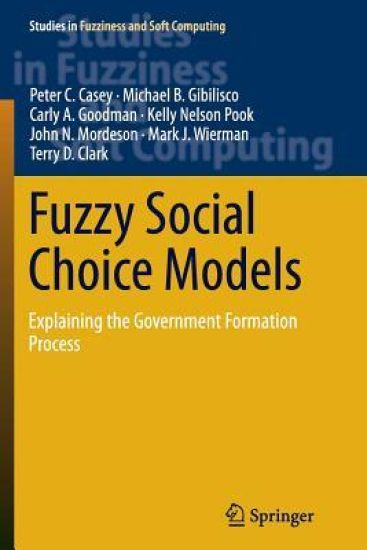
Fuzzy Social Choice Models

Fuzzy Social Choice Models

Peter C. Casey; Michael B. Gibilisco; Carly A. Goodman; Kelly Nelson Pook; John N. Mordeson; Mark J. Wierman; Terry D. Clark

Springer International Publishing AG
2014
sidottu
This book explores the extent to which fuzzy set logic can overcome some of the shortcomings of public choice theory, particularly its inability to provide adequate predictive power in empirical studies. Especially in the case of social preferences, public choice theory has failed to produce the set of alternatives from which collective choices are made. The book presents empirical findings achieved by the authors in their efforts to predict the outcome of government formation processes in European parliamentary and semi-presidential systems. Using data from the Comparative Manifesto Project (CMP), the authors propose a new approach that reinterprets error in the coding of CMP data as ambiguity in the actual political positions of parties on the policy dimensions being coded. The range of this error establishes parties’ fuzzy preferences. The set of possible outcomes in the process of government formation is then calculated on the basis of both the fuzzy Pareto set and the fuzzy maximal set, and the predictions are compared with those made by two conventional approaches as well as with the government that was actually formed. The comparison shows that, in most cases, the fuzzy approaches outperform their conventional counterparts.
Linear Models in the Mathematics of Uncertainty

Linear Models in the Mathematics of Uncertainty

Carol Jones; Mark J Wierman; Terry D Clark; Alex Pham; Michael A. Redmond

Springer-Verlag Berlin and Heidelberg GmbH Co. K
2013
sidottu
The purpose of this book is to present new mathematical techniques for modeling global issues. These mathematical techniques are used to determine linear equations between a dependent variable and one or more independent variables in cases where standard techniques such as linear regression are not suitable. In this book, we examine cases where the number of data points issmall (effects of nuclear warfare), where the experiment is not repeatable (the breakup of the former Soviet Union), and where the data is derived from expert opinion (how conservative is a political party). In all these cases the data is difficult to measure and an assumption of randomness and/or statistical validity is questionable. We apply our methods to real world issues in international relations such as nuclear deterrence, smart power, and cooperative threat reduction. We next apply our methods to issues in comparative politics such as successful democratization, quality of life, economic freedom, political stability, and failed states. Finally, issues involving deaf and hard of hearing children are explored.
Fuzzy Social Choice Models

Fuzzy Social Choice Models

Peter C. Casey; Michael B. Gibilisco; Carly A. Goodman; Kelly Nelson Pook; John N. Mordeson; Mark J. Wierman; Terry D. Clark

Springer International Publishing AG
2016
nidottu
This book explores the extent to which fuzzy set logic can overcome some of the shortcomings of public choice theory, particularly its inability to provide adequate predictive power in empirical studies. Especially in the case of social preferences, public choice theory has failed to produce the set of alternatives from which collective choices are made. The book presents empirical findings achieved by the authors in their efforts to predict the outcome of government formation processes in European parliamentary and semi-presidential systems. Using data from the Comparative Manifesto Project (CMP), the authors propose a new approach that reinterprets error in the coding of CMP data as ambiguity in the actual political positions of parties on the policy dimensions being coded. The range of this error establishes parties’ fuzzy preferences. The set of possible outcomes in the process of government formation is then calculated on the basis of both the fuzzy Pareto set and the fuzzy maximal set, and the predictions are compared with those made by two conventional approaches as well as with the government that was actually formed. The comparison shows that, in most cases, the fuzzy approaches outperform their conventional counterparts.
Fuzzy Social Choice Theory

Fuzzy Social Choice Theory

Michael B. Gibilisco; Annie M. Gowen; Karen E. Albert; John N. Mordeson; Mark J. Wierman; Terry D. Clark

Springer International Publishing AG
2016
nidottu
This book offers a comprehensive analysis of the social choice literature and shows, by applying fuzzy sets, how the use of fuzzy preferences, rather than that of strict ones, may affect the social choice theorems. To do this, the book explores the presupposition of rationality within the fuzzy framework and shows that the two conditions for rationality, completeness and transitivity, do exist with fuzzy preferences. Specifically, this book examines: the conditions under which a maximal set exists; the Arrow’s theorem; the Gibbard-Satterthwaite theorem and the median voter theorem. After showing that a non-empty maximal set does exists for fuzzy preference relations, this book goes on to demonstrating the existence of a fuzzy aggregation rule satisfying all five Arrowian conditions, including non-dictatorship. While the Gibbard-Satterthwaite theorem only considers individual fuzzy preferences, this work shows that both individuals and groups can choose alternatives to various degrees, resulting in a social choice that can be both strategy-proof and non-dictatorial. Moreover, the median voter theorem is shown to hold under strict fuzzy preferences but not under weak fuzzy preferences. By providing a standard model of fuzzy social choice and by drawing the necessary connections between the major theorems, this book fills an important gap in the current literature and encourages future empirical research in the field.
Linear Models in the Mathematics of Uncertainty

Linear Models in the Mathematics of Uncertainty

Carol Jones; Mark J Wierman; Terry D Clark; Alex Pham; Michael A. Redmond

Springer-Verlag Berlin and Heidelberg GmbH Co. K
2015
nidottu
The purpose of this book is to present new mathematical techniques for modeling global issues. These mathematical techniques are used to determine linear equations between a dependent variable and one or more independent variables in cases where standard techniques such as linear regression are not suitable. In this book, we examine cases where the number of data points issmall (effects of nuclear warfare), where the experiment is not repeatable (the breakup of the former Soviet Union), and where the data is derived from expert opinion (how conservative is a political party). In all these cases the data is difficult to measure and an assumption of randomness and/or statistical validity is questionable. We apply our methods to real world issues in international relations such as nuclear deterrence, smart power, and cooperative threat reduction. We next apply our methods to issues in comparative politics such as successful democratization, quality of life, economic freedom, political stability, and failed states. Finally, issues involving deaf and hard of hearing children are explored.
Fuzzy Social Choice Theory

Fuzzy Social Choice Theory

Michael B. Gibilisco; Annie M. Gowen; Karen E. Albert; John N. Mordeson; Mark J. Wierman; Terry D. Clark

Springer International Publishing AG
2014
sidottu
This book offers a comprehensive analysis of the social choice literature and shows, by applying fuzzy sets, how the use of fuzzy preferences, rather than that of strict ones, may affect the social choice theorems. To do this, the book explores the presupposition of rationality within the fuzzy framework and shows that the two conditions for rationality, completeness and transitivity, do exist with fuzzy preferences. Specifically, this book examines: the conditions under which a maximal set exists; the Arrow’s theorem; the Gibbard-Satterthwaite theorem and the median voter theorem. After showing that a non-empty maximal set does exists for fuzzy preference relations, this book goes on to demonstrating the existence of a fuzzy aggregation rule satisfying all five Arrowian conditions, including non-dictatorship. While the Gibbard-Satterthwaite theorem only considers individual fuzzy preferences, this work shows that both individuals and groups can choose alternatives to various degrees, resulting in a social choice that can be both strategy-proof and non-dictatorial. Moreover, the median voter theorem is shown to hold under strict fuzzy preferences but not under weak fuzzy preferences. By providing a standard model of fuzzy social choice and by drawing the necessary connections between the major theorems, this book fills an important gap in the current literature and encourages future empirical research in the field.
Applying Fuzzy Mathematics to Formal Models in Comparative Politics

Applying Fuzzy Mathematics to Formal Models in Comparative Politics

Terry D. Clark; Jennifer M. Larson; John N. Mordeson; Joshua D. Potter; Mark J. Wierman

Springer-Verlag Berlin and Heidelberg GmbH Co. K
2010
nidottu
This book explores the intersection of fuzzy mathematics and the spatial modeling of preferences in political science. Beginning with a critique of conventional modeling approaches predicated on Cantor set theoretical assumptions, the authors outline the potential benefits of a fuzzy approach to the study of ambiguous or uncertain preference profiles. While crisp models assume that ambiguity is a form of confusion emerging from imperfect information about policy options, the authors argue instead that some level of ambiguity is innate in human preferences and social interaction. What fuzzy mathematics offers the researcher, then, is a precise tool with which he can model the inherently imprecise dimensions of nuanced empirical reality. Moving beyond the limited treatment fuzzy methodologies have received in extant political science literature, this book develops single- and multidimensional models of fuzzy preference landscapes and characterizes the surprisingly high levels of stability that emerge from interactions between players operating within these models. The material presented makes it a good text for a graduate seminar in formal modeling. It is also suitable as an introductory text in fuzzy mathematics for graduate and advanced undergraduate students.
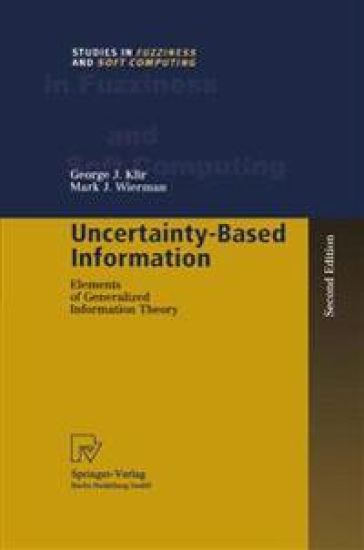
Uncertainty-Based Information

Uncertainty-Based Information

George J. Klir; Mark J. Wierman

Physica-Verlag GmbH Co
2010
nidottu
Information is precious. It reduces our uncertainty in making decisions. Knowledge about the outcome of an uncertain event gives the possessor an advantage. It changes the course of lives, nations, and history itself. Information is the food of Maxwell's demon. His power comes from know­ ing which particles are hot and which particles are cold. His existence was paradoxical to classical physics and only the realization that information too was a source of power led to his taming. Information has recently become a commodity, traded and sold like or­ ange juice or hog bellies. Colleges give degrees in information science and information management. Technology of the computer age has provided access to information in overwhelming quantity. Information has become something worth studying in its own right. The purpose of this volume is to introduce key developments and results in the area of generalized information theory, a theory that deals with uncertainty-based information within mathematical frameworks that are broader than classical set theory and probability theory. The volume is organized as follows.
Applying Fuzzy Mathematics to Formal Models in Comparative Politics

Applying Fuzzy Mathematics to Formal Models in Comparative Politics

Terry D. Clark; Jennifer M. Larson; John N. Mordeson; Joshua D. Potter; Mark J. Wierman

Springer-Verlag Berlin and Heidelberg GmbH Co. K
2008
sidottu
This book explores the intersection of fuzzy mathematics and the spatial modeling of preferences in political science. Beginning with a critique of conventional modeling approaches predicated on Cantor set theoretical assumptions, the authors outline the potential benefits of a fuzzy approach to the study of ambiguous or uncertain preference profiles. While crisp models assume that ambiguity is a form of confusion emerging from imperfect information about policy options, the authors argue instead that some level of ambiguity is innate in human preferences and social interaction. What fuzzy mathematics offers the researcher, then, is a precise tool with which he can model the inherently imprecise dimensions of nuanced empirical reality. Moving beyond the limited treatment fuzzy methodologies have received in extant political science literature, this book develops single- and multidimensional models of fuzzy preference landscapes and characterizes the surprisingly high levels of stability that emerge from interactions between players operating within these models. The material presented makes it a good text for a graduate seminar in formal modeling. It is also suitable as an introductory text in fuzzy mathematics for graduate and advanced undergraduate students.
Uncertainty-Based Information

Uncertainty-Based Information

George J. Klir; Mark J. Wierman

Physica-Verlag GmbH Co
1999
sidottu
Information is precious. It reduces our uncertainty in making decisions. Knowledge about the outcome of an uncertain event gives the possessor an advantage. It changes the course of lives, nations, and history itself. Information is the food of Maxwell's demon. His power comes from know­ ing which particles are hot and which particles are cold. His existence was paradoxical to classical physics and only the realization that information too was a source of power led to his taming. Information has recently become a commodity, traded and sold like or­ ange juice or hog bellies. Colleges give degrees in information science and information management. Technology of the computer age has provided access to information in overwhelming quantity. Information has become something worth studying in its own right. The purpose of this volume is to introduce key developments and results in the area of generalized information theory, a theory that deals with uncertainty-based information within mathematical frameworks that are broader than classical set theory and probability theory. The volume is organized as follows.