Kirjojen hintavertailu. Mukana 12 595 353 kirjaa ja 12 kauppaa.
Kirjailija
Mark Kac
Kirjat ja teokset yhdessä paikassa: 10 kirjaa, julkaisuja vuosilta 1957-2021, suosituimpien joukossa Statistical Independence in Probability, Analysis and Number Theory. Vertaile teosten hintoja ja tarkista saatavuus suomalaisista kirjakaupoista.
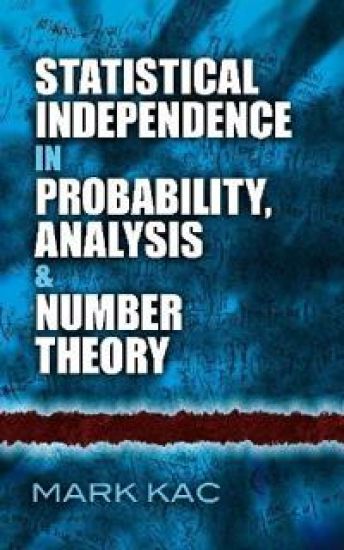
This concise monograph in probability by Mark Kac, a well-known mathematician, presumes a familiarity with Lebesgue's theory of measure and integration, the elementary theory of Fourier integrals, and the rudiments of number theory. Readers may then follow Dr. Kac's attempt "to rescue statistical independence from the fate of abstract oblivion by showing how in its simplest form it arises in various contexts cutting across different mathematical disciplines." The treatment begins with an examination of a formula of Vieta that extends to the notion of statistical independence. Subsequent chapters explore laws of large numbers and mile Borel's concept of normal numbers; the normal law, as expressed by Abraham de Moivre and Andrey Markov's method; and number theoretic functions as well as the normal law in number theory. The final chapter ranges in scope from kinetic theory to continued fractions. All five chapters are enhanced by problems.
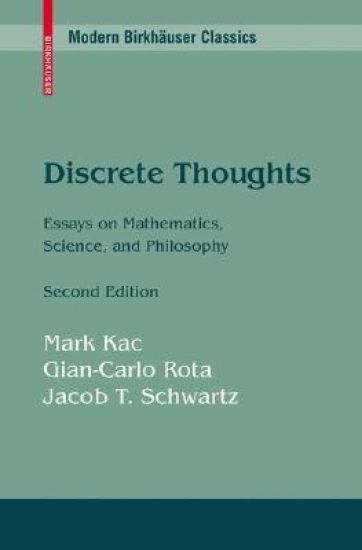
as anywhere today, it is becoming more d- ficult to tell the truth. To be sure, our store of accurate facts is more plentiful now than it has ever been, and the minutest details of history are being thoroughly recorded. Scientists, - men and scholars vie with each other in publishing excruciatingly definitive accounts of all that happens on the natural, political and historical scenes. Unfortunately, telling the truth is not quite the same thing as reciting a rosary of facts. Jos6 Ortega y Gasset, in an adm- able lesson summarized by Antonio Machado's three-line poem, prophetically warned us that the reason people so often lie is that they lack imagination: they don't realize that the truth, too, is a matter of invention. Sometime, in a future that is knocking at our door, we shall have to retrain ourselves or our children to properly tell the truth. The exercise will be particularly painful in mathematics. The enrapturing discoveries of our field systematically conceal, like footprints erased in the sand, the analogical train of thought that is the authentic life of mathematics. Shocking as it may be to a conservative logician, the day will come when currently MATHEMATICS, IN vague concepts such as motivation and purpose will be made formal and accepted as constituents of a revamped logic, where they will at last be allotted the equal status they deserve, si- by-side with axioms and theorems.
Now available in the Cambridge Mathematical Library, the classic work from Luis Santaló. Integral geometry originated with problems on geometrical probability and convex bodies. Its later developments, however, have proved to be useful in several fields ranging from pure mathematics (measure theory, continuous groups) to technical and applied disciplines (pattern recognition, stereology). The book is a systematic exposition of the theory and a compilation of the main results in the field. The volume can be used to complement courses on differential geometry, Lie groups or probability or differential geometry. It is ideal both as a reference and for those wishing to enter the field.
as anywhere today, it is becoming more d- ficult to tell the truth. To be sure, our store of accurate facts is more plentiful now than it has ever been, and the minutest details of history are being thoroughly recorded. Scientists, - men and scholars vie with each other in publishing excruciatingly definitive accounts of all that happens on the natural, political and historical scenes. Unfortunately, telling the truth is not quite the same thing as reciting a rosary of facts. Jos6 Ortega y Gasset, in an adm- able lesson summarized by Antonio Machado's three-line poem, prophetically warned us that the reason people so often lie is that they lack imagination: they don't realize that the truth, too, is a matter of invention. Sometime, in a future that is knocking at our door, we shall have to retrain ourselves or our children to properly tell the truth. The exercise will be particularly painful in mathematics. The enrapturing discoveries of our field systematically conceal, like footprints erased in the sand, the analogical train of thought that is the authentic life of mathematics. Shocking as it may be to a conservative logician, the day will come when currently MATHEMATICS, IN vague concepts such as motivation and purpose will be made formal and accepted as constituents of a revamped logic, where they will at last be allotted the equal status they deserve, si- by-side with axioms and theorems.
Professor Kac's monograph is designed to illustrate how simple observations can be made the starting point of rich and fruitful theories and how the same theme recurs in seemingly unrelated disciplines. An elementary but thorough discussion of the game of ""heads or tails,"" including the normal law and the laws of large numbers, is presented in a setting in which a variety of purely analytic results appear natural and inevitable. The chapter ""Primes Play a Game of Chance"" uses the same setting in dealing with problems of the distribution of values of arithmetic functions. The final chapter ""From Kinetic Theory to Continued Fractions"" deals with a spectacular application of the ergodic theorems to continued fractions. Mark Kac conveyed his infectious enthusiasm for mathematics and its applications in his lectures, papers, and books. Two of his papers won Chauvenet awards for expository excellence.