Kirjojen hintavertailu. Mukana 12 595 353 kirjaa ja 12 kauppaa.

Kirjailija

Mark Kelbert

Kirjat ja teokset yhdessä paikassa: 5 kirjaa, julkaisuja vuosilta 2008-2014, suosituimpien joukossa Probability and Statistics by Example: Volume 1, Basic Probability and Statistics. Vertaile teosten hintoja ja tarkista saatavuus suomalaisista kirjakaupoista.

5 kirjaa

Kirjojen julkaisuhaarukka 2008-2014.

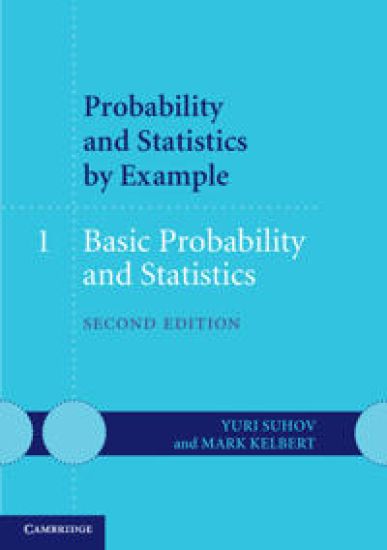
Probability and Statistics by Example: Volume 1, Basic Probability and Statistics
Probability and statistics are as much about intuition and problem solving as they are about theorem proving. Consequently, students can find it very difficult to make a successful transition from lectures to examinations to practice because the problems involved can vary so much in nature. Since the subject is critical in so many applications from insurance to telecommunications to bioinformatics, the authors have collected more than 200 worked examples and examination questions with complete solutions to help students develop a deep understanding of the subject rather than a superficial knowledge of sophisticated theories. With amusing stories and historical asides sprinkled throughout, this enjoyable book will leave students better equipped to solve problems in practice and under exam conditions.
Information Theory and Coding by Example

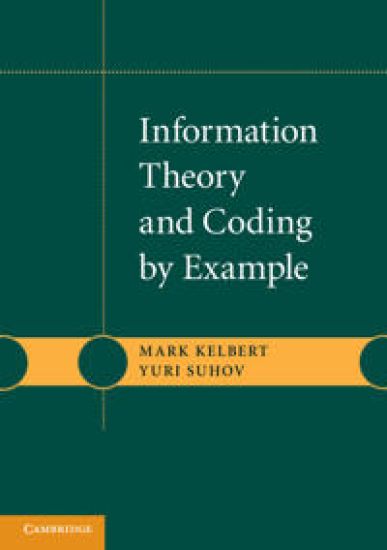
Information Theory and Coding by Example

Mark Kelbert; Yuri Suhov

Cambridge University Press
2013
sidottu
This fundamental monograph introduces both the probabilistic and algebraic aspects of information theory and coding. It has evolved from the authors' years of experience teaching at the undergraduate level, including several Cambridge Maths Tripos courses. The book provides relevant background material, a wide range of worked examples and clear solutions to problems from real exam papers. It is a valuable teaching aid for undergraduate and graduate students, or for researchers and engineers who want to grasp the basic principles.
Information Theory and Coding by Example

Information Theory and Coding by Example

Mark Kelbert; Yuri Suhov

Cambridge University Press
2013
pokkari
This fundamental monograph introduces both the probabilistic and algebraic aspects of information theory and coding. It has evolved from the authors' years of experience teaching at the undergraduate level, including several Cambridge Maths Tripos courses. The book provides relevant background material, a wide range of worked examples and clear solutions to problems from real exam papers. It is a valuable teaching aid for undergraduate and graduate students, or for researchers and engineers who want to grasp the basic principles.
Probability and Statistics by Example: Volume 2, Markov Chains: A Primer in Random Processes and their Applications
Probability and Statistics are as much about intuition and problem solving as they are about theorem proving. Because of this, students can find it very difficult to make a successful transition from lectures to examinations to practice, since the problems involved can vary so much in nature. Since the subject is critical in many modern applications such as mathematical finance, quantitative management, telecommunications, signal processing, bioinformatics, as well as traditional ones such as insurance, social science andengineering, the authors have rectified deficiencies in traditional lecture-based methods by collecting together a wealth of exercises with complete solutions, adapted to needs and skills of students. Following on from the success of Probability and Statistics by Example: Basic Probability and Statistics, the authors here concentrate on random processes, particularly Markov processes, emphasising modelsrather than general constructions. Basic mathematical facts are supplied as and when they are needed andhistorical information is sprinkled throughout.
Probability and Statistics by Example: Volume 2, Markov Chains: A Primer in Random Processes and their Applications
Probability and Statistics are as much about intuition and problem solving as they are about theorem proving. Because of this, students can find it very difficult to make a successful transition from lectures to examinations to practice, since the problems involved can vary so much in nature. Since the subject is critical in many modern applications such as mathematical finance, quantitative management, telecommunications, signal processing, bioinformatics, as well as traditional ones such as insurance, social science andengineering, the authors have rectified deficiencies in traditional lecture-based methods by collecting together a wealth of exercises with complete solutions, adapted to needs and skills of students. Following on from the success of Probability and Statistics by Example: Basic Probability and Statistics, the authors here concentrate on random processes, particularly Markov processes, emphasising modelsrather than general constructions. Basic mathematical facts are supplied as and when they are needed andhistorical information is sprinkled throughout.