Kirjojen hintavertailu. Mukana 12 390 323 kirjaa ja 12 kauppaa.

Kirjailija

Mark N. Franklin

Kirjat ja teokset yhdessä paikassa: 5 kirjaa, julkaisuja vuosilta 1996-2009, suosituimpien joukossa Choosing Europe?. Vertaile teosten hintoja ja tarkista saatavuus suomalaisista kirjakaupoista.

5 kirjaa

Kirjojen julkaisuhaarukka 1996-2009.

Choosing Europe?

Choosing Europe?

Cees van der Eijk; Mark N. Franklin

The University of Michigan Press
1996
sidottu
This is a book about elections to the European Parliament, their failure to legitimate and control the exercise of power in the European Union, and the consequences of this failure for domestic politics in EU member states. It also sheds new light on why voters behave the way they do. The authors examine the 1989 Europe-wide elections with the aid of large-scale surveys fielded in all twelve member countries of the (then) European Community--placing European citizens within their institutional, political, economic, and social contexts. In particular, because three countries held national elections concurrently with the 1989 European elections, the study controls for the presence or absence of a national election context--permitting the authors to investigate electoral behavior in general, not just at European elections. Looking at such behavior while taking account of the strategic contexts within which elections are held has yielded new insights about turnout and party choice, while clarifying the crisis of legitimacy that faces the European Union. The more recent Europe-wide elections of 1994 are used to validate the findings. This book will be of interest to political scientists interested in elections, the European Union, comparative politics, and political development.

Elections and Voters

Elections and Voters

Cees Van der Eijk; Mark N. Franklin

Red Globe Press
2009
nidottu
This major new text by two leading authorities in the field provides a state-of-the-art assessment of what we know about voting behaviour and the character, consequences and significance of elections in democratic states. It shows how patterns of electoral behaviour have evolved over time and vary in different countries.
Elections and Voters

Elections and Voters

Cees Van der Eijk; Mark N. Franklin

Red Globe Press
2009
sidottu
This major new text by two leading authorities in the field provides a state-of-the-art assessment of what we know about voting behaviour and the character, consequences and significance of elections in democratic states. It shows how patterns of electoral behaviour have evolved over time and vary in different countries.
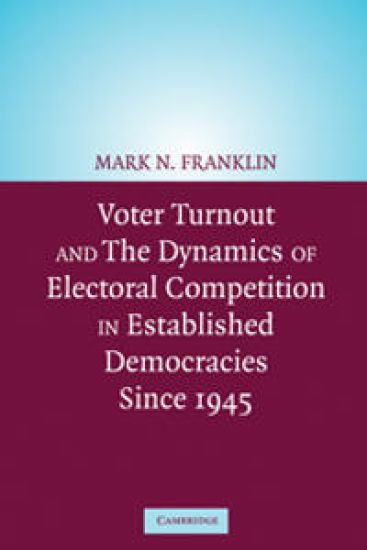
Voter Turnout and the Dynamics of Electoral Competition in Established Democracies since 1945
Voting is a habit. People learn the habit of voting, or not, based on experience in their first few elections. Elections that do not stimulate high turnout among young adults leave a 'footprint' of low turnout in the age structure of the electorate as many individuals who were new at those elections fail to vote at subsequent elections. Elections that stimulate high turnout leave a high turnout footprint. So a country's turnout history provides a baseline for current turnout that is largely set, except for young adults. This baseline shifts as older generations leave the electorate and as changes in political and institutional circumstances affect the turnout of new generations. Among the changes that have affected turnout in recent years, the lowering of the voting age in most established democracies has been particularly important in creating a low turnout footprint that has grown with each election.
Voter Turnout and the Dynamics of Electoral Competition in Established Democracies since 1945
Voting is a habit. People learn the habit of voting, or not, based on experience in their first few elections. Elections that do not stimulate high turnout among young adults leave a ‘footprint’ of low turnout in the age structure of the electorate as many individuals who were new at those elections fail to vote at subsequent elections. Elections that stimulate high turnout leave a high turnout footprint. So a country’s turnout history provides a baseline for current turnout that is largely set, except for young adults. This baseline shifts as older generations leave the electorate and as changes in political and institutional circumstances affect the turnout of new generations. Among the changes that have affected turnout in recent years, the lowering of the voting age in most established democracies has been particularly important in creating a low turnout footprint that has grown with each election.