Kirjojen hintavertailu. Mukana 12 390 323 kirjaa ja 12 kauppaa.

Kirjailija

Mark Nixon

Kirjat ja teokset yhdessä paikassa: 10 kirjaa, julkaisuja vuosilta 2010-2025, suosituimpien joukossa Control Loop Foundation. Vertaile teosten hintoja ja tarkista saatavuus suomalaisista kirjakaupoista.

10 kirjaa

Kirjojen julkaisuhaarukka 2010-2025.

Feature Extraction and Image Processing for Computer Vision

Feature Extraction and Image Processing for Computer Vision

Mark Nixon; Alberto Aguado

ELSEVIER SCIENCE PUBLISHING CO INC
2025
nidottu
Feature Extraction and Image Processing for Computer Vision, Fifth Edition is an essential guide to the implementation of image processing and computer vision techniques, with tutorial introductions and sample code in MATLAB and Python. Algorithms are presented and fully explained to enable complete understanding of the methods and techniques demonstrated, providing a link between theory and implementation. Essential background theory is carefully explained. This text gives students and researchers in image processing and computer vision a complete introduction to classic and state-of-the art methods in feature extraction together with practical guidance on their implementation.
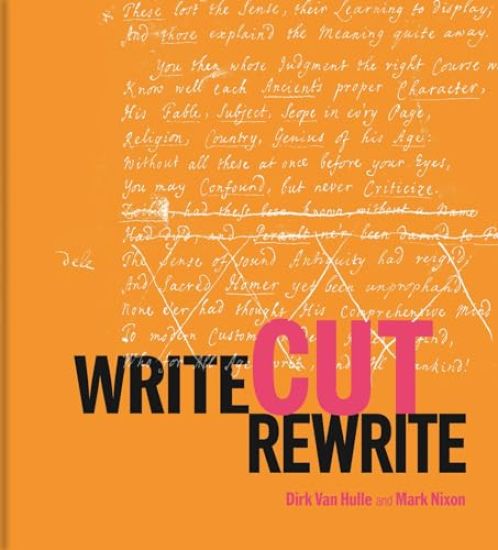
Write Cut Rewrite

Write Cut Rewrite

Dirk Hulle; Mark Nixon

BODLEIAN LIBRARY
2024
sidottu
Imagine looking over the shoulder of your favourite author and witnessing the moment they begin writing the opening chapter of their best-loved novel. What you might see is that the author has to write, cut and rewrite their words, often many times, in order to find the right form. Unearthing what has been jettisoned, moved or edited can give us valuable insights into the creative process. Editorial decisions are documented in an extraordinary number of literary manuscripts, notebooks and letters preserved in libraries and archives. What would Frankenstein have looked like if Mary and Percy Shelley had not collaborated on the draft? Would we view The Wind in the Willows differently if its title had remained ‘The Mole & the Water Rat’? This highly illustrated book invites you to explore these roads-not-taken and discover ideas which did not make it into renowned novels, poems and plays. With insights into the drafting techniques of writers as varied as Jane Austen, Christina Rossetti, Raymond Chandler, Samuel Beckett, Franz Kafka, John le Carré, Alan Bennett, Barbara Pym, Philip Pullman and Alice Oswald, this is a fascinating unveiling of the mysteries of writing, cutting, rewriting and publishing exceptional creative works.
Feature Extraction and Image Processing for Computer Vision

Feature Extraction and Image Processing for Computer Vision

Mark Nixon; Alberto Aguado

Academic Press Inc
2019
nidottu
Feature Extraction for Image Processing and Computer Vision is an essential guide to the implementation of image processing and computer vision techniques, with tutorial introductions and sample code in MATLAB and Python. Algorithms are presented and fully explained to enable complete understanding of the methods and techniques demonstrated. As one reviewer noted, "The main strength of the proposed book is the link between theory and exemplar code of the algorithms." Essential background theory is carefully explained. This text gives students and researchers in image processing and computer vision a complete introduction to classic and state-of-the art methods in feature extraction together with practical guidance on their implementation.
Samuel Beckett's Library

Samuel Beckett's Library

Dirk Van Hulle; Mark Nixon

Cambridge University Press
2017
pokkari
Samuel Beckett's Library critically examines the reading notes and marginalia contained in the books of Samuel Beckett's surviving library in Paris. Previously inaccessible to scholars, this is the first study to assess the importance of the marginalia, inscriptions, and other manuscript notes in the 750 volumes of the library. Setting the library into context with other manuscript material such as drafts and notebooks, this book examines the way in which Beckett absorbed, 'translated', and transmitted his reading in his own work. It thus illuminates Beckett's cultural and intellectual world, and shows the ways in which his reading often engendered writing.
WirelessHART™

WirelessHART™

Deji Chen; Mark Nixon; Aloysius Mok

Springer-Verlag New York Inc.
2014
nidottu
The process control industry has seen generations of technology advancement, from pneumatic communication to electrical communication to electronic c- munication, from centralized control to distributed control. At the center of today’s distributed control systems are operator workstations. These operator wo- stations provide the connection between those overseeing and running plant operations to the process itself. With each new generation of products the operator workstation has become increasingly more intelligent. Newer applications provide advanced alarming, control, and diagnostics. Behind all of these applications are smarter devices. These smart devices provide greater process insight, reduce en- neering costs, and contribute to improving the overall operational performance of the plant. Smart devices include advanced diagnostics that can report the health of the device and in many cases, the health of the process that the device is connected to. It is not uncommon for smart devices to include diagnostics that can detect plugged lines, burner flame instability, agitator loss, wet gas, orifice wear, leaks, and cavitations. These devices tell the user how well they are operating and when they need maintenance. Improvements in sensor technology and diagnostics have lead to a large variety of smart devices. So how do users connect the capabilities of these smart devices to their existing control system infrastructures? The answer is wireless. Wireless technology has matured to the point that it now can be safely applied in industrial control, monitor, and asset management applications.
Samuel Beckett's Library

Samuel Beckett's Library

Dirk Van Hulle; Mark Nixon

Cambridge University Press
2013
sidottu
Samuel Beckett's Library critically examines the reading notes and marginalia contained in the books of Samuel Beckett's surviving library in Paris. Previously inaccessible to scholars, this is the first study to assess the importance of the marginalia, inscriptions, and other manuscript notes in the 750 volumes of the library. Setting the library into context with other manuscript material such as drafts and notebooks, this book examines the way in which Beckett absorbed, 'translated', and transmitted his reading in his own work. It thus illuminates Beckett's cultural and intellectual world, and shows the ways in which his reading often engendered writing.
Samuel Beckett's German Diaries 1936-1937

Samuel Beckett's German Diaries 1936-1937

Mark Nixon

Continuum Publishing Corporation
2011
sidottu
Sixdiary notebooks kept by Samuel Beckett during his1936-7 trip through Nazi Germany were discovered in 1989. Samuel Beckett's German Diaries 1936-1937 is the first study to explore the relevance of these diaries to Beckett's development as a writer. Using the diaries as the central point of focus, Nixon draws on unpublished manuscripts, notebooks, correspondence, reading notes from the 1930s to reflect on both Beckett's creative evolution prior to 1936 and the direction his writing took after his return to Dublin in April 1937. As well as gaining an insight into Beckett's reading of classical German literature, Nixon shows how the pared-down style of writing, the self-examination and the importance of the visual arts that govern Beckett's post-war works traces back to the pages of these notebooks. By illuminating how Beckett's writing and aesthetics underwent a far-reaching change during the 1930s, Nixon's study is crucial to our understanding of the emergence of Beckett as a radical writer in the post-war years.
Samuel Rawson Gardiner and the Idea of History

Samuel Rawson Gardiner and the Idea of History

Mark Nixon

Royal Historical Society
2011
sidottu
A study of an eminent historian of seventeenth-century Britain and his work, showing its continued importance for all those working on the period. Samuel Rawson Gardiner [1829-1902] is the colossus of seventeenth-century historiography. His twenty-volume history of Britain from 1603 to 1656 and his many editions of key texts still serve to underpin almost all study of the Civil Wars and of the Commonwealth and Protectorate. Yet, despite his importance, his work has often been reduced by historians of historiography to simple caricature, in which his personal politics and his denominational allegiances got the better of his worthy empiricism. This book seeks to challenge the inadequate view of him and his work, offering a rich contextualisation by locating his writings within a wide range of literary and philosophical milieux,British and continental European. In so doing it not only suggests new ways of looking at Victorian historiography in general, but also proposes a new approach to the growing history of historical writing. Mark Nixon is an independent scholar and museum curator.
WirelessHART™

WirelessHART™

Deji Chen; Mark Nixon; Aloysius Mok

Springer-Verlag New York Inc.
2010
sidottu
The process control industry has seen generations of technology advancement, from pneumatic communication to electrical communication to electronic c- munication, from centralized control to distributed control. At the center of today’s distributed control systems are operator workstations. These operator wo- stations provide the connection between those overseeing and running plant operations to the process itself. With each new generation of products the operator workstation has become increasingly more intelligent. Newer applications provide advanced alarming, control, and diagnostics. Behind all of these applications are smarter devices. These smart devices provide greater process insight, reduce en- neering costs, and contribute to improving the overall operational performance of the plant. Smart devices include advanced diagnostics that can report the health of the device and in many cases, the health of the process that the device is connected to. It is not uncommon for smart devices to include diagnostics that can detect plugged lines, burner flame instability, agitator loss, wet gas, orifice wear, leaks, and cavitations. These devices tell the user how well they are operating and when they need maintenance. Improvements in sensor technology and diagnostics have lead to a large variety of smart devices. So how do users connect the capabilities of these smart devices to their existing control system infrastructures? The answer is wireless. Wireless technology has matured to the point that it now can be safely applied in industrial control, monitor, and asset management applications.