Kirjojen hintavertailu. Mukana 12 390 323 kirjaa ja 12 kauppaa.

Kirjailija

Mark Poster

Kirjat ja teokset yhdessä paikassa: 9 kirjaa, julkaisuja vuosilta 1990-2006, suosituimpien joukossa Information Please. Vertaile teosten hintoja ja tarkista saatavuus suomalaisista kirjakaupoista.

9 kirjaa

Kirjojen julkaisuhaarukka 1990-2006.

Information Please

Information Please

Mark Poster

Duke University Press
2006
sidottu
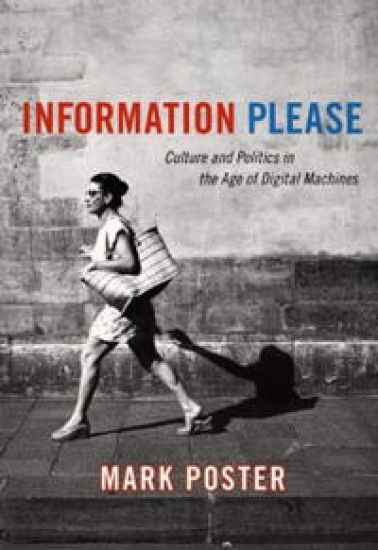
Information Please advances the ongoing critical project of the media scholar Mark Poster: theorizing the social and cultural effects of electronically mediated information. In this book Poster conceptualizes a new relation of humans to information machines, a relation that avoids privileging either the human or the machine but instead focuses on the structures of their interactions. Synthesizing a broad range of critical theory, he explores how texts, images, and sounds are made different when they are mediated by information machines, how this difference affects individuals as well as social and political formations, and how it creates opportunities for progressive change.Poster’s critique develops through a series of lively studies. Analyzing the appearance of Sesame Street’s Bert next to Osama Bin Laden in a New York Times news photo, he examines the political repercussions of this Internet “hoax” as well as the unlimited opportunities that Internet technology presents for the appropriation and alteration of information. He considers the implications of open-source licensing agreements, online personas, the sudden rise of and interest in identity theft, peer-to-peer file sharing, and more. Focusing explicitly on theory, he reflects on the limitations of critical concepts developed before the emergence of new media, particularly globally networked digital communications, and he argues that, contrary to the assertions of Michael Hardt and Antonio Negri, new media do not necessarily reproduce neoimperialisms. Urging a rethinking of assumptions ingrained during the dominance of broadcast media, Poster charts new directions for work on politics and digital culture.
Information Please

Information Please

Mark Poster

Duke University Press
2006
pokkari
Information Please advances the ongoing critical project of the media scholar Mark Poster: theorizing the social and cultural effects of electronically mediated information. In this book Poster conceptualizes a new relation of humans to information machines, a relation that avoids privileging either the human or the machine but instead focuses on the structures of their interactions. Synthesizing a broad range of critical theory, he explores how texts, images, and sounds are made different when they are mediated by information machines, how this difference affects individuals as well as social and political formations, and how it creates opportunities for progressive change.Poster’s critique develops through a series of lively studies. Analyzing the appearance of Sesame Street’s Bert next to Osama Bin Laden in a New York Times news photo, he examines the political repercussions of this Internet “hoax” as well as the unlimited opportunities that Internet technology presents for the appropriation and alteration of information. He considers the implications of open-source licensing agreements, online personas, the sudden rise of and interest in identity theft, peer-to-peer file sharing, and more. Focusing explicitly on theory, he reflects on the limitations of critical concepts developed before the emergence of new media, particularly globally networked digital communications, and he argues that, contrary to the assertions of Michael Hardt and Antonio Negri, new media do not necessarily reproduce neoimperialisms. Urging a rethinking of assumptions ingrained during the dominance of broadcast media, Poster charts new directions for work on politics and digital culture.
What's the Matter with the Internet?

What's the Matter with the Internet?

Mark Poster

University of Minnesota Press
2001
nidottu
A provocative investigation into the social and cultural implications of the Internet by a leading cultural critic.As the Internet has become more and more a part of our daily lives, responses to its impact on culture and society have tended toward the extremes, hopeful or pessimistic. Fears that the Internet undermines community, inhibits social interaction, exacerbates economic and racial divisions, and facilitates greater state or corporate intrusion into our lives are balanced by excitement about the transformative qualities of the new medium and its potential to stimulate individual creativity, inspire new social forms, and further democratization.In What’s the Matter with the Internet?, leading cultural theorist Mark Poster offers a sophisticated and astute assessment of the potential the new medium has to redefine culture and politics. Avoiding the mindless hype and meaningless jargon that has characterized much of the debate about the future of the Web, he details what truly distinguishes the Internet from other media and the implications these novel properties have for such vital issues as authorship, national identity and global citizenship, the fate of ethnicity and race, and democracy. Arguing that the Internet demands a social and cultural theory appropriate to the specific qualities of cyberspace, Poster reformulates the ideas of thinkers associated with our understanding of postmodern culture and the media (including Foucault, Deleuze, Heidegger, Baudrillard, and Derrida) to account for and illuminate the virtual world, paying particular attention to its political dimensions and the nature of identity. In this innovative analysis, Poster acknowledges that although the colonization of the Internet by corporations and governments does threaten to retard its capacity to bring about genuine change, the new medium is still capable of transforming both contemporary social practices and the way we see the world and ourselves.
Information Subject

Information Subject

Mark Poster; Stanley Aronowitz

Routledge
2001
sidottu
First Published in 2001. In this collection of essays and interviews, Mark Poster examines theoretical approaches and develops his own position on our information based society. He contends that new communications media disrupt and transfigure the way identities are constituted in cultural exchanges. He looks in detail at several aspects of what might be called "internet culture", including virtuality and democracy. Poster advocates an awareness of the Internet and other new forms of communication, calling for a mobilization to ensure accessibility to all and to configure technology into vehicles of open cultural creation. For example, nothing is pure about the Internet politically, he points out, and it remains an open question as to who will transform the potentiality of new communications media into determinate cultural configurations. This book explores the rupture and potentiality between the electronic self and the face-to-face self inherent in new forms of technology and media.
Information Subject

Information Subject

Mark Poster; Stanley Aronowitz

Routledge
2001
nidottu
First Published in 2001. In this collection of essays and interviews, Mark Poster examines theoretical approaches and develops his own position on our information based society. He contends that new communications media disrupt and transfigure the way identities are constituted in cultural exchanges. He looks in detail at several aspects of what might be called "internet culture", including virtuality and democracy. Poster advocates an awareness of the Internet and other new forms of communication, calling for a mobilization to ensure accessibility to all and to configure technology into vehicles of open cultural creation. For example, nothing is pure about the Internet politically, he points out, and it remains an open question as to who will transform the potentiality of new communications media into determinate cultural configurations. This book explores the rupture and potentiality between the electronic self and the face-to-face self inherent in new forms of technology and media.
The Second Media Age

The Second Media Age

Mark Poster

JOHN WILEY AND SONS LTD
1995
nidottu
This text examines the implications of new communication technologies in the light of recent work in social and cultural theory. It critically evaluates the concepts of media and technology in various traditions of cultural theory, with the aim of rethinking the relations of humans to machines.
Postsuburban California

Postsuburban California

Rob Kling; Spencer C. Olin; Mark Poster

University of California Press
1995
pokkari
Neither a city nor a traditional suburb, Orange County, California represents a striking example of a new kind of social formation. This multidisciplinary volume offers a cogent case study of the "postsuburban" phenomenon.
The Mode of Information

The Mode of Information

Mark Poster

JOHN WILEY AND SONS LTD
1990
nidottu
In this path-breaking work, Mark Poster highlights the nature of the newly emerging forms of social life, in the current era. The flexibility of language which the computer allows makes the written word less certain and less concrete. The result of these changes, Poster argues, is a new communication experience, an interaction between humankind and a new kind of reality. Poster discusses the addictive properties of television and arcade video games, as well as the surveillance possibilities which the new communication technologies offer the state. His wide-ranging analysis incorporates the new language-based theories of mathematics, philosophy and literature in Wiener, Derrida and Barthes, among others. This work is a major new contribution to the debate surrounding the future of electronically mediated-experiences.