Kirjojen hintavertailu. Mukana 12 595 353 kirjaa ja 12 kauppaa.

Kirjailija

Mark Saul

Kirjat ja teokset yhdessä paikassa: 5 kirjaa, julkaisuja vuosilta 2001-2022, suosituimpien joukossa Algebraic Inequalities. Vertaile teosten hintoja ja tarkista saatavuus suomalaisista kirjakaupoista.

5 kirjaa

Kirjojen julkaisuhaarukka 2001-2022.

A Festival of Mathematics

A Festival of Mathematics

Alice Peters; Mark Saul

AMERICAN MATHEMATICAL SOCIETY
2022
nidottu
This book, inspired by the Julia Robinson Mathematics Festival, aims to engage students in mathematical discovery through fun and approachable problems that reveal deeper mathematical ideas.Each chapter starts with a gentle on-ramp, such as a game or puzzle requiring no more than simple arithmetic or intuitive concepts of symmetry. Follow-up problems and activities require intuitive logic and reveal more sophisticated notions of strategy and algorithms. Projects are designed so that progress is more important than any end goal, ensuring that students will learn something significant no matter how far they get. The process of understanding the questions and how they build on one another becomes an exhilarating ride, revealing serious mathematics before the reader is aware of the transition.This book can be used in classrooms, math clubs, after school activities, homeschooling, and parent/student gatherings and is appropriate for students of age 8 to 18, as well as for teachers wanting to hone their skills.In the interest of fostering a greater awareness and appreciation of mathematics and its connections to other disciplines and everyday life, MSRI and the AMS are publishing books in the Mathematical Circles Library series as a service to young people, their parents and teachers, and the mathematics profession.

Hadamard's Plane Geometry

Hadamard's Plane Geometry

Mark Saul

Amer Mathematical Society
2010
sidottu
Jacques Hadamard, among the greatest mathematicians of the twentieth century, made signal contributions to a number of fields. But his mind could not be confined to the upper reaches of mathematical thought. He also produced a massive two-volume work, on plane and solid geometry, for pre-college teachers in the French school system. In those books, Hadamard's style invites participation. His exposition is minimal, providing only the results necessary to support the solution of the many elegant problems he poses afterwards. That is, the problems interpret the text in the way that harmony interprets melody in a well-composed piece of music. The present volume offers solutions to the problems in the first part of Hadamard's work ("Lessons in Geometry. I. Plane Geometry", Jacques Hadamard, Amer. Math. Soc. (2008)), and can be viewed as a reader's companion to that book. It requires of the reader only the background of high school plane geometry, which "Lessons in Geometry" provides. The solutions strive to connect the general methods given in the text with intuitions that are natural to the subject, giving as much motivation as possible as well as rigorous and formal solutions.Ideas for further exploration are often suggested, as well as hints for classroom use. This book will be of interest to high school teachers, gifted high school students, college students, and those mathematics majors interested in geometry.
Trigonometry

Trigonometry

I.M. Gelfand; Mark Saul

Birkhauser Boston Inc
2001
nidottu
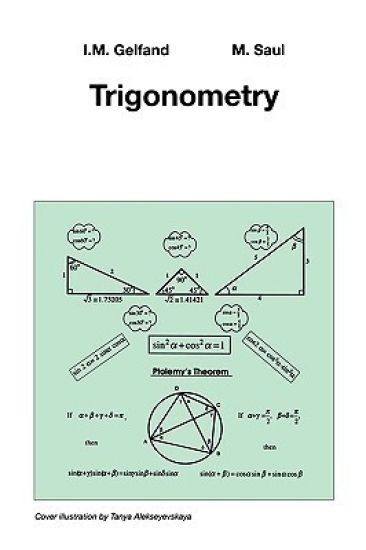
In a sense, trigonometry sits at the center of high school mathematics. It originates in the study of geometry when we investigate the ratios of sides in similar right triangles, or when we look at the relationship between a chord of a circle and its arc. It leads to a much deeper study of periodic functions, and of the so-called transcendental functions, which cannot be described using finite algebraic processes. It also has many applications to physics, astronomy, and other branches of science. It is a very old subject. Many of the geometric results that we now state in trigonometric terms were given a purely geometric exposition by Euclid. Ptolemy, an early astronomer, began to go beyond Euclid, using the geometry of the time to construct what we now call tables of values of trigonometric functions. Trigonometry is an important introduction to calculus, where one stud­ ies what mathematicians call analytic properties of functions. One of the goals of this book is to prepare you for a course in calculus by directing your attention away from particular values of a function to a study of the function as an object in itself. This way of thinking is useful not just in calculus, but in many mathematical situations. So trigonometry is a part of pre-calculus, and is related to other pre-calculus topics, such as exponential and logarithmic functions, and complex numbers.