Kirjojen hintavertailu. Mukana 12 595 353 kirjaa ja 12 kauppaa.
Kirjailija
Mark van Atten
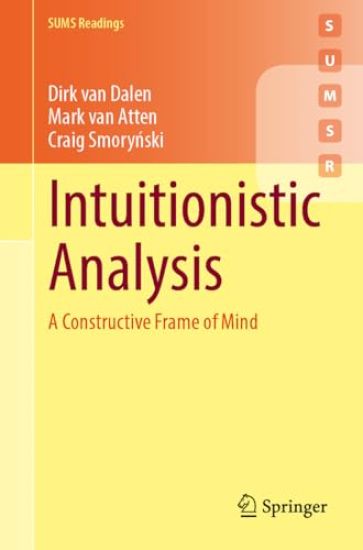
Kirjat ja teokset yhdessä paikassa: 5 kirjaa, julkaisuja vuosilta 2006-2026, suosituimpien joukossa Intuitionistic Analysis. Vertaile teosten hintoja ja tarkista saatavuus suomalaisista kirjakaupoista.
This volume tackles Gödel's two-stage project of first using Husserl's transcendental phenomenology to reconstruct and develop Leibniz' monadology, and then founding classical mathematics on the metaphysics thus obtained. The author analyses the historical and systematic aspects of that project, and then evaluates it, with an emphasis on the second stage.The book is organised around Gödel's use of Leibniz, Husserl and Brouwer. Far from considering past philosophers irrelevant to actual systematic concerns, Gödel embraced the use of historical authors to frame his own philosophical perspective. The philosophies of Leibniz and Husserl define his project, while Brouwer's intuitionism is its principal foil: the close affinities between phenomenology and intuitionism set the bar for Gödel's attempt to go far beyond intuitionism.The four central essays are `Monads and sets', `On the philosophical development of Kurt Gödel', `Gödel and intuitionism', and `Construction and constitution in mathematics'. The first analyses and criticises Gödel's attempt to justify, by an argument from analogy with the monadology, the reflection principle in set theory. It also provides further support for Gödel's idea that the monadology needs to be reconstructed phenomenologically, by showing that the unsupplemented monadology is not able to found mathematics directly. The second studies Gödel's reading of Husserl, its relation to Leibniz' monadology, and its influence on his published writings. The third discusses how on various occasions Brouwer's intuitionism actually inspired Gödel's work, in particular the Dialectica Interpretation. The fourth addresses the question whether classical mathematics admits of the phenomenological foundation that Gödel envisaged, and concludes that it does not.The remaining essays provide further context. The essays collected here were written and published over the last decade. Notes have been added to record further thoughts, changes of mind, connections between the essays, and updates of references.
This volume tackles Gödel's two-stage project of first using Husserl's transcendental phenomenology to reconstruct and develop Leibniz' monadology, and then founding classical mathematics on the metaphysics thus obtained. The author analyses the historical and systematic aspects of that project, and then evaluates it, with an emphasis on the second stage.The book is organised around Gödel's use of Leibniz, Husserl and Brouwer. Far from considering past philosophers irrelevant to actual systematic concerns, Gödel embraced the use of historical authors to frame his own philosophical perspective. The philosophies of Leibniz and Husserl define his project, while Brouwer's intuitionism is its principal foil: the close affinities between phenomenology and intuitionism set the bar for Gödel's attempt to go far beyond intuitionism.The four central essays are `Monads and sets', `On the philosophical development of Kurt Gödel', `Gödel and intuitionism', and `Construction and constitution in mathematics'. The first analyses and criticises Gödel's attempt to justify, by an argument from analogy with the monadology, the reflection principle in set theory. It also provides further support for Gödel's idea that the monadology needs to be reconstructed phenomenologically, by showing that the unsupplemented monadology is not able to found mathematics directly. The second studies Gödel's reading of Husserl, its relation to Leibniz' monadology, and its influence on his published writings. The third discusses how on various occasions Brouwer's intuitionism actually inspired Gödel's work, in particular the Dialectica Interpretation. The fourth addresses the question whether classical mathematics admits of the phenomenological foundation that Gödel envisaged, and concludes that it does not.The remaining essays provide further context. The essays collected here were written and published over the last decade. Notes have been added to record further thoughts, changes of mind, connections between the essays, and updates of references.
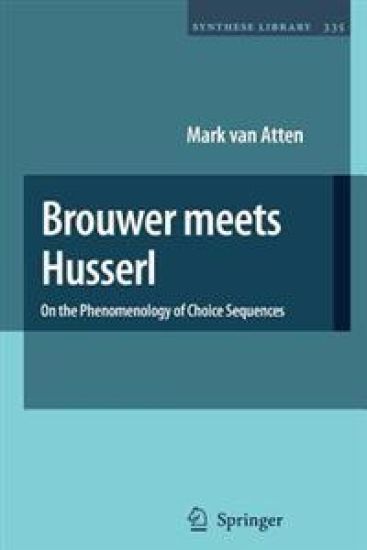
Can the straight line be analysed mathematically such that it does not fall apart into a set of discrete points, as is usually done but through which its fundamental continuity is lost? And are there objects of pure mathematics that can change through time? Mathematician and philosopher L.E.J. Brouwer argued that the two questions are closely related and that the answer to both is "yes''. To this end he introduced a new kind of object into mathematics, the choice sequence. But other mathematicians and philosophers have been voicing objections to choice sequences from the start. This book aims to provide a sound philosophical basis for Brouwer's choice sequences by subjecting them to a phenomenological critique in the style of the later Husserl.
Can the straight line be analysed mathematically such that it does not fall apart into a set of discrete points, as is usually done but through which its fundamental continuity is lost? And are there objects of pure mathematics that can change through time? Mathematician and philosopher L.E.J. Brouwer argued that the two questions are closely related and that the answer to both is "yes''. To this end he introduced a new kind of object into mathematics, the choice sequence. But other mathematicians and philosophers have been voicing objections to choice sequences from the start. This book aims to provide a sound philosophical basis for Brouwer's choice sequences by subjecting them to a phenomenological critique in the style of the later Husserl.