Kirjojen hintavertailu. Mukana 12 390 323 kirjaa ja 12 kauppaa.

Kirjailija

Mark Wigley

Kirjat ja teokset yhdessä paikassa: 12 kirjaa, julkaisuja vuosilta 2001-2025, suosituimpien joukossa Histories in Conflict: The Haus der Kunst and the Ideological Uses of Art, 1937-1955. Vertaile teosten hintoja ja tarkista saatavuus suomalaisista kirjakaupoista.

12 kirjaa

Kirjojen julkaisuhaarukka 2001-2025.

In Praise of Bacteria

In Praise of Bacteria

Beatriz Colomina; Mark Wigley

LARS MULLER PUBLISHERS
2025
nidottu
The sequel to the authors’ Are We Human?, this provocative book is an urgent manifesto for an alternative architectural philosophy. It treats bacteria as the real architects, construction workers, maintenance crews and inhabitants of buildings. Colomina and Wigley draw on the latest research into microbes to rethink the past and possible futures of the built environment. The book explores the intimate entanglements of the microbes within bodies and buildings over the last 10,000 years, culminating in the antibiotic philosophy of contemporary architecture. The diseases of our time are diseases of the built environment. The deadly combination of rapidly declining microbial diversity and rising antibiotic-resistant bacteria is as great a threat as climate change. Hostility to bacteria has to give way to new forms of hospitality from a more symbiotic architecture that learns from bacteria, embracing them and reconnecting with soil, plants and other species. Buildings based on fear of bacteria, which is to say fear of life itself, must give way to buildings learning from models of coexistence based on bacteria themselves.The main goal of the book is to rethink the very idea of shelter in terms of forms of inclusion rather than prophylactic forms of exclusion.
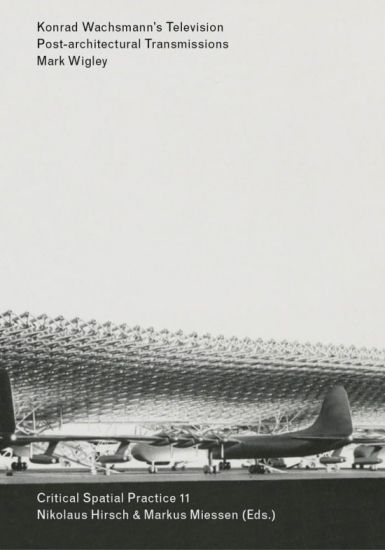
Konrad Wachsmann's Television

Konrad Wachsmann's Television

Mark Wigley

Sternberg Press
2020
pokkari
A novel reading of the work of one of the most influential designers of the twentieth century. In this provocative intellectual biography, architectural historian Mark Wigley makes the surprising claim that the thinking behind modernist architect Konrad Wachsmann's legendary projects was dominated by the idea of television. Investigating the archives of one of the most influential designers of the twentieth century, Wigley scrutinizes Wachsmann's design, research, and teaching, closely reading a succession of unseen drawings, models, photographs, correspondence, publications, syllabi, reports, and manuscripts to argue that Wachsmann is an anti-architect--a student of some of the most influential designers of the 1920s who dedicated thirty-five post-Second World War years to the disappearance of architecture. Wachsmann turned architecture against itself. His hypnotic projects for a new kind of space were organized around the thought that television enables a different way of living together. While architecture is typically embarrassed by television, preferring to act as if it never happened, Wachsmann fully embraced it. He dissolved buildings into pulsating mirages that influenced the experimental avant-gardes of the 1960s and 1970s; but Wigley demonstrates that this work was even more extreme than the experiments it inspired. Wigley's forensic analysis of a career shows that Wachsmann developed one of the most compelling manifestos of what architecture would need to become in the age of ubiquitous electronics.
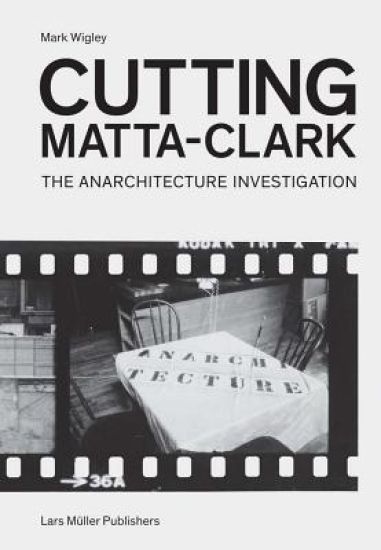
Cutting Matta-Clark

Cutting Matta-Clark

Mark Wigley

Lars Muller Publishers
2018
nidottu
Of the many shows at the fabled 112 Greene Street gallery--an artistic epicenter of New York's downtown scene in the 1970s--the Anarchitecture group show of March 1974 has been the subject of the most enduring discussion, despite a complete lack of documentation about it. Anarchitecture has become a foundational myth, but one that remains to be properly understood. Stemming from a series of meetings organized by Gordon Matta-Clark and refl ecting his long-standing interest in architecture, the Anarchitecture exhibition was conceived as an anonymous group statement in photographs about the intersection of art and building. But did it actually happen? It exists only through oblique archival traces and the memories of the participants. Cutting Matta-Clark investigates the Anarchitecture group as a kind of collective research seminar, through extensive interviews with the protagonists and a dossier of all the available evidence.The dossier includes a collection of Matta-Clark's aphoristic "art cards," the 96 photographs that were produced by the various participants for possible inclusion in the exhibition, and images from a recently unearthed video of Matta-Clark's now famous bus trip to see Splitting in Englewood, New Jersey.
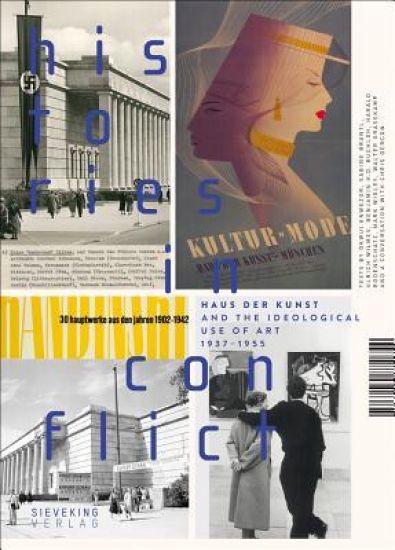
Histories in Conflict: The Haus der Kunst and the Ideological Uses of Art, 1937-1955

Histories in Conflict: The Haus der Kunst and the Ideological Uses of Art, 1937-1955

Sabine Branti; Harald Bodenschatz; Benjamin H. D. Buchloh; Chris Dercon; Okwui Enwezor; Walter Grasskamp; Mark Wigley; Ulrich Wilmes

Sieveking Verlag
2017
nidottu
For the Haus der Kunst in Munich, the question of how to deal with its own past arose directly after the end of the Second World War, when the building once again served as an exhibition space . This richly illustrated volume spans the key historical dates during which a social and political development took place, at whose beginning stood the ideology of the National Socialists and whose end marked the start of Germany's transformation into a democratic state. In this time period, it was not only the orientation of the Haus der Kunst's content that changed; as a result of the cultural-historical upheavals of this time, the basis for the building's development as an international exhibition venue was also laid. Today the Haus der Kunst plays a formative role in the discussion of relevant positions in contemporary art. It documents the historical developments within the context of political and cultural transformations, as well as their international parallels and references. Large exhibitions that were influential for the topography of the art of the twentieth century such as the World Exposition in Paris in 1937, the biennials in Venice, and the first documenta in 1955 provide the coordinates for the international dimension of the Haus der Kunst's story.
Are We Human?

Are We Human?

Beatriz Colomina; Mark Wigley

Lars Muller Publishers
2016
nidottu
Are We Human? rethinks the philosophy of design in a multi-dimensional exploration from the very first tools and ornaments to the constant buzz of social media. The average day involves the experience of thousands of layers of design that reach to outside space but also reach deep into our bodies and brains. Even the planet itself has been completely encrusted by design as a geological layer. There is no longer an outside to the world of design. Design has become the world. Design is what makes the human. It is the very basis of social life. But design also engineers inequalities and new forms of neglect, such as lawlessness, poverty, and the climate at the same time as the human genome and the weather are being actively redesigned. We can no longer reassure ourselves with the idea of "good design." Design itself needs to be redesigned.
Buckminster Fuller Inc

Buckminster Fuller Inc

Mark Wigley

Lars Muller Publishers
2015
nidottu
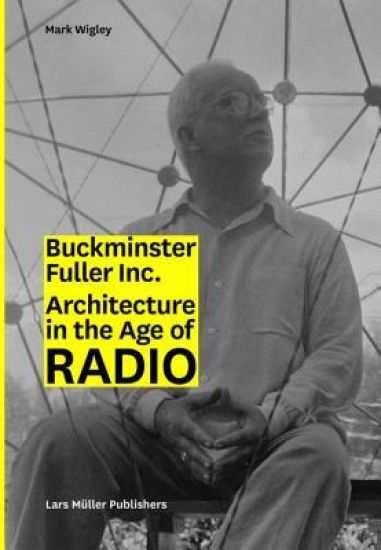
Bucky Inc. offers a deep exploration of Richard Buckminster Fuller's work and thought to shed new light on the questions raised by our increasingly electronic world. It shows that Fuller's entire career was a multi-dimensional reflection on the architecture of radio. He always insisted that the real site of architecture is the electromagnetic spectrum. His buildings were delicate mobile instruments for accessing the invisible universe of overlapping signals. Every detail was understood as a way of tuning into hidden waves. Architecture was built in, with, for and as radio. Bucky Inc. rethinks the legacy of one of the key protagonists of the twentieth-century. It draws extensively on Fuller's archive to follow his radical thinking from toilets to telepathy, plastic to prosthetics, and data to deep-space. It shows how the critical arguments and material techniques of arguably the single most exposed designer of the last century were overlooked at the time but have become urgently relevant today.
Eisenman/Wigley

Eisenman/Wigley

Victor Eisenman; Mark Wigley; Peter Eisenman

GSAPP Books
2014
nidottu
Beginning in 2003, Mark Wigley and Peter Eisenman sat down each summer with an audience of students to debate issues pertinent to contemporary architecture practice and education. This publication compiles all ten years of the debates and presents them a single edited volume. The discussions were wide-ranging, tackling issues from pedagogy to image production and from architectural style to architecture's place within culture. The cast of characters they invoked was equally expansive--Manfredo Tafuri and Colin Rowe, of course, and a host of historical and contemporary architects (alongside cultural figures like Thomas Pynchon and Steven Colbert). Although often trenchant in their points of disagreement, these debates are marked by a sense of levity and mutual respect as Eisenman and Wigley explore deeply held theoretical concerns and a series of questions about the future of the architectural discipline.
Preservation is Overtaking Us

Preservation is Overtaking Us

Rem Koolhaas; Jorge Otero–pailos; Jordan Carver; Mark Wigley

Columbia Books on Architecture and the City
2014
nidottu
Preservation is Overtaking Us brings together two lectures given by Rem Koolhaas at Columbia University's Graduate School of Architecture, Planning and Preservation, along with a response (framed as a supplement to the original lectures) by Jorge Otero-Pailos. In the first essay Koolhaas describes alternative strategies for preserving Beijing, China. The second talk marks the inaugural Paul Spencer Byard lecture, named in celebration of the longtime professor of Historic Preservation at GSAPP. These two lectures trace key moments of Koolhaas' thinking on preservation, including his practice's entry into China and the commission to redevelop the State Hermitage Museum in St. Petersburg, Russia. In a format well known to Koolhaas' readers, Otero-Pailos reworks the lectures into a working manifesto, using it to interrogate OMA's work from within the discipline of preservation.
Dan Graham's New Jersey

Dan Graham's New Jersey

Mark Wigley; Mark Wasiuta

Lars Muller Publishers
2011
sidottu
Dan Graham, one of America's most important contemporary artists, is best known today for his sculptural works and installations. His photographic works are generally not so well known, despite the fact that he first became famous for his photographic series, Homes for America, pictures of typical American suburbia. To this day the theme of architecture and its surfaces represents an extremely important facet of his work, as does the question of what role it plays in postmodern society and in the context of everyday culture. This publication presents new photographs by Dan Graham, taken in the context of a study trip with the architecture faculty of Columbia University, together with a selection of original photographs from the Homes for America series. The new images exhibit stark similarities to the old pictures, because they were taken in the same locations, in the same deserts of suburban streets and housing that Graham had photographed in the 1960s. This creates a fascinating reference system of repetitions and differences, in terms of both the temporal and the spatial, that asks questions of the viewer about architecture, public space, and their function in society.
Thyssen-Bornemisza Art Contemporary

Thyssen-Bornemisza Art Contemporary

Mark Wigley; Elke Krasny; Andreas Schlaegel

Buchhandlung Walther Konig GmbH Co. KG. Abt. Verlag
2008
sidottu
In the 1920s, the Thyssen-Bornemisza family began amassing an art collection which now comprises almost 1,000 works, from the thirteenth century through the close of the twentieth. Herein, works from Madrid's Thyssen-Bornemisza Museum--with works by Holbein, Titian, Rembrandt, Monet, Picasso, Hopper and others.
White Walls, Designer Dresses

White Walls, Designer Dresses

Mark Wigley

MIT Press
2001
pokkari
In a daring revisionist history of modern architecture, Mark Wigley opens up a new understanding of the historical avant-garde. He explores the most obvious, but least discussed, feature of modern architecture: white walls. Although the white wall exemplifies the stripping away of the decorative masquerade costumes worn by nineteenth-century buildings, Wigley argues that modern buildings are not naked. The white wall is itself a form of clothing-the newly athletic body of the building, like that of its occupants, wears a new kind of garment and these garments are meant to match. Not only did almost all modern architects literally design dresses, Wigley points out, their arguments for a modern architecture were taken from the logic of clothing reform. Architecture was understood as a form of dress design.Wigley follows the trajectory of this key subtext by closely reading the statements and designs of most of the protagonists, demonstrating that it renders modern architecture's relationship with the psychosexual economy of fashion much more ambiguous than the architects' endlessly repeated rejections of fashion would suggest. Indeed, Wigley asserts, the very intensity of these rejections is a symptom of how deeply they are embedded in the world of clothing. By drawing on arguments about the relationship between clothing and architecture first formulated in the middle of the nineteenth century, modern architects in fact presented a sophisticated theory of the surface, modernizing architecture by transforming the status of the surface.White Walls, Designer Dresses shows how this seemingly incidental clothing logic actually organizes the detailed design of the modern building, dictating a system of polychromy, understood as a multicolored outfit. The familiar image of modern architecture as white turns out to be the effect of a historiographical tradition that has worked hard to suppress the color of the surfaces of the buildings that it describes. Wigley analyzes this suppression in terms of the sexual logic that invariably accompanies discussions of clothing and color, recovering those sensuously colored surfaces and the extraordinary arguments about clothing that were used to defend them.