Kirjojen hintavertailu. Mukana 12 387 977 kirjaa ja 12 kauppaa.

Kirjailija

Mark Wormald

Kirjat ja teokset yhdessä paikassa: 3 kirjaa, julkaisuja vuosilta 2001-2023, suosituimpien joukossa Physical Chemistry for the Life Sciences. Vertaile teosten hintoja ja tarkista saatavuus suomalaisista kirjakaupoista.

3 kirjaa

Kirjojen julkaisuhaarukka 2001-2023.

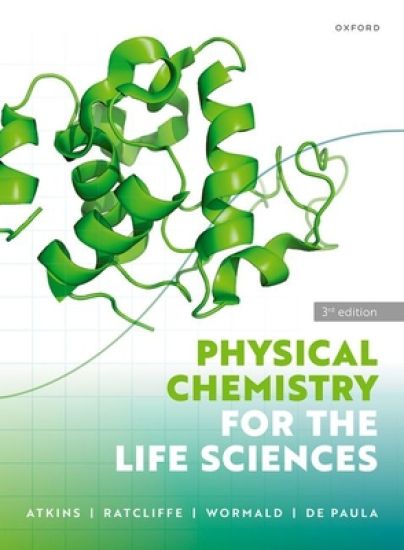
Physical Chemistry for the Life Sciences

Physical Chemistry for the Life Sciences

Peter Atkins; R. George Ratcliffe; Mark Wormald; Julio de Paula

Oxford University Press
2023
nidottu
Molecular assemblies, macromolecules, proteins, nucleic acids: they form a substantial part of all living organisms, from plants to humans. Indeed, they are critical for keeping them alive. But how do they operate? Chemical processes are at the core of life: understanding life means unveiling the physical principles on which it is built. From thermodynamics to molecular interactions, Physical Chemistry for the Life Sciences 3rd edition explains how the principles of physical chemistry apply to the processes of life. Offering worked examples and multiple case studies throughout, students are supported to master even the most complex concepts and how they apply in biological contexts, while acquiring key problem-solving and mathematical skills. Directly addressing the main challenges faced by students, its pedagogically rich approach provides an accessible and holistic guide The extended scope of this new edition includes the essential techniques that can be used to characterize biological systems, including biochemical spectroscopy, x-ray diffraction, and spectrometry.
The Catch

The Catch

Mark Wormald

BLOOMSBURY PUBLISHING PLC
2023
nidottu
‘An absolute gem . . . I was delightfully lost by the river throughout’ Paul Whitehouse‘Marvellous . . . The Catch leaves both its writer and its reader wonderfully "lost in water"’ Robert Macfarlane‘Penetrating and poetic, filled with honeyed prose and thoughtful criticism’ The TimesA brilliant blend of memoir and biography, The Catch is a stunning meditation on poetry and nature, and a quiet reflection on what it means to be a father and a son._______________It is in the midst of a swirling river, casting a line, that Mark Wormald meets Ted Hughes. He stands where the poet stood, forty years ago, because fishing was Ted Hughes’s way of breathing – and because the poet's writing has made Mark understand that it has always been his way of breathing, too.Using Hughes’s poetry collection River and his fishing diaries as a guide, Mark returns again and again to the rivers and lakes in Britain and Ireland where the poet fished. At times, he uses Ted's fly patterns; at others his rods. It is an obsession; a fundamental connection to nature; a thrilling wildness; an elemental pursuit. But it is also a release and a consolation, as Mark fishes after the sudden death of his mother and during the slow fading of his father.
Principles and Problems in Physical Chemistry for Biochemists

Principles and Problems in Physical Chemistry for Biochemists

Nicholas C. Price; Raymond A. Dwek; R. G. Ratcliffe; Mark Wormald

Oxford University Press
2001
nidottu
What use is physical chemistry to the student of biochemistry and biology? This central question is answered in this book mainly through the use of worked examples and problems. The book starts by introducing the laws of thermodynamics, and then uses these laws to derive the equations relevant to the student in dealing with chemical equilibria (including the binding of small molecules to proteins), properties of solutions, acids and bases, and oxidation-reduction processes. The student is thus shown how a knowledge of thermodynamic qualities makes it possible to predict whether, and how, a reaction will proceed. Thermodynamics, however, gives no information about how fast a reaction will happen. The study of the rates at which processes occur (kinetics) forms the second main theme of the book. This section poses and answers questions such as `how is the rate of a reaction affected by temperature, pH, ionic strength, and the nature of the reactants? These same ideas are then shown to be useful in the study of enzyme-catalysed reactions.