Kirjojen hintavertailu. Mukana 12 595 353 kirjaa ja 12 kauppaa.

Kirjailija

Marlan O. Scully

Kirjat ja teokset yhdessä paikassa: 4 kirjaa, julkaisuja vuosilta 1974-2019, suosituimpien joukossa Laser Physics. Vertaile teosten hintoja ja tarkista saatavuus suomalaisista kirjakaupoista.

4 kirjaa

Kirjojen julkaisuhaarukka 1974-2019.

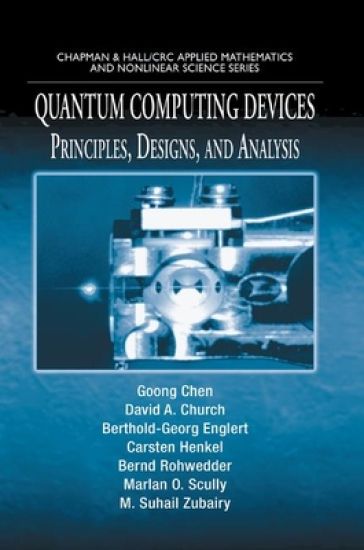
Quantum Computing Devices

Quantum Computing Devices

Goong Chen; David A. Church; Berthold-Georg Englert; Carsten Henkel; Bernd Rohwedder; Marlan O. Scully; M. Suhail Zubairy

CRC Press
2019
nidottu
One of the first books to thoroughly examine the subject, Quantum Computing Devices: Principles, Designs, and Analysis covers the essential components in the design of a "real" quantum computer. It explores contemporary and important aspects of quantum computation, particularly focusing on the role of quantum electronic devices as quantum gates. Largely self-contained and written in a tutorial style, this reference presents the analysis, design, and modeling of the major types of quantum computing devices: ion traps, cavity quantum electrodynamics (QED), linear optics, quantum dots, nuclear magnetic resonance (NMR), superconducting quantum interference devices (SQUID), and neutral atom traps. It begins by explaining the fundamentals and algorithms of quantum computing, followed by the operations and formalisms of quantum systems. For each electronic device, the subsequent chapters discuss physical properties, the setup of qubits, control actions that produce the quantum gates that are universal for quantum computing, relevant measurements, and decoherence properties of the systems. The book also includes tables, diagrams, and figures that illustrate various data, uses, and designs of quantum computing. As nanoelectronics will inevitably replace microelectronics, the development of quantum information science and quantum computing technology is imperative to the future of information science and technology. Quantum Computing Devices: Principles, Designs, and Analysis helps fulfill this need by providing a comprehensive collection of the most promising devices for the future.
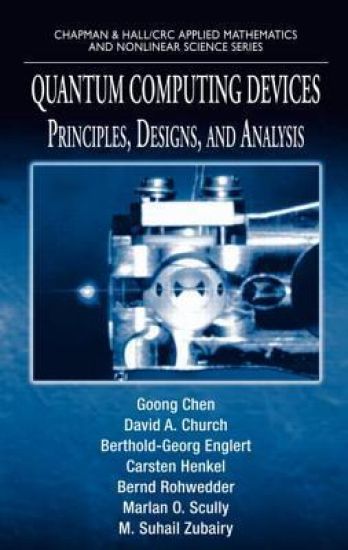
Quantum Computing Devices

Quantum Computing Devices

Goong Chen; David A. Church; Berthold-Georg Englert; Carsten Henkel; Bernd Rohwedder; Marlan O. Scully; M. Suhail Zubairy

Chapman Hall/CRC
2006
sidottu
One of the first books to thoroughly examine the subject, Quantum Computing Devices: Principles, Designs, and Analysis covers the essential components in the design of a "real" quantum computer. It explores contemporary and important aspects of quantum computation, particularly focusing on the role of quantum electronic devices as quantum gates. Largely self-contained and written in a tutorial style, this reference presents the analysis, design, and modeling of the major types of quantum computing devices: ion traps, cavity quantum electrodynamics (QED), linear optics, quantum dots, nuclear magnetic resonance (NMR), superconducting quantum interference devices (SQUID), and neutral atom traps. It begins by explaining the fundamentals and algorithms of quantum computing, followed by the operations and formalisms of quantum systems. For each electronic device, the subsequent chapters discuss physical properties, the setup of qubits, control actions that produce the quantum gates that are universal for quantum computing, relevant measurements, and decoherence properties of the systems. The book also includes tables, diagrams, and figures that illustrate various data, uses, and designs of quantum computing. As nanoelectronics will inevitably replace microelectronics, the development of quantum information science and quantum computing technology is imperative to the future of information science and technology. Quantum Computing Devices: Principles, Designs, and Analysis helps fulfill this need by providing a comprehensive collection of the most promising devices for the future.
Quantum Optics

Quantum Optics

Marlan O. Scully; M. Suhail Zubairy

Cambridge University Press
1997
pokkari
The field of quantum optics has witnessed significant theoretical and experimental developments in recent years. This book provides an in-depth and wide-ranging introduction to the subject, emphasising throughout the basic principles and their applications. The book begins by developing the basic tools of quantum optics, and goes on to show the application of these tools in a variety of quantum optical systems, including lasing without inversion, squeezed states and atom optics. The final four chapters are devoted to a discussion of quantum optical tests of the foundations of quantum mechanics, and to particular aspects of measurement theory. Assuming only a background of standard quantum mechanics and electromagnetic theory, and containing many problems and references, this book will be invaluable to graduate students of quantum optics, as well as to researchers in this field.
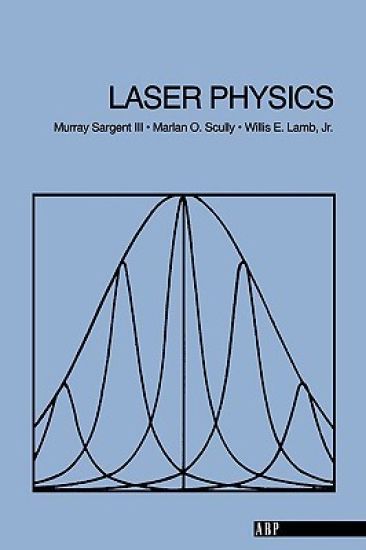
Laser Physics

Laser Physics

Murray Sargent; Iii Sargent; Marlan O. Scully; Willis E. Jr. Lamb

Westview Press Inc
1974
nidottu
This book treats the interaction of radiation with matter, particular attention being paid to the laser. Knowledge is assumed of the usual half-year introduction of quantum mechanics found in undergraduate physics curricula. The material can be covered in two semesters, or, alternatively, the first part (Chaps 1-13) can be used as a one-semester course in which quantum mechanical aspects of the electromagnetic field are ignored. Each chapter is accompanied by problems that illustrate the text and give useful (occasionally new) results. Existing laser media are intrinsically quantum mechanical and are most easily studied with the quantum theory. Understanding the laser along these lines enlivens one's understanding of quantum mechanics itself. In fact, the material constitutes a viable, applied alternative for the usual second and third semesters of quantum mechanics.