Kirjojen hintavertailu. Mukana 12 427 697 kirjaa ja 12 kauppaa.

Kirjailija

Marsilio Ficino

Kirjat ja teokset yhdessä paikassa: 32 kirjaa, julkaisuja vuosilta 1999-2026, suosituimpien joukossa Platonis Et Quae Vel Platonis Esse Feruntur Vel Platonica Solent Comitari Scripta Graece Omnia Ad Codices Manuscriptos. Vertaile teosten hintoja ja tarkista saatavuus suomalaisista kirjakaupoista.

32 kirjaa

Kirjojen julkaisuhaarukka 1999-2026.

Commentary on Plotinus

Commentary on Plotinus

Marsilio Ficino

HARVARD UNIVERSITY PRESS
2026
sidottu
Marsilio Ficino (1433–1499) was the leading Platonic philosopher of the Renaissance and is generally recognized as the greatest authority on ancient Platonism before modern times. Among his greatest accomplishments as a scholar was his 1492 Latin translation of the complete works of Plotinus (204–270 CE), the founder of Neoplatonism. The 1492 edition also contained an immense commentary that remained for centuries the principle introduction to Plotinus’s works for Western scholars. At the same time, it constitutes a major statement of Ficino’s own late metaphysics. The I Tatti edition, planned in six volumes, contains the first modern edition of the Latin text and the first translation into any modern language. The present volume also contains a summary of Ficino’s argumentation in the commentary on Plotinus’ First Ennead.
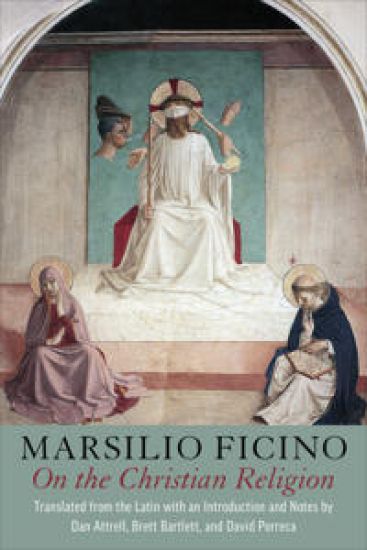
On the Christian Religion

On the Christian Religion

Marsilio Ficino

UNIVERSITY OF TORONTO PRESS
2022
sidottu
This is the first translation into English of Marsilio Ficino’s De Christiana religione, a text first written in Latin in 1474, the year after its author’s ordination in the Roman Catholic Church. On the Christian Religion is this Florentine humanist’s attempt to lay out the history of the religion of Christ, the Logos ("Word" or "Reason"), in accordance with the doctrines of ancient philosophy. The work –focuses on how Christ in his pre-incarnate form was revealed as much to certain ancient pagan sages and prophets as to those of the Old Testament, and how both groups played an equal role in foreshadowing the ultimate fulfilment of all the world’s religions in Christianity. The first part elucidates the history of the prisca theologia – the ancient theology – a single natural religion shared by the likes of Zoroaster, Hermes Trismegistus, Orpheus, Aglaophemus, Pythagoras, and Plato, and how it was fulfilled by Christ’s Incarnation and the spread of his Church through his apostles. The second part of the work, however, constitutes a series of attacks against the ways in which the books of the Old Testament were variously interpreted by Islamic and, more importantly, Jewish sages who threatened Ficino’s own Christological interpretations of Scripture. This new English translation includes an introduction that situates the text within the broader scope of Ficino’s intellectual activity and historical context. The book allows us to encounter a more nuanced image of Ficino, that of him as a theologian, historian, and anti-Jewish, anti-Islamic, anti-pagan polemicist.
Commentary on Plotinus, Volume 5

Commentary on Plotinus, Volume 5

Marsilio Ficino

Harvard University Press
2018
sidottu
Marsilio Ficino (1433-1499) was the leading Platonic philosopher of the Renaissance and is generally recognized as the greatest authority on ancient Platonism before modern times. Among his finest accomplishments as a scholar was his 1492 Latin translation of the complete works of Plotinus (204-270 CE), the founder of Neoplatonism. The 1492 edition also contained an immense commentary that remained for centuries the principle introduction to Plotinus's works for Western scholars. At the same time, it constitutes a major statement of Ficino's own late metaphysics. The I Tatti edition, planned in six volumes, contains the first modern edition of the Latin text and the first translation into any modern language. The present volume also includes a substantial analytical study of Ficino's interpretation of Plotinus' Fourth Ennead.
Commentary on Plotinus

Commentary on Plotinus

Marsilio Ficino

Harvard University Press
2017
sidottu
Marsilio Ficino (1433–1499) was the leading Platonic philosopher of the Renaissance and is generally recognized as the greatest authority on ancient Platonism before modern times. Among his greatest accomplishments as a scholar was his 1492 Latin translation of the complete works of Plotinus (204–270 CE), the founder of Neoplatonism. The 1492 edition also contained an immense commentary that remained for centuries the principle introduction to Plotinus’s works for Western scholars. At the same time, it constitutes a major statement of Ficino’s own late metaphysics. The I Tatti edition, planned in six volumes, contains the first modern edition of the Latin text and the first translation into any modern language. The present volume also contains an extensive analytical study of Ficino’s interpretation of Plotinus’s Third Ennead.
De amore

De amore

Marsilio Ficino

Vidarforlaget
2015
sidottu
Det foreliggende skriftet Om kjærligheten (De amore), datert 1469, var opprinnelig tenkt som en kommentar til Platons Symposion, Drikkegildet i Athen fra 380-årene f.Kr. - en hyllest til kjærlighetsguden Eros, med det skjønne og det gode som det sant guddommelige. Platon hadde som alltid, gitt sitt filosofiske verk en dialogisk form - her: taler holdt ved et drikkelag. Ficino lar i likhet med Platon «kommentaren» bestå av taler ved en sammenkomst, i dette tilfelle på Platons fødsels- og dødsdag den syvende november. En årlig feiring som takket være Lorenzo il Magnifico ble gjenopptatt i 1468 etter et avbrekk på tolvhundre år. Det var Lorenzos farfar, den gamle Cosimo av Medici som hadde gitt Ficino i oppdrag å oversette alle Platons dialoger til latin. De amore ble så til som et selvstendig verk for å utfylle oversettelsen og presentere en spesiell form for platonisme. Her finner vi en videreutvikling av Platon i retning av en altomfattende filosofisk-teologisk synkretisme. Ficinos kjennskap til antikke diktere og filosofer preger fremstillingen. Dialogens deltagere var kjente personer i Ficinos samtid og behandler temaet kjærligheten fra forskjellige vinkler. Senere oversatte Ficino selv De amore til sitt morsmål italiensk, dvs. toskansk. For å aktualisere Ficinos kjærlighetsfilosofi, er det som innledning tatt med et bidrag fra den norske platoniker Aasmund Brynildsen fra 1973, i tillegg til en innledning ved redaktøren for bokserien om renessansens filosofer, Tore Frost.
On Dionysius the Areopagite

On Dionysius the Areopagite

Marsilio Ficino

Harvard University Press
2015
sidottu
In 1490/92 Marsilio Ficino, the Florentine scholar-philosopher-magus who was largely responsible for the Renaissance revival of Plato, made new translations of, with running commentaries on, two treatises he believed were the work of Dionysius the Areopagite, the disciple of St. Paul mentioned in the Acts of the Apostles. His aim was to show how these two treatises (in fact the achievement of a sixth-century Christian follower of the Neoplatonist Proclus) had inspired pagan thinkers in the later Platonic tradition like Plotinus and Iamblichus. These major products of fifteenth-century Christian Platonism are here presented in new critical editions accompanied by English translations, the first into any modern language.
On Dionysius the Areopagite

On Dionysius the Areopagite

Marsilio Ficino

Harvard University Press
2015
sidottu
In 1490/92 Marsilio Ficino, the Florentine scholar-philosopher-magus who was largely responsible for the Renaissance revival of Plato, made new translations of, with running commentaries on, two treatises he believed were the work of Dionysius the Areopagite, the disciple of St. Paul mentioned in the Acts of the Apostles. His aim was to show how these two treatises (in fact the achievement of a sixth-century Christian follower of the Neoplatonist Proclus) had inspired pagan thinkers in the later Platonic tradition like Plotinus and Iamblichus. These major products of fifteenth-century Christian Platonism are here presented in new critical editions accompanied by English translations, the first into any modern language.
Commentaries on Plato

Commentaries on Plato

Marsilio Ficino

Harvard University Press
2012
sidottu
Marsilio Ficino (1433–1499), the Florentine scholar-philosopher-magus, was largely responsible for the Renaissance revival of Plato. Ficino’s commentaries on Plato remained the standard guide to the Greek philosopher’s works for centuries. Vanhaelen’s new translation of Ficino’s vast commentary on the Parmenides makes this monument of Renaissance metaphysics accessible to the modern student of philosophy.The volume contains the first critical edition of the Latin text, an ample introduction, and extensive notes.
Commentaries on Plato

Commentaries on Plato

Marsilio Ficino

Harvard University Press
2012
sidottu
Marsilio Ficino (1433–1499), the Florentine scholar-philosopher-magus, was largely responsible for the Renaissance revival of Plato. Ficino’s commentaries on Plato remained the standard guide to the Greek philosopher’s works for centuries. Vanhaelen’s new translation of Ficino’s vast commentary on the Parmenides makes this monument of Renaissance metaphysics accessible to the modern student of philosophy.The volume contains the first critical edition of the Latin text, an ample introduction, and extensive notes.