Kirjojen hintavertailu. Mukana 12 501 523 kirjaa ja 12 kauppaa.

Kirjailija

Marta Dziewanska

Kirjat ja teokset yhdessä paikassa: 8 kirjaa, julkaisuja vuosilta 2011-2019, suosituimpien joukossa Andrzej Wróblewski: Recto / Verso. Vertaile teosten hintoja ja tarkista saatavuus suomalaisista kirjakaupoista.

8 kirjaa

Kirjojen julkaisuhaarukka 2011-2019.

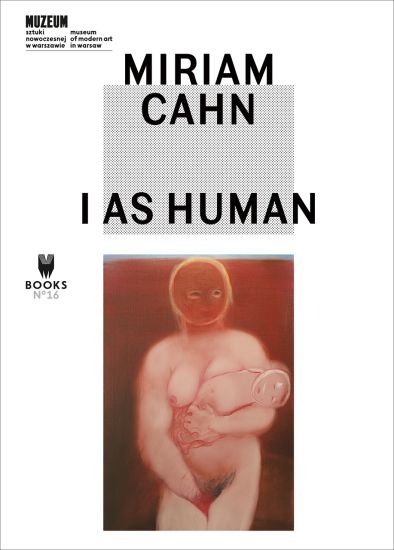
Miriam Cahn – I As Human

Miriam Cahn – I As Human

Marta Dziewanska; Kathleen Bühler; Adam Szymczyk; Éric De Chassey; Paul B. Preciado; Paul Preciado; Élisabeth Lebovici; Anna Ara; Fernando López Garcia

Museum of Modern Art in Warsaw
2019
nidottu
A rebel and feminist, the Switzerland-born Miriam Cahn is one of the major artists of her generation. Widely known for her drawings and paintings, she also experiments with photography, moving images, sculptures, and performance art. Cahn’s diverse body of work is disturbing and dreamlike, filled with striking human figures pulsing with an energy both passionate and violent. These pieces, along with Cahn’s reflections on artistic expression, have always responded to her contemporary moment. In the 1980s, her work addressed the feminist, peace, and environmental movements, while the work she produced in the 1990s and early 2000s contains allusions to the war in the former Yugoslavia, the conflict in the Middle East, and the September 11 terrorist attacks. Her recent production tackles ever-evolving political conflicts, engaging with the European refugee crisis and the “#metoo” movement.Miriam Cahn: I as Human examines different facets of the artist’s prolific and troubling oeuvre, featuring contributions from art historians, critics, and philosophers including Kathleen Bühler, Paul B. Preciado, Elisabeth Lebovici, Adam Szymczyk, Natalia Sielewicz and .
The Other Transatlantic – Kinetic and Op Art in Eastern Europe and Latin America

The Other Transatlantic – Kinetic and Op Art in Eastern Europe and Latin America

Marta Dziewanska; Dieter Roelstraete; Abigail Winograd

Museum of Modern Art in Warsaw
2018
nidottu
The Other Transatlantic is attuned to the brief but historically significant moment in the postwar period between 1950 and 1970 when the trajectories of the Central and Eastern European art scenes on the one hand, and their Latin American counterparts on the other, converged in a shared enthusiasm for Kinetic and Op Art. As the axis connecting the established power centers of Paris, London, and New York became increasingly dominated by monolithic trends including Pop, minimalism, and conceptualism another web of ideas was being spun linking the hubs of Warsaw, Budapest, Zagreb, Buenos Aires, Caracas, and Sao Paulo. These artistic practices were dedicated to what appeared to be an entirely different set of aesthetic concerns: philosophies of art and culture dominated by notions of progress and science, the machine and engineering, construction and perception. This book presents a highly illustrated introduction to this significant transnational phenomenon in the visual arts.
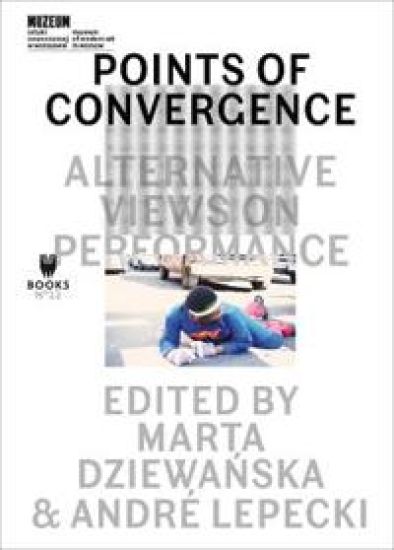
Points of Convergence – Alternative Views on Performance

Points of Convergence – Alternative Views on Performance

Marta Dziewanska; André Lepecki; Andre Lepecki

Museum of Modern Art in Warsaw
2017
nidottu
Thanks to its very nature, performance enters into natural dialogue with art, new media, politics, and the social sphere as a whole. Always happening in the here and now, and with a unique freedom and openness to the unknown, performance is a medium with a special ability to question its own subjects, materials, and languages. As a result, it is often best reflected in the dynamic character of contemporary art and contemporaneity in the broadest sense of the word. Points of Convergence explores these ideas and investigates critical approaches to performance, ultimately aiming to stimulate new discussion between theorists and practitioners. With twelve essays by leading figures in the field of performance arts, this illustrated volume is structured in two parts. The first, authored by academics in the discipline, features an introduction to key areas of scholastic research. The second part, authored by curators and other researchers, then focuses on an account of individual traditions of performance. Taken together, the contributions identify new possibilities for interaction between the theoretical aspects of performance art and the ways performance plays out within local contexts.
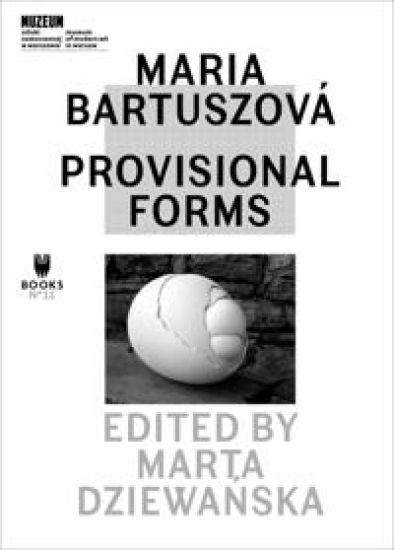
Maria Bartuszová – Provisional Forms

Maria Bartuszová – Provisional Forms

Marta Dziewanska

Museum of Modern Art in Warsaw
2016
nidottu
The work of Slovak sculptor Maria Bartuszova (1936-96) was first presented to international audiences in Kassel in 2007. Although her art has appeared in influential exhibitions and been included in prestigious contemporary art collections, up until now, she has yet to receive the widespread recognition she deserves. Dziewanska's book offers distinct perspectives on Bartuszova's work from renowned international critics in an effort to increase our awareness of her sculptures. Working alone behind the Iron Curtain, Bartuszova was one of a number of female artists who not only experimented formally and embarked intuitively on new themes, but who, because they were at odds with mainstream modernist trends, remained in isolation or in a marginalized position. Revealing her dynamic treatment of plaster-a material that, from a sculptor's point of view, is both primitive and common-the book deftly reveals how Bartuszova experimented with materials, never hesitating to treat tradition, accepted norms, and trusted techniques as simply transitory and provisional. Offering a much-needed history of a vibrant body of work, Maria Bartuszova: Provisional Forms is an important contribution to the literature on great female artists.
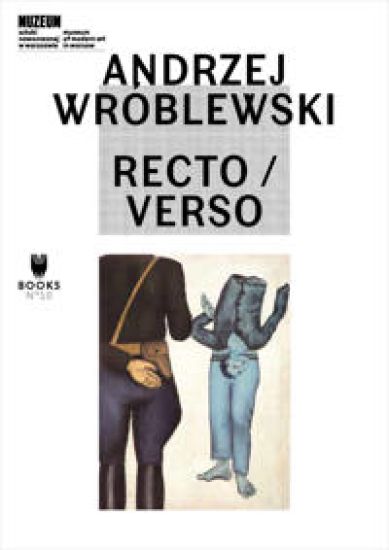
Andrzej Wróblewski: Recto / Verso

Andrzej Wróblewski: Recto / Verso

Éric De Chassey; Marta Dziewanska

Museum of Modern Art in Warsaw
2015
nidottu
One of Poland's most important and independent postwar artists, Andrzej Wroblewski (1927-57) created in his short life his own highly individual, suggestive, and prolific form of abstract and figurative painting that continues to inspire artists today. This volume offers a stunning presentation and thorough reevaluation of his work and its legacy in the international context of art history. Offering an insightful picture of the world of postwar painting in communist Europe, and highlighting Wroblewski's political engagement, the book helps us to understand the immensely evocative vision of war and oppression that he created. This close look at a painter and a period that are of growing interest for international art historians will serve to further cement Wroblewski in the postwar pantheon.
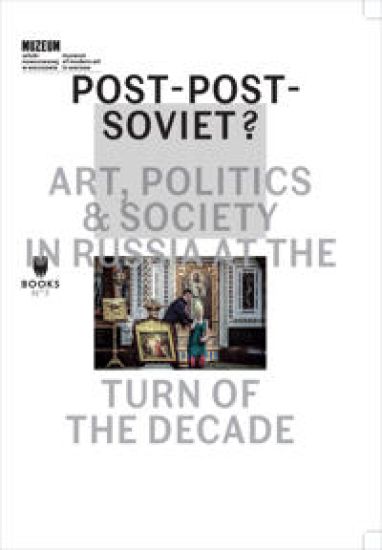
Post–Post–Soviet? – Art, Politics and Society in Russia at the Turn of the Decade

Post–Post–Soviet? – Art, Politics and Society in Russia at the Turn of the Decade

Marta Dziewanska; Ekaterina Degot; Ilya Budratskis; Anna Aslanyan

Museum of Modern Art in Warsaw
2013
nidottu
By placing emerging artists in their political and social contexts, this collection attempts to confront the new activist scene that has arisen in the Russian art world during the past few years. The recent explosion of protests in Russia - often with their very purpose being to decry the lack of artistic freedom - is a symptom of a fundamental change in culture heralded by Vladimir Putin's first election. This shift was precipitated by the change to a highly commercial, isolated world, financed and informed by oligarchs. In response, the Russian contemporary art scene has faced shrinking freedom yet an even more urgent need for expression. While much of what is emerging from the Moscow art scene is too new to be completely understood, the editors of this volume seek to bring to light the important work of Russian artists today and to explicate the political environment that has given rise to such work. "Post-Post-Soviet?" features criticism by writers and scholars, as well as dialogues with artists. Contributors include Boris Kagarlitsky, Ekaterina Degot, Keti Chukhrov, Boris Buden, Artur Zmijewski, and others.
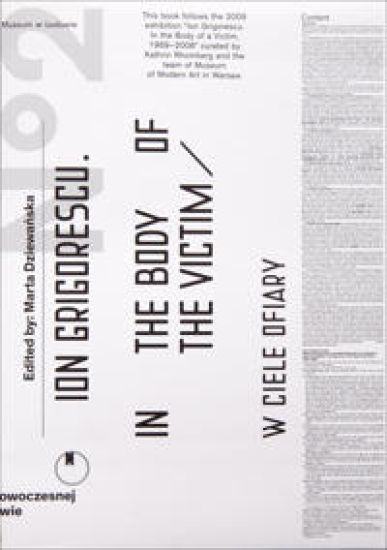
Ion Grigorescu – In the Body of the Victim

Ion Grigorescu – In the Body of the Victim

Marta Dziewanska

Museum of Modern Art in Warsaw
2011
nidottu
This book considers the oeuvre of Ion Grigorescu, one of the most charismatic and original artists from the former Eastern bloc, who until 1989 worked in relative isolation and whose art reflects his search for a place within an extremely oppressive political system. Grigorescu, born in 1945 in Bucharest and educated as a painter, was one of the first Romanian conceptual artists and advocates of anti-art, postulating a radical consolidation of artistic activities with quotidian life. He is the creator of numerous films, photographic series, and actions recorded on film, as well as drawings and collages that documented both his private life and the passage of the Romanian people from life under communist regimes to the realities of expansive capitalism. The retrospective understanding of his art presented here offers much more than just another lost chapter in the history of the Central European avant-garde - Grigorescu's work is revealed to be singular, introducing religious and spiritual motifs into conceptual art and demonstrating his conviction that political crises are rooted in a crisis of the spirit.
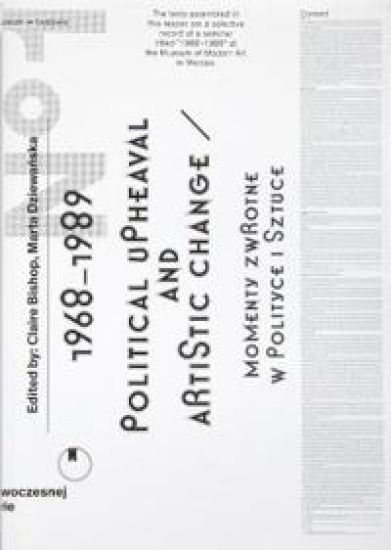
1968–1989. Political Upheaval and Artistic Change

1968–1989. Political Upheaval and Artistic Change

Claire Bishop; Marta Dziewanska

Museum of Modern Art in Warsaw
2011
nidottu
This volume comprises of a selection of texts and presentations from a seminar organized in Warsaw in 2008 by the Museum of Modern Art with art historian Claire Bishop that presented a comparative reflection of Western and Eastern European evaluations of the artistic significance of 1968 and the transformations of 1989, which saw the end of the Soviet empire. The essays presented here explore the extent to which political change affects the form, medium, and distribution of visual art; explain the differences among artistic practices that appear similar but arose in diverse political and ideological contexts; and, consider the possibility and desirability of writing a European art history that brings together East and West.