Kirjailija
Martin Anderson
Kirjat ja teokset yhdessä paikassa: 19 kirjaa, julkaisuja vuosilta 2001-2025, suosituimpien joukossa Symbols and Metaphors. Vertaile teosten hintoja ja tarkista saatavuus suomalaisista kirjakaupoista.
Mukana myös kirjoitusasut: Martín Anderson
19 kirjaa
Kirjojen julkaisuhaarukka 2001-2025.
Before Dark reflects Martin Anderson's peripatetic lifestyle of three decades. During a weekend in Paris in 1971, whilst teaching at the University of Grenoble, he met T.T. Wong, a young Chinese artist from Shanghai, and their long discussions cemented his aspiration to go East. English society had, he felt, since he was born into it shortly after the end of World War II, succeeded only in submerging his nose in the effluvium of a squalid sewer of class discriminations, so the time was more than ripe for him to bid farewell to the UK. Arriving, eventually, at the University of Hong Kong where T.T. Wong's letter of introduction to a young Dostoevsky scholar heading a department had directed his feet, Anderson discovered that it was an institution where the ancien regime (Terms of Service finely calibrated to reflect skin pigmentation...) was firmly entrenched. After a good number of years he moved still further east, to Manila and the University of the Philippines. Through all these years, and the first few years of his return to the UK, the poems of Before Dark were written, along with the prose The Hoplite Journals, described by the novelist James Hamilton-Paterson as "enter[ing] that select pantheon of books to travel with, a vademecum ... A most remarkable achievement."The late American poet, Gustaf Sobin, in the early 1980s, identified Anderson's poetry - then appearing in initial issues of Shearsman magazine - as deserving attention: "Great purity and acuity, and a perfect ear. A wonderful poet". More recently Steve Spence commented that Anderson's collection A Country Without Names (2022), published by Shearsman Books, "deals in a global manner with all the problems we are facing at the moment. It's a dark testament but a terrific book." And the Texas-based Canadian poet David Wevill has observed: "A profound book. Moral, not moralizing. Intense ... A masterpiece."
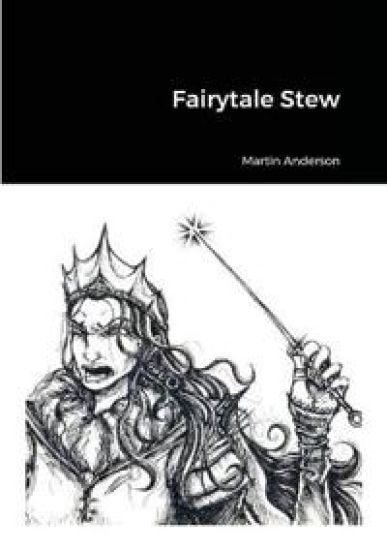
Fairytale Stew follows the exploits of the quirky and sarcastic Ducatsnatch, as he travels around Fairy Tale Land, encountering all the best loved characters from rhyme and fable. Ducatsnatch is enlisted by the dangerous Brothers Grimm to undo the spell, fairytale stew, that his employer, the Dread-Witch Queen Xyzz, has cast upon their land in order to enact revenge on all its inhabitants. As he attempts to reverse the diabolical spell that has mixed up the stories and their characters, Ducatsnatch gets increasingly exasperated at the way that the characters are all constrained by the conventions of fairy tales and the stereotypes of their personalities. However, the attentions of Fairy Tale Land's heroines and the shining example of the heroes spur him on to a great showdown against his ex-boss, the Dread-Witch Queen Xyzz. However, he will need more than his cutting humour and irreverent look at the folk of Fairy Tale Land to beat the driven Xyzz.
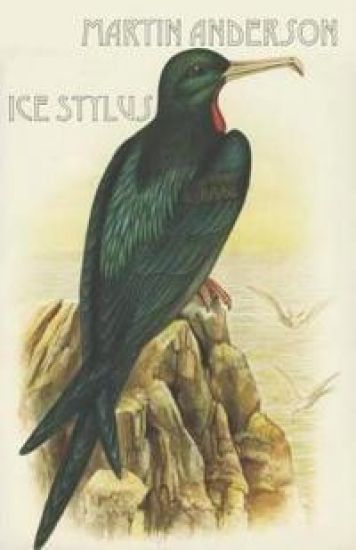
A Country Without Names offers a conspectus of human activity from its earliest imagined days and the formation of agrarian state sedentism to our own day. Its tesserae, gathered from beyond the boundaries of a single country or culture, constitute a mosaic in which might be gleaned all the fury and fatuity of the pursuit of that gilded phantasmagoria of a just and beneficent state. Whilst a certain sombreness - from Flowering Midnight's dark elegy for the English pastoral lyric, to the fate of Congo's Patrice Lumumba in the contemporary, and near contemporary, political parallels animating Under Jui-yi Shan - imbues the collection it should be seen, however, as no more than the corollary of an unsentimental probing of experience, in a collection which is both paean for the natural world and indictment of those human qualities and structures which threaten it. Ian Seed, reviewing Ice Stylus, the last volume, after Interlocutors of Paradise and Obsequy for Lost Things, in Anderson's Unsubdued Singing trilogy, noted "its highly charged lyricism ... the language ... sparse, staccato, pared down to a minimum." And pointed to "its timeless, archetypal quality" to "the sense of an epic journey into the darkness of the western psyche ... One is reminded above all, in the tension between the aesthetic qualities of the writing and its political, historical and philosophical subject matter, of the work of Ezra Pound ... In the current political climate this is a book which may also be read as ... a plea to begin anew with a narrative that acknowledges the humility of our place within the universe and our responsibility to it."
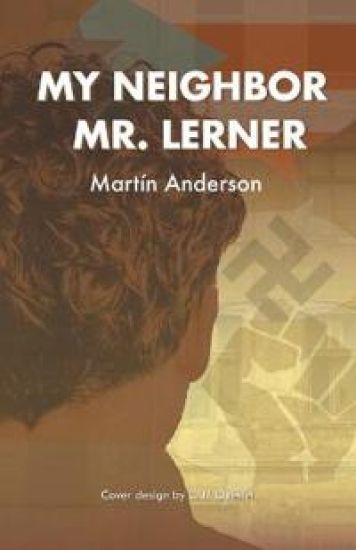
In this compelling and gripping tale social worker Joshua Blume confronts drug dealers, and crooked cops to help his clients. However his biggest challenge will come from an evil force that also saved his son's life. Josh is finding that he can no longer continue living as a bystander who is merely interested in doing the right thing by people. With each passing day the idea of true justice and how it is achieved is becoming intimately personal. This happens in his interactions with his colleague Maria, his new client Samuel Benson, his wife Amber, Detective Schmidt and lastly everything comes to a head when he learns the true identity of his neighbor Mr. Lerner.
Through these poems set within a major south east Asian city Anderson weaves, against the rotting entablatures of monumental imperial ambition, slowly degraded aspirations of native and non-native inhabitant.
The sequences of meditations which comprise Anderson's last two books Interlocutors of Paradise (Skylight Press) and Obsequy for Lost Things (Shearsman Books) trace fault lines deeply inscribed within the Judeo-Christian psyche of the West. Ice Stylus is the final volume of Anderson's Unsubdued Singing trilogy. Many of the sequences in Interlocutors of Paradise and Obsequy for Lost Things begin in a geography which is both real and subliminal: the Essex Thames-side salt marsh. This is also Isaiah's "parched wastes of salt": here manifestation of wilderness, the condition of spiritual inanition, which has so frequently been attributed by the West to the non-West to legitimise aggression whilst masking its real objective of the expropriation of other peoples' wealth, finds objective representation. It is the aggressor himself, the sequences suggest, not the victim, who suffers from inanition. From the salt marshes his questing voyages take him in search of things he covets and dreams of, only to confront him, finally, with the reality of their non-existence. In this "dark land", perhaps intimating archetypal adventure, his passage takes him through the trials and ordeals of many wastes of water. What such a journey eventually delivers to him, however, is not a sacred fire of illumination or boon of wisdom to take back to his old world to re-vivify it. Instead, he is vouchsafed the white isotope of destruction, turning everything dark and possessing the potential to annihilate the very products of time he has so violently sought to wrest from others.
Obsequy For Lost Things consists of three prose-poetry sequences. The first two share the setting of the Thames estuary. They all share, however, like the author's previous collection of prose-poetry sequences (from Skylight Press) Interlocutors of Paradise, and his The Hoplite Journals, a concern with history and the psychology of colonialism. As such they also confront, in "the defeat of colonialism", what Martin Jacques called "the most important event of the 20thC". An event, involving the attempt to brutally resist it, which coming-of-age British poets in the 1960s didn't confront, and which A. Alvarez in his essay in his influential anthology The New Poetry (1962) didn't deem worthy of inclusion alongside other manifestations of "Evil": nuclear war and the Nazi holocaust. If British poets today, however, are to acquire what he termed "a new seriousness, a willingness to face the full range of [their] experience with [their] full intelligence" then they need to avoid what Alvarez called "easy exits" and to redress such an omission.
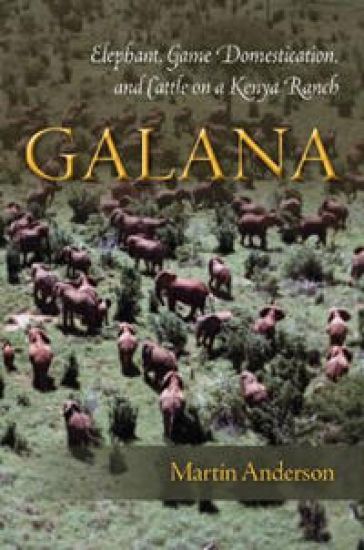
An avid sportsman, Martin Anderson first visited Kenya on a hunting safari in 1960, three years before the country gained its independence from English colonial administration. Anxious to return and be a part of Kenya's new beginning and Jomo Kenyata's encouragement of "harambee" (working together with European settlers/farmers), he partnered with a Kenya settler and started to raise cattle. Four years later and with one more partner, he accepted the government's offer to develop a vast tract of raw African bush for a game and cattle ranch. This book is a history of that grand and remarkable journey. Galana recounts the story of the creation, achievements, and demise of the largest cattle ranch in Kenya and perhaps all of Africa. Located on an arid 2,500-square-mile tract—1 percent of all the land in Kenya—the Galana Ranch was founded in 1968. Galana introduced cattle into a region with virulent insect-borne disease, adapted the animals to the land, and bred resistant stock. It conducted scientific research into the domestication of wildlife, and aimed to manage Galana's vast natural population of elephants, lions, rhino, lesser kudu, eland, oryx, and other game to help that population attain a level the land could support. In the 1970s and 80s, however, an epidemic of poaching nearly wiped out Galana's vast elephant herds, and the ranch shut down in 1989. This engrossing memoir goes to the heart of Kenya's wildlife management issues and political challenges through a personal tale of adventure and enterprise in Africa.
The Lower Reaches is framed within precise geography, the Lower Hope region of the Thames estuary where the author was born and grew up beside a river on which "the dreams of men, the seed of commonwealths, the germs of empire" floated. Anderson lived for decades in the Far East. His meditation interrogates the formation of national identity and freights with poignant significance the old maxim that so much of British history happened overseas.
The Vegetable Container Gardening Guide: How to Grow Food in a Container Garden
Martin Anderson
Createspace Independent Publishing Platform
2013
nidottu
This compendium edition of all three volumes of Martin Anderson's The Hoplite Journals evokes events and places largely in South East and South Asia as well as the West, exploring allegiances and identities within the troubled context of mostly colonial and ex-colonial possessions.
Seed Saving for the Organic Gardener
Martin Anderson
Createspace Independent Publishing Platform
2013
nidottu
Organic seed harvesting made simple For the aspiring organic gardener, there's nothing more rewarding than growing organic crops from seeds you've harvested yourself. This book gives you the information you need to get started harvesting and planting your own seeds. The following topics are covered: - Why saving seeds is preferable to buying seeds. - The key difference between hybrid and open-pollinated seeds. - Why you need to avoid GMO seeds at all costs. - How to control cross-pollination of your plants. - Bagging, isolating and boxing your plants. - Growing healthy seeds. - How to harvest seeds from a number of popular plants including artichokes, asparagus, broccoli, carrots, flowers, corn, strawberries, cucumbers, melons and more. - Why you should avoid harvesting tree seeds (there's a much better way to grow trees). - What heirloom seeds are and why they're important. - Special handling of plants you plan on harvesting heirloom seeds from. - The difference between organic and heirloom seeds. - How to start your seeds once planting season rolls around. - Sowing seeds in your garden. Buy Seed Saving for the Organic Gardener today and learn how to harvest seeds from your plants.
Interlocutors of Paradise is a collection of five short meditations on colonialism and the Western mind. Written as a series of provocative, symbolist-tinged prose-poems, each section situates the reader in beautifully crafted spaces, hollows to be filled either by spiritual purpose or wilful invasion. It begins by evoking the historical formation and expression of national identity - an identity predicated on past colonial and imperial activities. This is followed by three meditations that are largely situated within that region of the Thames estuary where Joseph Conrad lived, set and conceived Heart of Darkness. The Thames, that river in the book on which floated "The dreams of men, the seed of commonwealths, the germs of empire", figures prominently also in the book's opening meditation, where it is the setting of, amongst other things, Edmund Spenser's poem Prothalamion and his friend Sir Walter Raleigh's departure and voyage to Roanoke in the New World. In the final meditation its presence fades, giving way instead to the aspirant spaces of a settled New World. But a world not 'settled' enough to have eradicated restlessness.
Martin Anderson was born and grew up in England. Shearsman Books first published his work in the 1980s. Anderson has lived a large part of his life as an expatriate and many of his poetry collections have been published abroad. His poetry is, as a result, not well known in the UK. The poems of Snow, written whilst resident for almost three decades in the Far East, look both to that region for their ostensible subject matter and back to the UK. Snow is a collection in its own right, not simply borrowings from Anderson's earlier collections. Its choice and arrangement of poems suggests a terrain richer and more complex than those of individual poems and collections, and one within which they may be rewardingly re-encountered.
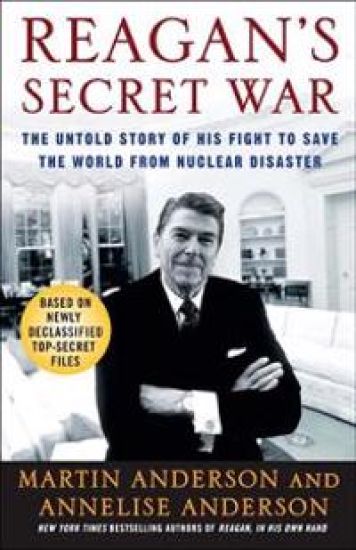
On February 6, 1981, at his first National Security Council meeting, Ronald Reagan told his advisers: "I will make the decisions." As Reagan's Secret War reveals, these words provide the touchstone for understanding the extraordinary accomplishments of the Reagan administration, including the decisive events that led to the end of the Cold War. In penning this book, New York Times bestselling authors Martin Anderson and Annelise Anderson drew upon their unprecedented access to more than eight million highly classified documents housed within the Ronald Reagan Presidential Library in Simi Valley, California--unseen by the public until now. Using his top secret clearances, Martin Anderson was able to access Ronald Reagan's most privileged exchanges with subordinates and world leaders as well as the tactical record of how Reagan fought to win the Cold War and control nuclear weapons. The most revelatory of these documents are the minutes of Reagan-chaired National Security Council meetings, the dozens of secret letters sent by Reagan to world leaders, and the eyewitness notes from Reagan-Gorbachev summits. Along with these findings, the authors use Reagan's speeches, radio addresses, personal diaries, and other correspondence to develop a striking picture of a man whose incisive intelligence, uncanny instincts, and quiet self-confidence changed the course of history. What emerges from this treasure trove of material is irrefutable evidence that Reagan intended from his first days in office to bring down the Soviet Union, that he considered eliminating nuclear weapons his paramount objective, and that he--not his subordinates--was the principal architect of the policies that ultimately brought the Soviets to the nuclear-arms negotiating table. The authors also affirm that many of Reagan's ideas, including his controversial "Star Wars" missile-defense initiative, proved essential in dissolving the Soviet Union and keeping America safe. Riveting and eye-opening, Reagan's Secret War provides a front-row seat to history, a journey into the political mind of a remarkable leader, and proof that one man can, through the force of his deep convictions, bring about sweeping global change.
The poems in this latest collection by Martin Anderson are largely concerned with the nature, from both a perceptual and ontological perspective, of continuing and intrinsic identities. We belong "To nowhere/to no thing/to the shortest abridgement/of air of word/to the cruel insignia/of our acquisitions". At the heart of all that we are, of all that we think, feel, see, touch, taste and smell, are 'shadows/pulled through/a world impatient/to sound'. A world, pregnant with meaning and language, which is, finally, a 'mirror colliding/with its reflection'.
Reagan in His Own Voice
Kiron K. Skinner; Annelise Anderson; Martin Anderson
Simon Schuster Audio
2001
cd
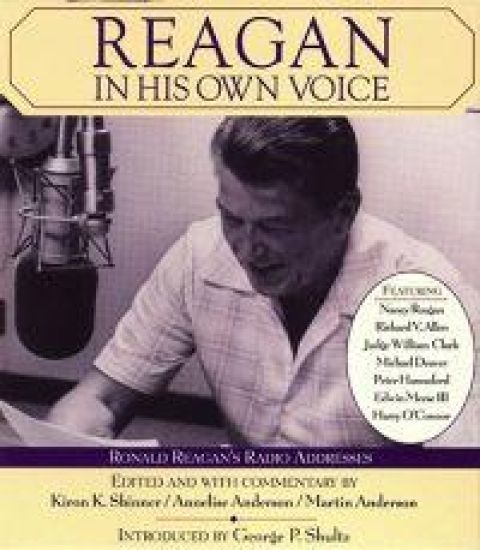
Reagan In His Own Voice features Ronald Reagan's radio addresses from the late 1970s. Edited by Kiron K. Skinner, Annelise Anderson, and Martin Anderson, they are introduced by George Shultz and feature additional introductions by Nancy Reagan, Richard V. Allen, Judge William Clark, Michael Deaver, Peter Hannaford, Edwin Meese III and Harry O'Connor. From 1975 to 1979 Ronald Reagan gave more than 1,000 daily radio broadcasts, the great majority of which he wrote himself. This program represents the opening of a major archive of pre-presidential material from the Reagan Library and the Hoover Institution Archives. These addresses transform our image of Ronald Reagan, and enhance and revise our understanding of the late 1970s -- a time when Reagan held no political office, but was nonetheless mapping out a strategy to transform the economy, end the cold war, and create a vision of America that would propel him to the presidency. These radio programs demonstrate that Reagan had carefully considered nearly every issue he would face as president. Reagan's radio broadcasts will change his reputation even among his closest allies and friends. Here, in his own voice, Reagan the thinker is finally fully revealed.