Kirjojen hintavertailu. Mukana 12 390 323 kirjaa ja 12 kauppaa.

Kirjailija

Martin Carrier

Kirjat ja teokset yhdessä paikassa: 6 kirjaa, julkaisuja vuosilta 1989-2021, suosituimpien joukossa Wissenschaftstheorie zur Einführung. Vertaile teosten hintoja ja tarkista saatavuus suomalaisista kirjakaupoista.

6 kirjaa

Kirjojen julkaisuhaarukka 1989-2021.

Narratives and Comparisons – Adversaries or Allies in Understanding Science?

Narratives and Comparisons – Adversaries or Allies in Understanding Science?

Martin Carrier; Rebecca Mertens; Carsten Reinhardt

Transcript Verlag
2021
nidottu
As a powerful tool in the production of knowledge, comparing plays a crucial part in the sciences and the humanities. This volume explores the relationship between comparing and narrating in epistemic practices and clarifies the ways in which narratives enable or impede practices of comparing. It takes into account related activities, such as measuring and classifying, modeling, establishing norms and categories, as well as organizing and popularizing knowledge, to analyze the ambivalent relationship between narratives, scientific explanation, and understanding. The contributions bring out the epistemic role of narratives, and elucidate how narratives are connected to comparisons and scientific explanations.
Wissenschaftstheorie zur Einführung

Wissenschaftstheorie zur Einführung

Martin Carrier

JUNIUS VERLAG GMBH
2021
nidottu
Wissenschaftliches Wissen ist besonders streng geprüftes Wissen, das sich von der bloßen Meinung abheben soll. Dieser Anspruch beruht auf der methodischen Prüfung wissenschaftlicher Behauptungen an der Erfahrung. Wesentlicher Teil der Wissenschaftstheorie ist die Methodenlehre, die sich damit befasst, welche Verfahren der Prüfung in der Wissenschaft akzeptiert sind und in welchem Zusammenhang sie mit dem wissenschaftlichen Erkenntnisanspruch stehen. Im Mittelpunkt dieser Einführung stehen daher die Verfahren der Geltungssicherung in der Wissenschaft in ihrem historischen Wandel. Wichtige Herausforderungen für die Methodenlehre ergeben sich u.a. daraus, dass Wissenschaft ihr Erkenntnisziel im Spannungsfeld von gesellschaftlichen Nutzenerwartungen und Wertvorgaben verfolgen muss.
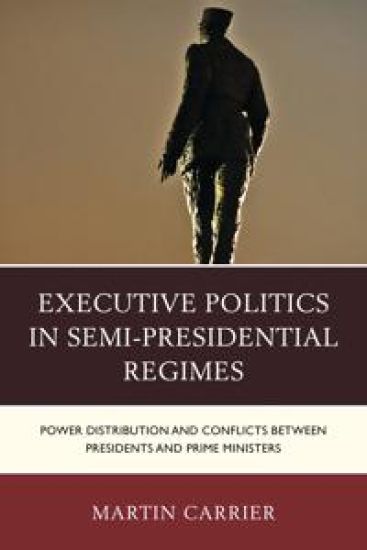
Executive Politics in Semi-Presidential Regimes
This book analyzes the power variations between political executives in semi-presidential regimes. It contrasts institutional, partisan, and extra-institutional explanations and identifies patterns of change for the power distribution between presidents and prime ministers. It provides an empirical analysis of selected case studies and demonstrates the necessity to understand power variations in a configurative perspective, exposing the limits of institutional design explanations. This study ultimately aims to contribute to both the literature on semi-presidentialism and to the literature on democratic regimes by providing a systematic assessment of these different configurations, in both mature and emerging democracies. To explore this phenomenon, this research tests the key factors of power variation proposed in the semi-presidential literature on the power relationship between presidents and prime ministers mainly in France’s Fifth Republic and post-1993 Ukraine, but also to a lesser extent in Finland, post-1993 Russia, and post-1990 Poland.
The Completeness of Scientific Theories
Earlier in this century, many philosophers of science (for example, Rudolf Carnap) drew a fairly sharp distinction between theory and observation, between theoretical terms like 'mass' and 'electron', and observation terms like 'measures three meters in length' and 'is _2° Celsius'. By simply looking at our instruments we can ascertain what numbers our measurements yield. Creatures like mass are different: we determine mass by calculation; we never directly observe a mass. Nor an electron: this term is introduced in order to explain what we observe. This (once standard) distinction between theory and observation was eventually found to be wanting. First, if the distinction holds, it is difficult to see what can characterize the relationship between theory :md observation. How can theoretical terms explain that which is itself in no way theorized? The second point leads out of the first: are not the instruments that provide us with observational material themselves creatures of theory? Is it really possible to have an observation language that is entirely barren of theory? The theory-Iadenness of observation languages is now an accept­ ed feature of the logic of science. Many regard such dependence of observation on theory as a virtue. If our instruments of observation do not derive their meaning from theories, whence comes that meaning? Surely - in science - we have nothing else but theories to tell us what to try to observe.
The Completeness of Scientific Theories
Earlier in this century, many philosophers of science (for example, Rudolf Carnap) drew a fairly sharp distinction between theory and observation, between theoretical terms like 'mass' and 'electron', and observation terms like 'measures three meters in length' and 'is _2° Celsius'. By simply looking at our instruments we can ascertain what numbers our measurements yield. Creatures like mass are different: we determine mass by calculation; we never directly observe a mass. Nor an electron: this term is introduced in order to explain what we observe. This (once standard) distinction between theory and observation was eventually found to be wanting. First, if the distinction holds, it is difficult to see what can characterize the relationship between theory :md observation. How can theoretical terms explain that which is itself in no way theorized? The second point leads out of the first: are not the instruments that provide us with observational material themselves creatures of theory? Is it really possible to have an observation language that is entirely barren of theory? The theory-Iadenness of observation languages is now an accept­ ed feature of the logic of science. Many regard such dependence of observation on theory as a virtue. If our instruments of observation do not derive their meaning from theories, whence comes that meaning? Surely - in science - we have nothing else but theories to tell us what to try to observe.