Kirjojen hintavertailu. Mukana 12 390 323 kirjaa ja 12 kauppaa.

Kirjailija

Martin Cohen

Kirjat ja teokset yhdessä paikassa: 37 kirjaa, julkaisuja vuosilta 1988-2026, suosituimpien joukossa 101 ????? ????????. Vertaile teosten hintoja ja tarkista saatavuus suomalaisista kirjakaupoista.

37 kirjaa

Kirjojen julkaisuhaarukka 1988-2026.

Israel–Palestine and the Case for One State
This scholarly but accessible book exploring the Palestine-Israel Conflict, balances history, politics, and human experience to make the case for a one state solution arguing that the conflict has its roots in European racism and American fundamentalism, forces which have combined to produce what has been called a setter-colonial state.
Liberalism, Human Values and Schools as Microcosms of Society
This seminal volume provides an accessible overview of key ethical and philosophical debates surrounding contemporary education policy, advocating for a future in education that is primarily driven by prioritising social values.Grounded in the educational ideas of recent British liberal and philosophical thinkers, including Roger Scruton, Mary Midgley and Brenda Almond in particular, the book provides a deeper understanding of the importance of intellectual and moral freedom as it plays out in today’s schools. The book echoes Almond’s call for education to be viewed through the lens of social values and argues for a broader societal strategy to the philosophy of education than narrowly utilitarian attempts to prepare pupils for the labour market. Chapters present various debates in society that relate to liberalism, social values and utilitarianism, and ultimately encourage dialogue on the approach towards education that is necessary to create a socially adjusted, thoughtful and genuinely knowledgeable society of the future.By encouraging readers to think about the requirements of the schools of tomorrow along with their role in shaping both individual lives and society itself, this book will be of interest to scholars, postgraduate students and researchers in the fields of philosophy of education, education studies and moral and value education. Those interested in the sociology of education and citizenship studies more broadly will also benefit from the volume.
Critical Thinking Skills For Dummies

Critical Thinking Skills For Dummies

Martin Cohen

JOHN WILEY SONS INC
2024
nidottu
Learn how to argue points effectively, analyze information, and make sound judgments The ability to think clearly and critically is a lifelong benefit that you can apply in any situation that calls for reflection, analysis, and planning. Being able to think systematically and solve problems is also a great career asset. Critical Thinking Skills For Dummies helps you hone your thinking abilities and become a better communicator. You’ll find hands-on, active instruction and exercises that you can put to work today as you navigate social media and news websites, chat with AI, fact-check your own and others’ views, and more. Become a thinking machine, with this Dummies guide. Identify other people’s arguments and conclusions—and spot holes in themEvaluate evidence and produce more effective arguments in any situationRead between the lines of what people say and form your own judgmentsApply critical thinking to school or college assignments to improve your academic performance This is the perfect Dummies title for students, researchers, and everyone who seeks to improve their reasoning and analysis ability.
Rethinking Thinking

Rethinking Thinking

Martin Cohen

IMPRINT ACADEMIC
2022
pokkari
• How do generals — and business strategists — outwit their opponents?• Where do designers and artists get their inspirations from?• How can all of us 'pump up the originality' and steer our thinking off the standard, well-worn tracks?Everyone, as the French philosopher René Descartes pointed out long ago, thinks. That’s the easy bit. The harder part, and what this book is really about, is how to make your thinking original and effective. And here the problem is that too often we don’t really engage the gears of our brain, don’t really look at issues in an original or active way, we just respond. Like computers, inputs are processed according to established rules and outputs are thus largely predetermined. Yet that’s not what makes us human and that’s not where the big prizes in life are to be found.In the third millennium, we need to think a bit more — not less! And so the focus in this book is on practical suggestions about ways to think better… on thinking strategies that each have their own style, applications and benefits.
The Leader's Bookshelf

The Leader's Bookshelf

Martin Cohen

BLOOMSBURY PUBLISHING PLC
2022
nidottu
Which books inspired some of the world’s most successful people – and why? Come on a journey of literary exploration and find out how books can impact your life. It turns out that the life stories of many famous people start out with a particular book that inspired them when young. Here, Martin Cohen explores the lives of some remarkable people – inventors, scientists, business gurus and political leaders – and the books that have challenged, inspired, and influenced them. And so exploring the ideas, dreams and inspirations that this diverse group shared is at the heart of this book too. Inspiration, in particular, is the thread that ties together individuals with characters and backgrounds as diverse as Jane Goodall and Barack Obama, Malcolm X and Judge Clarence Thomas, Oprah Winfrey and Malala Yousafzai, Rachel Carson and Frans Lanting.Often, behind many tales of achievement lies much more than a collection of smart tactics. There are beliefs and values that guide many a grand strategy, too. And the strategies are often very different, which if you think about it, shouldn’t come as a surprise. If there really were just one recipe for success, well, everyone would be using it already. No, the thing that unifies these disparate approaches is that they all provided for their owners a kind of conceptual grid onto which a wide range of day-to-day creative, scientific, or business practices are able to develop and grow. For Sergey Brin and Larry Page, the founders of Google, for example, the grid was Charles Darwin’s notions of natural mutation and iteration. With Henry Ford, the man who pioneered the method of the assembly line, the grid was an obscure, ethereal theory of life as a sequence of reincarnations. And for both Oprah Winfrey and Steve Jobs, the grid was existentialist ideas about the pursuit of authenticity. In all these cases, a grand, indeed often philosophical, theory meshed perfectly with a practical business strategy. All of these remarkable people, and the books that most inspired them, are explored in this book.
Ralph Gibson: Sacred Land

Ralph Gibson: Sacred Land

Martin Cohen; Rabbi David Ellenson; Moshe Safdi

Distributed Art Publishers
2020
sidottu
Ralph Gibson's diptych portrayal of Israel, a land at once deeply modern and incredibly ancient The American photographer Ralph Gibson traveled throughout Israel and the surrounding region to create a portrait of a land where the past is vividly part of the present. He contrasts these in two-page spreads in which color and black-and-white images face one another: ancient language in a visual dialogue with contemporary human experience. As architect Moshe Safdie writes in his accompanying text: “This is the promise and paradox of Israel, a new country in an ancient land, modernity next to regression, with abundant and creative energy and cultural output. The high-tech world of invention next to Torah studies. It is still a young country, not even yet past its Centennial. With an optimistic eye, one sees the promise yet to be.” For this project, Gibson visited many of the well-known sites of the Holy Land, including the ancient city of Petra in Jordan as well as Masada and the Sea of Galilee flowing into the River Jordan. Sacred Land is a sumptuous study in the aesthetics of time. Ralph Gibson was born in Los Angeles in 1939. In 1956 he enlisted in the navy, where he began studying photography. Since he published his first photobook The Somnambulist in 1970, his work has been the subject of over 40 monographs. His work is widely exhibited and held in public collections around the world, such as the Stedelijk Museum, Amsterdam, and the Museum of Modern Art, New York. He lives and works in New York.
The Leader's Bookshelf

The Leader's Bookshelf

Martin Cohen

Rowman Littlefield
2020
sidottu
Which books inspired some of the world’s most successful people – and why? Come on a journey of literary exploration and find out how books can impact your life. It turns out that the life stories of many famous people start out with a particular book that inspired them when young. Here, Martin Cohen explores the lives of some remarkable people – inventors, scientists, business gurus and political leaders – and the books that have challenged, inspired, and influenced them. And so exploring the ideas, dreams and inspirations that this diverse group shared is at the heart of this book too. Inspiration, in particular, is the thread that ties together individuals with characters and backgrounds as diverse as Jimmy Carter and Henry Ford, Jane Goodall and Barack Obama, Malcolm X and Judge Clarence Thomas.Often, behind many tales of achievement lies much more than a collection of smart tactics. There are beliefs and values that guide many a grand strategy, too. And the strategies are often very different, which if you think about it, shouldn’t come as a surprise. If there really were just one recipe for success, well, everyone would be using it already. No, the thing that unifies these disparate approaches is that they all provided for their owners a kind of conceptual grid onto which a wide range of day-to-day creative, scientific, or business practices are able to develop and grow. For Sergey Brin and Larry Page, the founders of Google, for example, the grid was Charles Darwin’s notions of natural mutation and iteration. With Henry Ford, the man who pioneered the method of the assembly line, the grid was an obscure, ethereal theory of life as a sequence of reincarnations. And for both Oprah Winfrey and Steve Jobs, the grid was existentialist ideas about the pursuit of authenticity. In all these cases, a grand, indeed often philosophical, theory meshed perfectly with a practical business strategy. All of these remarkable people, and the books that most inspired them, are explored in this book.

I Think Therefore I Eat

I Think Therefore I Eat

Martin Cohen

Turner Publishing Company
2019
pokkari
"The worst thing about food science, the elephant in the room, is that it's not just the opinions that are changing—but the 'facts' themselves shift too." Did you know that the great philosophers were the original foodies? To eat or not to eat? That’s an easy question to answer. But what to eat? That’s a deep and profoundly difficult one. Doctors and nutritionists often disagree with each other, while celebrities and scientists keep pitching us new recipes and special diets. No one thought to ask the philosophers—those rational souls devoted to truth, ethics, and reason—what they think. Until now.
I Think Therefore I Eat

I Think Therefore I Eat

Martin Cohen

Turner
2018
sidottu
"The worst thing about food science, the elephant in the room, is that it's not just the opinions that are changing—but the 'facts' themselves shift too." Did you know that the great philosophers were the original foodies? To eat or not to eat? That’s an easy question to answer. But what to eat? That’s a deep and profoundly difficult one. Doctors and nutritionists often disagree with each other, while celebrities and scientists keep pitching us new recipes and special diets. No one thought to ask the philosophers—those rational souls devoted to truth, ethics, and reason—what they think. Until now.
Metaphor: Its Therapeutic Use and Construction

Metaphor: Its Therapeutic Use and Construction

Martin Cohen; David H Rosen

Resource Publications (CA)
2018
pokkari
This book helps counselors/therapists in all treatment modalities effectively use the extended metaphor as a therapeutic tool. It is a needed addition to every therapist's tool kit. The book will show you how to create a personalized and carefully constructed metaphor to reach a resistant client. This is especially important when we consider that each client is an individual and requires treatment specific to his or her needs. You will find a detailed description of the components used to create original therapeutic metaphors in a step-by-step fashion along with a rich and varied collection of metaphor examples. Two full-length annotated metaphors are provided to help you effect positive change in your clients. This book is a must for all mental health professionals. ""As a practicing clinician, I found this book to be interesting and intellectually stimulating. The author's wide-ranging and insightful examination of the uses of metaphor can help any thoughtful practitioner. It deserves a spot on every psychotherapist's bookshelf."" --Linda C. Saisselin, Licensed Clinical Social Worker, Private Practice, New York City ""Martin Cohen gave a very thorough explanation of the value of metaphors and why they are important in life and useful in therapy. The metaphors he presents are very helpful, especially the two that are annotated at the end of the book."" --Hope Lane, Therapist, Center for Family Development, Eugene, Oregon ""I think this book is an important subject and will be very useful. I found myself today using a metaphor with a private client and revisited the book to make sure I was remembering my thoughts about it."" --Zanne Miller, Licensed Professional Counselor, Private Practice ""As a Licensed Marriage Family Therapist and Art Therapist, story is very helpful for my clients. Martin Cohen breaks things down and makes the concepts accessible for therapists. I especially appreciate the powerful results of the tools that he astutely lays out in this groundbreaking and accessible book."" --Judith Ana Castro, Therapist, Center for Family Development, Eugene, Oregon ""The reading is thoroughly researched, and I enjoyed it. I can see the applicability of the metaphor tool across all psychotherapeutic approaches when direct speech doesn't quite reach the client. It's a very practical book. I was able to immediately use an example from it with a client of mine who had been suffering from complicated grief for years."" --Tatiana Sporea, Integrated Behavioral Health Therapist, Eugene, Oregon Martin Cohen earned his MS in Psychology through the California State University, Los Angeles, and his PhD from International College, Los Angeles. He was in private practice in Los Angeles, California, where he was also Clinical Director of MidValley Counseling and Psychological Services, and was the administrator for Psychiatric and Psychological Testing Services. Dr. Cohen has also been a clinician with the Center for Family Development in Eugene, Oregon.
Metaphor: Its Therapeutic Use and Construction

Metaphor: Its Therapeutic Use and Construction

Martin Cohen; David H Rosen

Resource Publications (CA)
2018
sidottu
This book helps counselors/therapists in all treatment modalities effectively use the extended metaphor as a therapeutic tool. It is a needed addition to every therapist's tool kit. The book will show you how to create a personalized and carefully constructed metaphor to reach a resistant client. This is especially important when we consider that each client is an individual and requires treatment specific to his or her needs. You will find a detailed description of the components used to create original therapeutic metaphors in a step-by-step fashion along with a rich and varied collection of metaphor examples. Two full-length annotated metaphors are provided to help you effect positive change in your clients. This book is a must for all mental health professionals. ""As a practicing clinician, I found this book to be interesting and intellectually stimulating. The author's wide-ranging and insightful examination of the uses of metaphor can help any thoughtful practitioner. It deserves a spot on every psychotherapist's bookshelf."" --Linda C. Saisselin, Licensed Clinical Social Worker, Private Practice, New York City ""Martin Cohen gave a very thorough explanation of the value of metaphors and why they are important in life and useful in therapy. The metaphors he presents are very helpful, especially the two that are annotated at the end of the book."" --Hope Lane, Therapist, Center for Family Development, Eugene, Oregon ""I think this book is an important subject and will be very useful. I found myself today using a metaphor with a private client and revisited the book to make sure I was remembering my thoughts about it."" --Zanne Miller, Licensed Professional Counselor, Private Practice ""As a Licensed Marriage Family Therapist and Art Therapist, story is very helpful for my clients. Martin Cohen breaks things down and makes the concepts accessible for therapists. I especially appreciate the powerful results of the tools that he astutely lays out in this groundbreaking and accessible book."" --Judith Ana Castro, Therapist, Center for Family Development, Eugene, Oregon ""The reading is thoroughly researched, and I enjoyed it. I can see the applicability of the metaphor tool across all psychotherapeutic approaches when direct speech doesn't quite reach the client. It's a very practical book. I was able to immediately use an example from it with a client of mine who had been suffering from complicated grief for years."" --Tatiana Sporea, Integrated Behavioral Health Therapist, Eugene, Oregon Martin Cohen earned his MS in Psychology through the California State University, Los Angeles, and his PhD from International College, Los Angeles. He was in private practice in Los Angeles, California, where he was also Clinical Director of MidValley Counseling and Psychological Services, and was the administrator for Psychiatric and Psychological Testing Services. Dr. Cohen has also been a clinician with the Center for Family Development in Eugene, Oregon.
The Eclipse of 'Elegant Economy'

The Eclipse of 'Elegant Economy'

Martin Cohen

Routledge
2016
nidottu
Elizabeth Gaskell might have been amused to learn that the Victorian 'elegant economy' she mocked so poignantly in Cranford reached a new apogee in the mid-twentieth century and endured the invasion of its precise antithesis, 'conspicuous consumption'. For Britons of all classes the years of austerity during and after the Second World War were years of disorientation and fears of resurgence of the worst of the interwar decades. They had never had more money in their pockets or less material things on which to spend it. Many took refuge in the 'elegant economy', its creator dubbed 'a sort of sour-grapeism, which made us very peaceful and satisfied'. Constrained by rationing, manufacturing and import controls personal finance could only be disbursed on non-material things - sometimes wisely, sometimes pragmatically and sometimes by throwing all caution to the wind. Here for the first time is the history of these diverse reactions explored through Britain's metamorphosis from austerity to affluence, with consumerism seen through fresh eyes. Today political commentators constantly warn of the encroachment of austerity. This book is a timely reminder of the years of real austerity in Britain: when regardless of financial status everyone suffered its tribulations: when a 'sub-prime' mortgage was unimaginable: when abuse of expense claims by public figures was unthinkable: and when no one dared utter a word critical of their bank or its manager.
The Philosophy Bible: The Definitive Guide to the Last 3,000 Years of Thought
This is a concise, comprehensive guide that covers the main schools of thought from the Ancient Chinese philosophies of Confucius and Lao Tzu; Ancient wisdom from Aristotle, Plato, Zeno and Pythagoras; through to those most influential of philosophers studied the world over -- Hegel, Marx, Descartes, Kant, Kierkegaard and Wittgenstein. It also discusses the "big questions", such as: What is truth? What kind of person is it good to be? What do we know and how do we know it? It considers the relationship between philosophy and religion, and the problem of morality. The book takes a two-pronged approach that looks at the chronological development of philosophical thought and the people behind the different schools of thinking. These definitive guides to their subjects together have sold over three million copies worldwide. Their success is undoubtedly owed to the comprehensiveness and quality of content, for an excellent price, and the smaller size is nonetheless filled with 400 illustrations.
101 Philosophy Problems

101 Philosophy Problems

Martin Cohen

Routledge
2016
sidottu
Does Farmer Field really know his prize cow, Daisy, is in the field? When is an unexpected exam not wholly unexpected? Are all bachelors (really) unmarried? Martin Cohen's 101 Philosophy Problems, Fourth Edition introduces philosophy in an entertaining but informative and stimulating way. Using philosophical puzzles, conundrums and paradoxes he skilfully unwraps some of the mysteries of the subject, from what we know - or think we know - to brainteasing thought experiments about ethics, science and the nature of the mind. For the Fourth Edition there are many new problems, including Maxwell's Moving Magnets, Einstein Changes Train Times, and Zeno's Paradox of Place; as well as two brand new sections including puzzles such as Lorenz's Waterywheel, and the Battle for Fractal Farm, and perplexing ethical dilemmas. The book has been extensively revised to bring it up to date with new developments in philosophy and society.With an updated glossary of helpful terms and possible solutions to the problems at the end of the book, 101 Philosophy Problems is essential reading for anyone coming to philosophy for the first time.
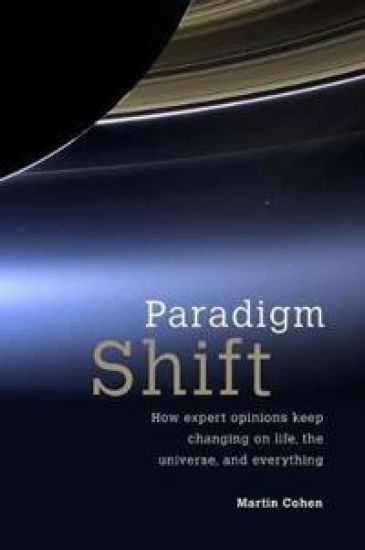
Paradigm Shift

Paradigm Shift

Martin Cohen

Imprint Academic
2015
pokkari
Why do giraffes have long necks? It can't really be for reaching tasty leaves since their main food is ground level bushes, tidy though that explanation would be. And how does relativity theory cope with the fact that the observable universe defies prediction by being far too small and anything but homogeneous? By inventing a vastly larger, but invisible, universe. And what exactly should we make of the scientists who claim to be witnessing thought itself, when the changes of blood flow in the brain that they observe are a thousand times slower than the neuronal activity it is supposed to reveal? A little scepticism is in order.Yet if philosophers of science, from Thomas Kuhn to Paul Feyerabend, have argued that science is a more haphazard process, driven by political fashion and short-term economic self-interest, today almost everyone seems to assume it is a vast jigsaw of interlocking facts pieced slowly but steadily together by expert practitioners.In this witty but profound 21st-century update on the issues, Martin Cohen offers vital clues for understanding not only the way knowledge develops, but also into the dangers of accepting too readily or too uncritically the claims of experts of all kinds — even philosophical ones! The claims are invariably presented as objective fact, yet are rooted in human subjectivity.