

Kirjailija
Martin Dean
Kirjat ja teokset yhdessä paikassa: 5 kirjaa, julkaisuja vuosilta 2008-2019, suosituimpien joukossa Grey Tropic. Vertaile teosten hintoja ja tarkista saatavuus suomalaisista kirjakaupoista.
5 kirjaa
Kirjojen julkaisuhaarukka 2008-2019.

Lessons and Legacies XIII
Alexandra Garbarini; Paul Jaskot; Brad Prager; Dana Smith; Marion Kaplan; Kaelber Lutz; Kubátová Hana; Martin Dean; Jan Grabowski; Simone Gigliotti; Pedro Correa Martín-Arroyo; Jonathan Druker; Gershon Greenberg; Lissa Skitolsky; Dorota Glowacka
Northwestern University Press
2018
sidottu
The social history of the genocide, its representation in postwar culture, and new theoretical approaches stand at the forefront of current research in a range of disciplines. Analyses at the most intimate scale—of the individual or of a particular locale— are juxtaposed with those that turn to broader studies of the war or postwar order. Complementing these different scales are theoretical investigations that address individual agency, moral judgment, and the construction of meaning and memory in the study of the victims of the Holocaust and in our understanding of society as a whole. Together they mark the contemporary scholarly landscape of Holocaust studies, which includes history as well as film and literary studies, philosophy, and religious studies (among other disciplines). Each of the volume's three sections contributes to understanding the Holocaust and postwar ramifications of the genocide by focusing on: 1) the history of specific communities of both victims and perpetrators; 2) postwar cultural representations; and 3) new theoretical understandings of each. The essays in this volume thus represent new interests in the field that contribute to building integrated histories of the Holocaust.
Lessons and Legacies XIII
Alexandra Garbarini; Paul Jaskot; Brad Prager; Dana Smith; Marion Kaplan; Kaelber Lutz; Kubátová Hana; Martin Dean; Jan Grabowski; Simone Gigliotti; Pedro Correa Martín-Arroyo; Jonathan Druker; Gershon Greenberg; Lissa Skitolsky; Dorota Glowacka
Northwestern University Press
2018
nidottu
The social history of the genocide, its representation in postwar culture, and new theoretical approaches stand at the forefront of current research in a range of disciplines. Analyses at the most intimate scale—of the individual or of a particular locale— are juxtaposed with those that turn to broader studies of the war or postwar order. Complementing these different scales are theoretical investigations that address individual agency, moral judgment, and the construction of meaning and memory in the study of the victims of the Holocaust and in our understanding of society as a whole. Together they mark the contemporary scholarly landscape of Holocaust studies, which includes history as well as film and literary studies, philosophy, and religious studies (among other disciplines). Each of the volume's three sections contributes to understanding the Holocaust and postwar ramifications of the genocide by focusing on: 1) the history of specific communities of both victims and perpetrators; 2) postwar cultural representations; and 3) new theoretical understandings of each. The essays in this volume thus represent new interests in the field that contribute to building integrated histories of the Holocaust.
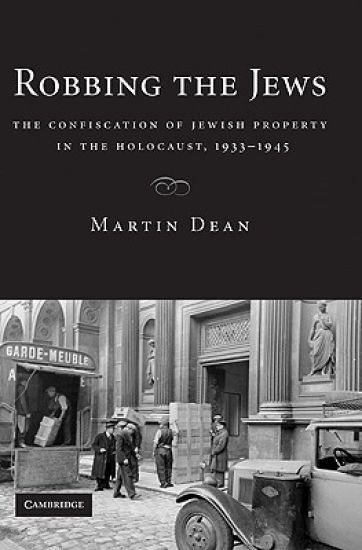
Robbing the Jews reveals the mechanisms by which the Nazis and their allies confiscated Jewish property; the book demonstrates the close relationship between robbery and the Holocaust. The spoliation evolved in intensifying steps. The Anschluss and Kristallnacht in 1938 reveal a dynamic tension between pressure from below and state-directed measures. In Western Europe, the economic persecution of the Jews took the form of legal decrees and administrative measures. In Eastern Europe, authoritarian governments adopted the Nazi program that excluded Jews from the economy and seized their property, based on indigenous antisemitism and plans for ethnically homogenous nation-states. In the occupied East, property was collected at the killing sites - the most valuable objects were sent to Berlin, whereas items of lesser value supported the local administration and rewarded collaborators. At several key junctures, robbery acted as a catalyst for genocide, accelerating the progression from pogrom to mass murder.
Robbing the Jews reveals the mechanisms by which the Nazis and their allies confiscated Jewish property; the book demonstrates the close relationship between robbery and the Holocaust. The spoliation evolved in intensifying steps. The Anschluss and Kristallnacht in 1938 reveal a dynamic tension between pressure from below and state-directed measures. In Western Europe, the economic persecution of the Jews took the form of legal decrees and administrative measures. In Eastern Europe, authoritarian governments adopted the Nazi program that excluded Jews from the economy and seized their property, based on indigenous antisemitism and plans for ethnically homogenous nation-states. In the occupied East, property was collected at the killing sites - the most valuable objects were sent to Berlin, whereas items of lesser value supported the local administration and rewarded collaborators. At several key junctures, robbery acted as a catalyst for genocide, accelerating the progression from pogrom to mass murder.