Kirjojen hintavertailu. Mukana 12 657 676 kirjaa ja 12 kauppaa.

Kirjailija

Martin F. Bach

Kirjat ja teokset yhdessä paikassa: 14 kirjaa, julkaisuja vuosilta 1978-2012, suosituimpien joukossa Variational Problems with Concentration. Vertaile teosten hintoja ja tarkista saatavuus suomalaisista kirjakaupoista.

14 kirjaa

Kirjojen julkaisuhaarukka 1978-2012.

Variational Problems with Concentration

Variational Problems with Concentration

Martin F. Bach

Springer Basel
2012
nidottu
To start with we describe two applications of the theory to be developed in this monograph: Bernoulli's free-boundary problem and the plasma problem. Bernoulli's free-boundary problem This problem arises in electrostatics, fluid dynamics, optimal insulation, and electro chemistry. In electrostatic terms the task is to design an annular con­ denser consisting of a prescribed conducting surface 80. and an unknown conduc­ tor A such that the electric field 'Vu is constant in magnitude on the surface 8A of the second conductor (Figure 1.1). This leads to the following free-boundary problem for the electric potential u. -~u 0 in 0. \A, u 0 on 80., u 1 on 8A, 8u Q on 8A. 811 The unknowns are the free boundary 8A and the potential u. In optimal in­ sulation problems the domain 0. \ A represents the insulation layer. Given the exterior boundary 80. the problem is to design an insulating layer 0. \ A of given volume which minimizes the heat or current leakage from A to the environment ]R.n \ n. The heat leakage per unit time is the capacity of the set A with respect to n. Thus we seek to minimize the capacity among all sets A c 0. of equal volume.
Atlas and Data of Solid-Solution Equilibria of Marine Evaporites

Atlas and Data of Solid-Solution Equilibria of Marine Evaporites

Eberhard Usdowski; Martin F. Bach

Springer-Verlag Berlin and Heidelberg GmbH Co. K
2012
nidottu
Solid-solution equilibria of marine evaporites are important in a wide range of science and technology. However, the data had not yet been summarized in a form that is at the same time comprehensive and permits to understand how the quinary seawater system builds up from its bounding systems. Thus the goal of the present volume is at the same time scientific and educational. The understanding of solid-solution equilibria of the various systems with respect to dissolution, precipitation and transformation of solids, their application to the evolution of brines, and a fast access to data is a necessary requirement for any modelling, especially in Geoscience. Another goal is to show the avail­ ability of data. Unfortunately, though solubility data are numereous there are substantial gaps, especially with respect to high temperatures. But also up to about 100 0 C data are missing for some of the systems so that they cannot be described entirely. Based on the present volume further work on the solubili­ ties of the minerals of marine evaporites may be promoted. The data have been viewed and collected over several years by the first author. The second author entered the preparation of the volume when it was realized that besides graphics and tables a fast access to data was required. Although both authors are responsible for the whole volume, responsibility is weighted somewhat differently for the various parts.
Dynamic Programming of Economic Decisions

Dynamic Programming of Economic Decisions

Martin F. Bach

Springer-Verlag Berlin and Heidelberg GmbH Co. K
2012
nidottu
Dynamic Programming is the analysis of multistage decision in the sequential mode. It is now widely recognized as a tool of great versatility and power, and is applied to an increasing extent in all phases of economic analysis, operations research, technology, and also in mathematical theory itself. In economics and operations research its impact may someday rival that of linear programming. The importance of this field is made apparent through a growing number of publications. Foremost among these is the pioneering work of Bellman. It was he who originated the basic ideas, formulated the principle of optimality, recognized its power, coined the terminology, and developed many of the present applications. Since then mathe­ maticians, statisticians, operations researchers, and economists have come in, laying more rigorous foundations [KARLIN, BLACKWELL], and developing in depth such application as to the control of stochastic processes [HoWARD, JEWELL]. The field of inventory control has almost split off as an independent branch of Dynamic Programming on which a great deal of effort has been expended [ARRoW, KARLIN, SCARF], [WIDTIN] , [WAGNER]. Dynamic Programming is also playing an in­ creasing role in modem mathematical control theory [BELLMAN, Adap­ tive Control Processes (1961)]. Some of the most exciting work is going on in adaptive programming which is closely related to sequential statistical analysis, particularly in its Bayesian form. In this monograph the reader is introduced to the basic ideas of Dynamic Programming.
Spatial Structures

Spatial Structures

Martin F. Bach

Springer-Verlag Berlin and Heidelberg GmbH Co. K
2012
nidottu
The common theme in the essays of this book is the emergence and sur­ vival of spatial structures. How are economic structures created in an otherwise homogeneous environment? The answer must be sought through an analysis of economic forces that operate in the two dimensional contin­ uum of space. Ultimately these forces emanate from the fundamental fact that spatial concentration is needed to reap increasing returns to scale. i. e. to gather the fruits of the division of labour. Adam Smith's dictum: "The division of labour is limited by the size of the market" poses a fundamental question to spatial economic analysis: just how do markets operate when extended over distances? Although these essays were written at different times they all relate to the problem of economic structures generated in spatial markets. They approach the phenomena of spatial order from different angles, but it is hoped in a connected and logically consistent way. We thank the editors and publishers of the Annals of Regional Science for permission to reprint parts of the articles "On the Shape and Size of Market Areas" and "Population Growth and Dispersal" to be published this year. It is our pleasure to thank Mrs. I. Strohlein for drawing several figures and Dr. H. Mittermeier for compiling the index. Last not least we are grateful to Mrs. B. Schwarzwalder for her patient job of typing and retyping this manuscript.
Lectures on Location Theory

Lectures on Location Theory

Martin F. Bach

Springer-Verlag Berlin and Heidelberg GmbH Co. K
2010
nidottu
Continuing the (neo-)classical tradition of von Thünen, Launhardt, Weber, Palander, and Lösch this book offers a fresh approach to the location of industries and other economic activities, of market areas, spatial price distribution, locational specialization, urban and transportation systems, and spatial interaction in general. It uses elementary economic reasoning supported by simple mathematical models, some classical, some new. The mathematical methods are presented in numbered Mathematical Notes. The author has been active in this field since 1950.
Lectures on Location Theory

Lectures on Location Theory

Martin F. Bach

Springer-Verlag Berlin and Heidelberg GmbH Co. K
1999
sidottu
Continuing the (neo-)classical tradition of von Thünen, Launhardt, Weber, Palander, and Lösch this book offers a fresh approach to the location of industries and other economic activities, of market areas, spatial price distribution, locational specialization, urban and transportation systems, and spatial interaction in general. It uses elementary economic reasoning supported by simple mathematical models, some classical, some new. The mathematical methods are presented in numbered Mathematical Notes. The author has been active in this field since 1950.
Variational Problems with Concentration

Variational Problems with Concentration

Martin F. Bach

Birkhauser Verlag AG
1999
sidottu
To start with we describe two applications of the theory to be developed in this monograph: Bernoulli's free-boundary problem and the plasma problem. Bernoulli's free-boundary problem This problem arises in electrostatics, fluid dynamics, optimal insulation, and electro chemistry. In electrostatic terms the task is to design an annular con­ denser consisting of a prescribed conducting surface 80. and an unknown conduc­ tor A such that the electric field 'Vu is constant in magnitude on the surface 8A of the second conductor (Figure 1.1). This leads to the following free-boundary problem for the electric potential u. -~u 0 in 0. \A, u 0 on 80., u 1 on 8A, 8u Q on 8A. 811 The unknowns are the free boundary 8A and the potential u. In optimal in­ sulation problems the domain 0. \ A represents the insulation layer. Given the exterior boundary 80. the problem is to design an insulating layer 0. \ A of given volume which minimizes the heat or current leakage from A to the environment ]R.n \ n. The heat leakage per unit time is the capacity of the set A with respect to n. Thus we seek to minimize the capacity among all sets A c 0. of equal volume.

Development of the Rat Spinal Cord: Immuno- and Enzyme Histochemical Approaches

Development of the Rat Spinal Cord: Immuno- and Enzyme Histochemical Approaches

Martin F. Bach; Egbert A.J.F. Lakke; Enrico Marani; Raph T.W.M. Thomeer

Springer-Verlag Berlin and Heidelberg GmbH Co. K
1993
nidottu
The studies described here were carried out in the Neuroregul­ ation Group, Department of Physiology, University of Leiden, the Netherlands. Over the last decade, this group, in close collaboration with the Department of Neurosurgery of the Academic Hospital of Leiden, has studied the development of the central nervous system from a neuroanatomical as well as a clinical perspective. During this period, the expression of several morphore­ gulators in the developing rat spinal cord was extensively investigated. Parallel studies focused on the development of the spinal cord fiber systems, which was studied by means of the intrauterine use of neuronal tracers. The main goal of these studies was to extend our knowledge about the (normal) generation of the spinal cord and to contribute to the under­ standing of clinical problems related to regeneration and degeneration in the mammalian central nervous system. The studies on morphoregulators, in particular, appeared to benefit two different scientific areas. Firstly, the correlation between morphoregulator expression patterns and known anatomy contributed to our knowledge about spinal cord development. Secondly, the correlation between morpho regulator expression patterns and known developmental processes may help to understand their precise function(s). This volume of Advances in Anatomy, Embryology and Cell Biology presents these particular studies on the development of the rat spinal cord performed over the last decade. As well as integrating the results of the tracer studies, this volume also provides an update on the development of the rat spinal cord.
Übungsbuch Strömungsmechanik

Übungsbuch Strömungsmechanik

Herbert Jr. Oertel; Martin F. Bach

Springer-Verlag Berlin and Heidelberg GmbH Co. K
1993
nidottu
Dieses Ubungsbuch begleitet die Vorlesungen zu Stromungsmechanik. Es dient als idealer Begleiter zur Vertiefung des Vorlesungsstoffes und zur Prufungsvorbereitung. Mit Aufgaben aus der Hydro- und Aerostatik, zur Stromfadentheorie, zur Stromung mit Reibung, zu den Grundgleichungen der Stromungsmechanik, zur Ahnlichkeitsmechanik und Beispielen zu numerischen Verfahren.
Inventory Control

Inventory Control

Dieter Bartmann; Martin F. Bach

Springer-Verlag Berlin and Heidelberg GmbH Co. K
1992
nidottu
Experts in operations research and developers of software application systems have been treading separate paths for many years. It is urgently necessary to reset this course so that the demanding requirements of variousCIM concepts can be realized. This is specially relevant for computer-based stock management. Both authors, with a number of years of practical experience behind them, have written this book with this objective in mind. The book shows how modern inventory control can be rationally structured with the help of OR. Two aspects are given importance:1) the necessary mathematical derivations are completely explained in detail so that the reader will be able to optimally handle a given situation with the help of the methods learned in this book, and 2) aside from the models, strong emphasis is given on numerical methods. Suitable algorithms are thoroughly explained for the more important cases.
Informationsverarbeitung und mentale Repräsentation

Informationsverarbeitung und mentale Repräsentation

Martin F. Bach

Springer-Verlag Berlin and Heidelberg GmbH Co. K
1990
nidottu
Wenn in der kognitiven Psychologie geistige Fahigkeiten des Menschen beschrieben oder erklart werden, ist dabei regelmassig von Meinungen, Wunschen, Wahrnehmungseindrucken oder anderen "gehaltvollen" Zustanden des kognitiven Systems die Rede. Menschen konnen sowohl als Besitzer geistiger Fahigkeiten wie auch als biologische Systeme beschrieben werden. Lassen sich beide Beschreibungen miteinander in Ubereinstimmung bringen? Im vorliegenden Band wird zunachst untersucht, welche Struktur psychologische Erklarungen geistiger Fahigkeiten haben mussen, um das Vorhandensein solcher Fahigkeiten verstandlich zu machen. Dann wird gefragt, welche objektiven Faktoren es rechtfertigen, dem kognitiven Sytem bestimmte Zustande zuzuordnen. Zum Schluss werden diese theoretischen Uberlegungen an einem empirischen Fall - der Wahrnehmungstheorie von David Marr - einer Uberprufung unterzogen.
The Motoneuronal Organization of the Spinal Accessory Nuclear Complex

The Motoneuronal Organization of the Spinal Accessory Nuclear Complex

Eva B. Krammer; Martin F. Bach; Thomas P. Egger; Maria Riedl; Helmut Gruber

Springer-Verlag Berlin and Heidelberg GmbH Co. K
1987
nidottu
Though more than 300 years have elapsed since the first description of the peculiar course of the spinal accessory (XI) nerve by Willis (1664), the crucial problems concerning what is known as accessory field of musculature and its innervation are still unsolved and a matter of controversy. Like the bulbar XI, the spinal XI nerve is commonly regarded as originally a branch of the vagus and, therefore, as a cranial nerve (Fiirbringer 1897; Gegenbaur 1898; Lubosch 1899). However, whether this nerve is of special visceral or somatic derivation is still debated. The conventional distinction between these function­ ally separate categories of cranial nerves is based largely on two criteria, namely, the position of the cranial nerve nucleus and the embryological derivation of the muscles innervated by this nerve. Unfortunately, little is known about the development of this accessory field of musculature, and the evidence concern­ ing the position of the spinal XI nucleus is contradictory. In fact, although the spinal XI nerve is usually regarded as a purely efferent nerve belong­ ing to the special visceral efferent group of cranial nerves and innervating muscles derived from the branchial mesoderm, each of these properties has been questioned. Consequently, the classification of the nerve is still unset­ tled. Evidence in support of a special visceral origin of the spinal XI nerve is found in the phylogenetic history of the spinal XI nucleus.
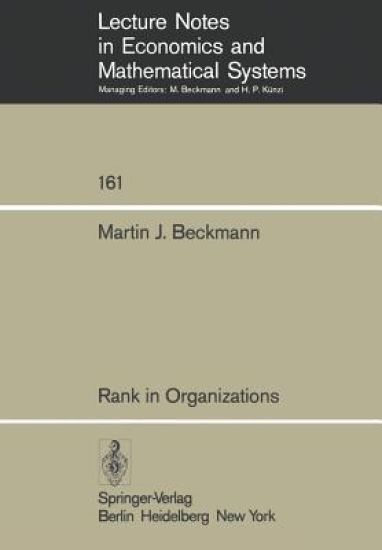
Rank in Organizations

Rank in Organizations

Martin F. Bach

Springer-Verlag Berlin and Heidelberg GmbH Co. K
1978
nidottu
Economic theory is growing not only in depth but in the breadth of its application as well. This study encroaches in part on a field normally considered as the domain of Sociology. But the methods applied here are those of mathematical economics. It has not been my ambition to make this as general and as mathe­ matically demanding as possible. On the contrary, I wanted to present as simple an argument as possible throughout. I wish to thank Brown University for granting me a Sabbatical leave in the Fall of 1977-78 in the course of which I wrote the first draft of this monograph. I am also grateful to the late Professor Jacob Marschak and to Professor Arthur Geoffrion for sponsoring me as a Visiting Scholar of the Western Management Science Institute, Graduate School of Management, UCLA for the months of November and December 1977. The Western Management Science Institute proved to be an ideal environment for writing: protective and stimulating at the same time. I have benefitted specifically from comments received as a result of presenting Chapters IV and V in the Marschak Colloquium on December 2, 1977, in particular by Professors Intri11igator and Spiro. My greatest indebtedness is to Jacob Marschak to whom I owe my awareness of and interest in the economic theory of organizations. He was my teacher, my director and supervisor, and my fatherly friend since 1950. It is thus entirely fitting that this work should be dedicated to his memory.