Kirjojen hintavertailu. Mukana 12 367 749 kirjaa ja 12 kauppaa.

Kirjailija

Martin Goodman

Kirjat ja teokset yhdessä paikassa: 31 kirjaa, julkaisuja vuosilta 1993-2026, suosituimpien joukossa Religion : i historia, samtid och framtid. Vertaile teosten hintoja ja tarkista saatavuus suomalaisista kirjakaupoista.

31 kirjaa

Kirjojen julkaisuhaarukka 1993-2026.

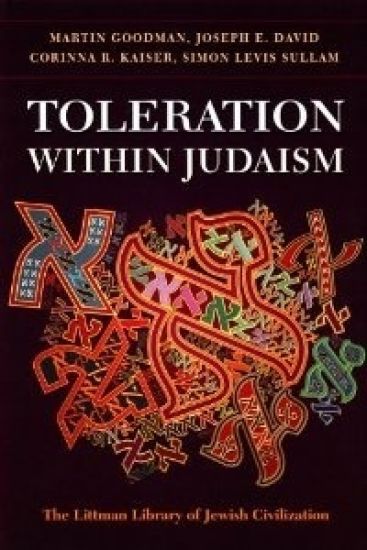
Toleration within Judaism

Toleration within Judaism

Martin Goodman; Joseph E. David; Corinna R. Kaiser; Simon Levis Sullam

The Littman Library of Jewish Civilization
2013
sidottu
The Bible itself calls the Jewish people ‘a company of nations’, suggesting that difference within Judaism is not a new phenomenon. It has continued throughout Jewish history, and this volume investigates how and why such difference has been tolerated. Drawing on examples from different geographical areas and from ancient times to the present, the contributors consider why Jews sometimes attempt to impose constraints on other Jews or relate to them as if they were not Jews at all, but at other times recognize differences of practice and belief and develop ways of handling them. In doing so, they provide an insight into a history of Judaism as a complex web of interactions between groups of Jews despite grounds for mutual antagonism. Substantial introductory chapters lay out the issues and provide an extensive survey of cases of toleration throughout the past two thousand years, outlining possible structural reasons for it. The eight chapters that follow each take a specific case of toleration within Judaism, attempting to explain it in light of the models outlined in the Introduction. Presented in chronological order, the cases have been selected to reflect a spectrum of responses, from grudging forbearance to enthusiastic welcome of difference. Covering both practice and theology, each case is presented in depth, with full documentation. The Conclusion provides an overview of the patterns of tolerance that have emerged and discusses the implications for writing the history of Judaism as a narrative more complex than either the tracing of a linear progression from the Bible to the present, with variations presented as deviations, or as a model of overlapping ‘Judaisms’. This innovative volume sheds light on an important and overlooked aspect of the history of Judaism and should have broad appeal, not only for students and scholars of Judaism but for students of religious studies more generally.
Regional Therapeutics for Advanced Malignancies

Regional Therapeutics for Advanced Malignancies

Martin Goodman

Jaypee Brothers Medical Publishers
2012
sidottu
Regional Therapeutics for Advanced Malignancies is a concise guide to treatment of cancer in different parts of the body. Divided into four sections, this book covers peritoneal disease; gynaecological malignancies; melanoma, sarcoma and lung; and liver. Each section discusses different treatments that may be used to treat cancer within that part of the body. Authored by recognised specialists in the UK and USA, this manual contains more than 120 colour images and illustrations. Key Features Concise guide to treatment of cancer in different regions of the bodyCovers peritoneal disease, gynaecological malignancies, melanoma, sarcoma and lung; and liverEach section discusses different treatment options for that regionRecognised authors from UK and USAMore than 120 colour images and illustrations
The Roman World 44 BC-AD 180

The Roman World 44 BC-AD 180

Martin Goodman

Routledge
2011
nidottu
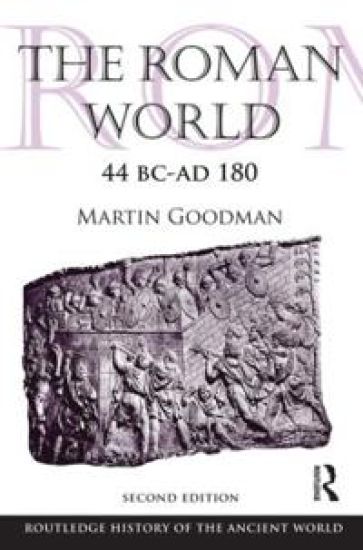
The Roman World 44 BC – AD 180 deals with the transformation of the Mediterranean regions, northern Europe and the Near East by the military autocrats who ruled Rome during this period. The book traces the impact of imperial politics on life in the city of Rome itself and in the rest of the empire, arguing that, despite long periods of apparent peace, this was a society controlled as much by fear of state violence as by consent.Martin Goodman examines the reliance of Roman emperors on a huge military establishment and the threat of force. He analyses the extent to which the empire functioned as a single political, economic and cultural unit and discusses, region by region, how much the various indigenous cultures and societies were affected by Roman rule. The book has a long section devoted to the momentous religious changes in this period, which witnessed the popularity and spread of a series of elective cults and the emergence of rabbinic Judaism and Christianity from the complex world of first-century Judaea. This book provides a critical assessment of the significance of Roman rule for inhabitants of the empire, and introduces readers to many of the main issues currently faced by historians of the early empire.This new edition, incorporating the finds of recent scholarship, includes a fuller narrative history, expanded sections on the history of women and slaves and on cultural life in the city of Rome, many new illustrations, an updated section of bibliographical notes, and other improvements designed to make the volume as useful as possible to students as well as the general reader.
The Roman World 44 BC-AD 180

The Roman World 44 BC-AD 180

Martin Goodman

Routledge
2011
sidottu
The Roman World 44 BC – AD 180 deals with the transformation of the Mediterranean regions, northern Europe and the Near East by the military autocrats who ruled Rome during this period. The book traces the impact of imperial politics on life in the city of Rome itself and in the rest of the empire, arguing that, despite long periods of apparent peace, this was a society controlled as much by fear of state violence as by consent.Martin Goodman examines the reliance of Roman emperors on a huge military establishment and the threat of force. He analyses the extent to which the empire functioned as a single political, economic and cultural unit and discusses, region by region, how much the various indigenous cultures and societies were affected by Roman rule. The book has a long section devoted to the momentous religious changes in this period, which witnessed the popularity and spread of a series of elective cults and the emergence of rabbinic Judaism and Christianity from the complex world of first-century Judaea. This book provides a critical assessment of the significance of Roman rule for inhabitants of the empire, and introduces readers to many of the main issues currently faced by historians of the early empire.This new edition, incorporating the finds of recent scholarship, includes a fuller narrative history, expanded sections on the history of women and slaves and on cultural life in the city of Rome, many new illustrations, an updated section of bibliographical notes, and other improvements designed to make the volume as useful as possible to students as well as the general reader.
Rome and Jerusalem: The Clash of Ancient Civilizations
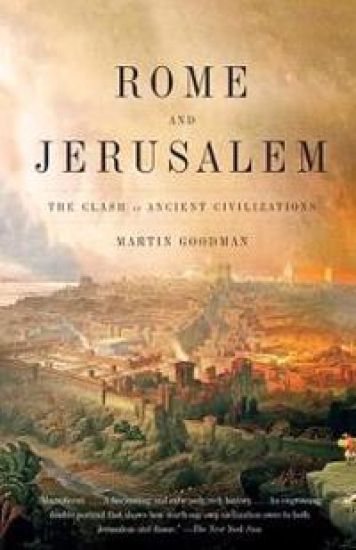
A magisterial history of the titanic struggle between the Roman and Jewish worlds that led to the destruction of Jerusalem. Martin Goodman--equally renowned in Jewish and in Roman studies--examines this conflict, its causes, and its consequences with unprecedented authority and thoroughness. He delineates the incompatibility between the cultural, political, and religious beliefs and practices of the two peoples and explains how Rome's interests were served by a policy of brutality against the Jews. At the same time, Christians began to distance themselves from their origins, becoming increasingly hostile toward Jews as Christian influence spread within the empire. This is the authoritative work of how these two great civilizations collided and how the reverberations are felt to this day.
Rome and Jerusalem

Rome and Jerusalem

Martin Goodman

Penguin Books Ltd
2008
pokkari
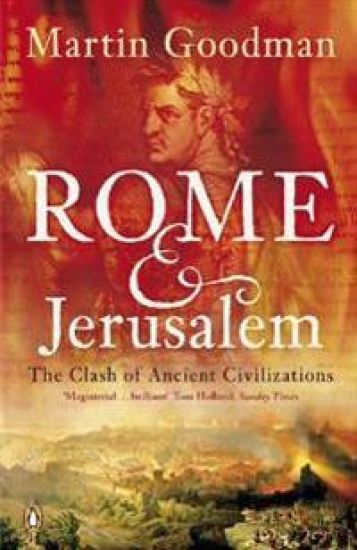
In Rome and Jerusalem: The Clash of Ancient Civilizations, Martin Goodman explores the history of a titanic struggle whose repercussions are still felt today. In 70CE, after four years of Jewish rebellion, Roman legions devastated the great city of Jerusalem. Sixty years later, its ruin was completed when Emperor Hadrian built a new city on top of it that Jews were forbidden even to enter. In this highly acclaimed book, Martin Goodman examines the background and course of this titanic conflict - from the political ambitions of Roman military leaders to the spread of Christian influence through the empire - and its lasting consequences. 'In this remarkable book Martin Goodman casts a truly fresh eye over well-known figures and events' History Today 'Important and powerfully expressed ... The best available general account of a turning point not just in the history of the Roman Empire but also in the development of the modern West' Simon Goldhill, The Times Higher Education Supplement 'Should be read by anyone seeking seriously to understand modern Middle Eastern tangles ... a lucid account of ancient tragedy' Diarmaid MacCulloch, Guardian 'Splendid ... an important book, on a difficult subject : the reason why Romans sought to destroy the Jews and Judaism completely. Only one man would have written it' Paul Johnson, Tablet Martin Goodman has divided his intellectual life between the Roman and Jewish worlds. He has edited both the Journal of Roman Studies and the Journal of Jewish Studies. He has taught Roman History at Birmingham and Oxford Universities, and is currently Professor of Jewish Studies at Oxford.
Judaism in the Roman World

Judaism in the Roman World

Martin Goodman

BRILL
2006
sidottu
Judaism in the Roman World deals with the religious lives of Jews in the Roman world from late Second Temple times to the Later Roman Empire. *** The studies collected here analyse a series of issues important in the development of Judaism in this period: the role of the Temple and pilgrimage in the first century CE; the attitude of Jews to the physical texts of the Torah and to the scribes who produced them; the extent of variety and change within Judaism before and after 70 CE and the nature of the evidence for particular types of Judaism; the role of synagogues and images in Jewish worship; and relations between Jews and Christians in the early centuries. *** This book should be particularly useful to students of ancient Judaism and those interested in Christian origins.
State and Society in Roman Galilee, A.D.132-212

State and Society in Roman Galilee, A.D.132-212

Martin Goodman

Vallentine Mitchell Co Ltd
2001
sidottu
In the second century A.D., Galilee fostered the formation of rabbinic Judaism. The society that flourished there has laid its mark on Judaism ever since, and it is a society that can be fully described through a large corpus of rabbinic writings. In this work, it becomes clear that the development of the independent and unique Jewish culture of Late Roman Palestine was encouraged by the Roman methods of administration, and that the rabbis can be best understood with a full appreciation of the world around them. The book examines Jewish society and administration in Galilee in the period between the Bar Kokhba war and the proclamation of universal Roman citizenship in A.D. 212. Along with epigraphic and archaelogical evidence, the author utilizes the extensive, heterogeneous rabbinic texts from that period to provide an overview of the customs and structure of a village society that is not possible for any other Roman province except Egypt. The author also uses the evidence to challenge common assumptions about the extent of rabbinic authority in Galilean society and its ability to change in response to social pressures.
Mission and Conversion

Mission and Conversion

Martin Goodman

Clarendon Press
1995
nidottu
This book tackles a central problem of Jewish and comparative religious history: proselytization and the origins of mission in the Early Church. Why did some individuals in the first four centuries of the Christian era believe it desirable to persuade as many outsiders to join their religious group, while others did not? In this book, the author offers a radical new explanation of the origins of mission in this period, arguing that mission is not an inherent religious instinct, that in antiquity it was found only sporadically among Jews and pagans, and that even Christians rarely stressed its importance in the early centuries. In the first half of the book, Dr Goodman makes a detailed and radical re-evaluation of the evidence for Jewish missionary attitudes in the late Second Temple and Talmudic periods, overturning many commonly held assumptions about the history of Judaism, in particular the view that Jews proselytized energetically in the first century AD. This leads him on to take issue with the common notion that the early Christian mission to the gentiles imitated or competed with contemporary Jews. Finally, the author puts forward some novel suggestions as to how the Jewish background to Christianity may nonetheless have contributed to the enthusiastic adoption of universal proselytization by some followers of Jesus in the apostolic age.
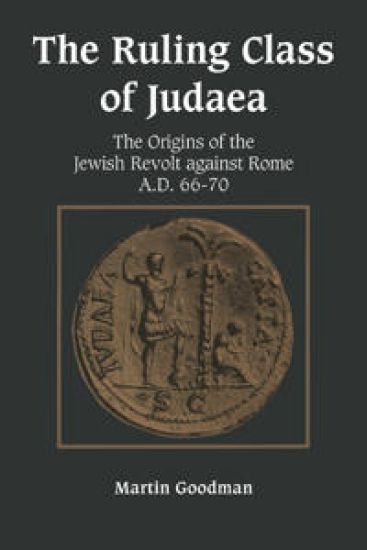
The Ruling Class of Judaea

The Ruling Class of Judaea

Martin Goodman

Cambridge University Press
1993
pokkari
This book examines why in AD 66 a revolt against Rome broke out in Judaea. It attempts to explain both the rebellion itself and its temporary success by discussing the role of the Jewish ruling class in the sixty years preceding the war and within the independent state which lasted until the destruction of the Temple in AD 70. The author seeks to show that the ultimate cause of the Revolt was a misunderstanding by Rome of the status criteria of Jewish society. The importance of the subject lies both in the significance of the history of Judaea in this period for the development of Judaism and early Christianity and in the light shed on Roman methods of provincial administration in general by an understanding of why Rome was unable to control a society with cultural values so different from its own.