Kirjojen hintavertailu. Mukana 12 390 323 kirjaa ja 12 kauppaa.

Kirjailija

Martin Hilpert

Kirjat ja teokset yhdessä paikassa: 10 kirjaa, julkaisuja vuosilta 2008-2026, suosituimpien joukossa Models of Modals. Vertaile teosten hintoja ja tarkista saatavuus suomalaisista kirjakaupoista.

10 kirjaa

Kirjojen julkaisuhaarukka 2008-2026.

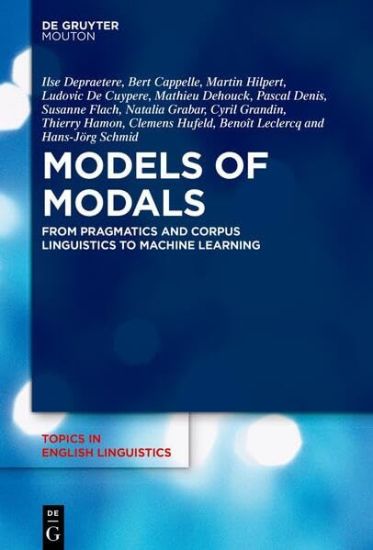
Models of Modals

Models of Modals

Ilse Depraetere; Bert Cappelle; Martin Hilpert; Ludovic De Cuypere; Mathieu Dehouck; Pascal Denis; Susanne Flach; Natalia Grabar; Cyril Grandin; Thierry Hamon; Clemens Hufeld; Benoît Leclercq; Hans-Jörg Schmid

De Gruyter
2024
isokokoinen pokkari
Modal verbs in English communicate delicate shades of meaning, there being a large range of verbs both on the necessity side (must, have to, should, ought to, need, need to) and the possibility side (can, may, could, might, be able to). They therefore constitute excellent test ground to apply and compare different methodologies that can lay bare the factors that drive the speaker’s choice of modal verb. This book is not merely concerned with a purely grammatical description of the use of modal verbs, but aims at advancing our understanding of lexical and grammatical units in general and of linguistic methodologies to explore these. It thus involves a genuine effort to compare, assess and combine a variety of approaches. It complements the leading descriptive qualitative work on modal verbs by testing a diverse range of quantitative methods, while not ignoring qualitative issues pertaining to the semantics-pragmatics interface. Starting from a critical assessment of what constitutes the meaning of modal verbs, different types of empirical studies (usage-based, data-driven and experimental), drawing considerably on the same data sets, shows how method triangulation can contribute to an enhanced understanding. Due attention is also given to individual variation as well as the degree to which modals can predict L2 proficiency level.

Models of Modals

Models of Modals

Ilse Depraetere; Bert Cappelle; Martin Hilpert; Ludovic De Cuypere; Mathieu Dehouck; Pascal Denis; Susanne Flach; Natalia Grabar; Cyril Grandin; Thierry Hamon; Clemens Hufeld; Benoît Leclercq; Hans-Jörg Schmid

De Gruyter
2023
sidottu
Modal verbs in English communicate delicate shades of meaning, there being a large range of verbs both on the necessity side (must, have to, should, ought to, need, need to) and the possibility side (can, may, could, might, be able to). They therefore constitute excellent test ground to apply and compare different methodologies that can lay bare the factors that drive the speaker’s choice of modal verb. This book is not merely concerned with a purely grammatical description of the use of modal verbs, but aims at advancing our understanding of lexical and grammatical units in general and of linguistic methodologies to explore these. It thus involves a genuine effort to compare, assess and combine a variety of approaches. It complements the leading descriptive qualitative work on modal verbs by testing a diverse range of quantitative methods, while not ignoring qualitative issues pertaining to the semantics-pragmatics interface. Starting from a critical assessment of what constitutes the meaning of modal verbs, different types of empirical studies (usage-based, data-driven and experimental), drawing considerably on the same data sets, shows how method triangulation can contribute to an enhanced understanding. Due attention is also given to individual variation as well as the degree to which modals can predict L2 proficiency level.
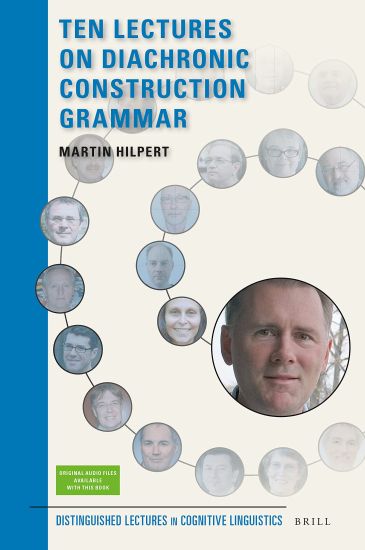
Ten Lectures on Diachronic Construction Grammar
In this book, Martin Hilpert lays out how Construction Grammar can be applied to the study of language change. In a series of ten lectures on Diachronic Construction Grammar, the book presents the theoretical foundations, open questions, and methodological approaches that inform the constructional analysis of diachronic processes in language. The lectures address issues such as constructional networks, competition between constructions, shifts in collocational preferences, and differentiation and attraction in constructional change. The book features analyses that utilize modern corpus-linguistic methodologies and that draw on current theoretical discussions in usage-based linguistics. It is relevant for researchers and students in cognitive linguistics, corpus linguistics, and historical linguistics.
Construction Grammar and its Application to English

Construction Grammar and its Application to English

Martin Hilpert

Edinburgh University Press
2019
sidottu
What do speakers of English know in order to produce utterances that other speakers will understand? Construction Grammar explains how knowledge of language is organized in speakers' minds. The central and radical claim of Construction Grammar is that linguistic knowledge can be fully described as knowledge of constructions, which are defined as symbolic units that connect a linguistic form with meaning. The implications of this claim are far-reaching: in Construction Grammar, not only lexical items, but also syntactic patterns are seen as symbolic, meaningful units. Instead of being meaningless structural templates, syntactic patterns actively contribute to the overall meaning of an utterance. Knowledge of language is thought of as a vast repository of interrelated symbolic units, and nothing else in addition. This book expands on this idea and familiarizes readers with the central concepts of Construction Grammar, as applied to English constructions. In the process, it explains how the theory of Construction Grammar relates to issues of language processing, language acquisition, and language variation and change.
Construction Grammar and its Application to English

Construction Grammar and its Application to English

Martin Hilpert

Edinburgh University Press
2019
nidottu
What do speakers of English know in order to produce utterances that other speakers will understand? Construction Grammar explains how knowledge of language is organized in speakers' minds. The central and radical claim of Construction Grammar is that linguistic knowledge can be fully described as knowledge of constructions, which are defined as symbolic units that connect a linguistic form with meaning. The implications of this claim are far-reaching: in Construction Grammar, not only lexical items, but also syntactic patterns are seen as symbolic, meaningful units. Instead of being meaningless structural templates, syntactic patterns actively contribute to the overall meaning of an utterance. Knowledge of language is thought of as a vast repository of interrelated symbolic units, and nothing else in addition. This book expands on this idea and familiarizes readers with the central concepts of Construction Grammar, as applied to English constructions. In the process, it explains how the theory of Construction Grammar relates to issues of language processing, language acquisition, and language variation and change.
Constructional Change in English

Constructional Change in English

Martin Hilpert

Cambridge University Press
2015
pokkari
Martin Hilpert combines construction grammar and advanced corpus-based methodology into a new way of studying language change. Constructions are generalizations over remembered exemplars of language use. These exemplars are stored with all their formal and functional properties, yielding constructional generalizations that contain many parameters of variation. Over time, as patterns of language use are changing, the generalizations are changing with them. This book illustrates the workings of constructional change with three corpus-based studies that reveal patterns of change at several levels of linguistic structure, ranging from allomorphy to word formation and to syntax. Taken together, the results strongly motivate the use of construction grammar in research on diachronic language change. This new perspective has wide-ranging consequences for the way historical linguists think about language change. It will be of particular interest to linguists working on morpho-syntax, sociolinguistics and corpus linguistics.
Constructional Change in English

Constructional Change in English

Martin Hilpert

Cambridge University Press
2013
sidottu
Martin Hilpert combines construction grammar and advanced corpus-based methodology into a new way of studying language change. Constructions are generalizations over remembered exemplars of language use. These exemplars are stored with all their formal and functional properties, yielding constructional generalizations that contain many parameters of variation. Over time, as patterns of language use are changing, the generalizations are changing with them. This book illustrates the workings of constructional change with three corpus-based studies that reveal patterns of change at several levels of linguistic structure, ranging from allomorphy to word formation and to syntax. Taken together, the results strongly motivate the use of construction grammar in research on diachronic language change. This new perspective has wide-ranging consequences for the way historical linguists think about language change. It will be of particular interest to linguists working on morpho-syntax, sociolinguistics and corpus linguistics.
Die jüdische Jugendbewegung

Die jüdische Jugendbewegung

Martin Hilpert

Grin Publishing
2008
pokkari
Studienarbeit aus dem Jahr 2007 im Fachbereich P dagogik - Sonstiges, Note: keine, Martin-Luther-Universit t Halle-Wittenberg (FB Erziehungswissenschaften), Veranstaltung: Seminar: Zur Geschichte der Kindheit im deutschen Judentum, 14 Quellen im Literaturverzeichnis, Sprache: Deutsch, Abstract: Als im nationalsozialistischen Deutschland die Aufkl rung in ihr Gegenteil - die Barbarei - umschlug, fielen sechs Millionen europ ischen Juden dem systematisch geplanten und industriell durchgef hrten Massenmord zum Opfer. Die Shoa wurde bis auf wenige Ausnahmen unwidersprochen von der gesamten deutschen Bev lkerung getragen. Von zentraler Bedeutung f r die unmenschlichen Handlungen der Nationalsozialisten ist das antisemitische Ressentiment, welches eine lange Tradition hat. Der Antisemitismus in der deutschen Gesellschaft f hrte nicht zuletzt zur Herausbildung einer eigenst ndigen j dischen Jugendbewegung. Gegenstand dieser Arbeit ist, die Konstitutionsbedingungen f r das Entstehen der J dischen Jugendbewegung zu beleuchten und deren soziale wie existenzielle Relevanz f r j dische Menschen aufzuzeigen. Meine Betrachtungen konzentrieren sich auf die Gr ndungsphase der j dischen Jugendbewegung zu Beginn des 20. Jahrhunderts. Im ersten Kapitel gebe ich einen Abriss der allgemeinen gesellschaftspolitischen Situation in Deutschland zu Beginn des 20. Jahrhunderts. Das zweite Kapitel wendet sich der Verfasstheit der allgemeinen deutschen Jugendbewegung zu und expliziert antisemitische Tendenzen innerhalb dieser. Daran ankn pfend beschreibe ich j dische Reaktionen auf den erstarkenden Antisemitismus und fokussiere die Herausbildung postassimilatorischer Str mungen. Das letzte Kapitel ist der konkreten Betrachtung der J dischen Jugendbewegung gewidmet und stellt exemplarisch anhand des gr ten j dischen Wanderbundes Blau-Wei die Entwicklung einer zionistischen Jugendorganisation dar. Die Jugendb nde organisations- bzw. strukturgeschichtlich zu analysieren wird in dieser Arbeit ni