Kirjojen hintavertailu. Mukana 12 152 606 kirjaa ja 12 kauppaa.

Kirjailija

Martin J. Gander

Kirjat ja teokset yhdessä paikassa: 5 kirjaa, julkaisuja vuosilta 2014-2024, suosituimpien joukossa Scientific Computing - An Introduction using Maple and MATLAB. Vertaile teosten hintoja ja tarkista saatavuus suomalaisista kirjakaupoista.

5 kirjaa

Kirjojen julkaisuhaarukka 2014-2024.

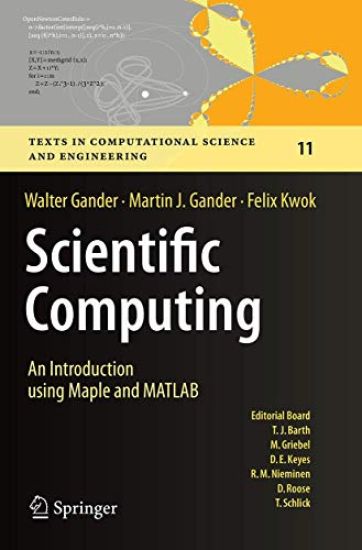
Scientific Computing -  An Introduction using Maple and MATLAB

Scientific Computing - An Introduction using Maple and MATLAB

Walter Gander; Martin J. Gander; Felix Kwok

Springer International Publishing AG
2016
nidottu
Scientific computing is the study of how to use computers effectively to solve problems that arise from the mathematical modeling of phenomena in science and engineering. It is based on mathematics, numerical and symbolic/algebraic computations and visualization. This book serves as an introduction to both the theory and practice of scientific computing, with each chapter presenting the basic algorithms that serve as the workhorses of many scientific codes; we explain both the theory behind these algorithms and how they must be implemented in order to work reliably in finite-precision arithmetic. The book includes many programs written in Matlab and Maple – Maple is often used to derive numerical algorithms, whereas Matlab is used to implement them. The theory is developed in such a way that students can learn by themselves as they work through the text. Each chapter contains numerous examples and problems to help readers understand the material “hands-on”.
Scientific Computing -  An Introduction using Maple and MATLAB

Scientific Computing - An Introduction using Maple and MATLAB

Walter Gander; Martin J. Gander; Felix Kwok

Springer International Publishing AG
2014
sidottu
Scientific computing is the study of how to use computers effectively to solve problems that arise from the mathematical modeling of phenomena in science and engineering. It is based on mathematics, numerical and symbolic/algebraic computations and visualization. This book serves as an introduction to both the theory and practice of scientific computing, with each chapter presenting the basic algorithms that serve as the workhorses of many scientific codes; we explain both the theory behind these algorithms and how they must be implemented in order to work reliably in finite-precision arithmetic. The book includes many programs written in Matlab and Maple – Maple is often used to derive numerical algorithms, whereas Matlab is used to implement them. The theory is developed in such a way that students can learn by themselves as they work through the text. Each chapter contains numerous examples and problems to help readers understand the material “hands-on”.
Time Parallel Time Integration

Time Parallel Time Integration

Martin J. Gander; Thibaut Lunet

SOCIETY FOR INDUSTRIAL APPLIED MATHEMATICS,U.S.
2024
nidottu
Predicting the future is a difficult task but, as with the weather, it is possible with good models. But how does one predict the far future before the near future is known? Time parallel time integration, also known as PinT (Parallel-in-Time) methods, aims to predict the near and far future simultaneously. In this self-contained book, the first on the topic, readers will find a comprehensive and up-to-date description of methods and techniques that have been developed to do just this.The authors describe the four main classes of PinT methods: shooting-type methods, waveform relaxation methods, time parallel multigrid methods, and direct time parallel methods. In addition, they provide historical background for each of the method classes, complete convergence analyses for the most representative variants of the methods in each class, and illustrations and runnable MATLAB code.
Iterative Methods and Preconditioners for Systems of Linear Equations

Iterative Methods and Preconditioners for Systems of Linear Equations

Gabriele Ciaramella; Martin J. Gander

SOCIETY FOR INDUSTRIAL APPLIED MATHEMATICS,U.S.
2022
nidottu
Iterative methods use successive approximations to obtain more accurate solutions. Iterative Methods and Preconditioners for Systems of Linear Equationspresents historical background,derives complete convergence estimates for all methods, illustrates and provides Matlab codes for all methods, and studies and tests all preconditioners first as stationary iterative solvers.This textbook is appropriate for undergraduate and graduate students in need of an overview or of deeper knowledge about iterative methods. It can be used in courses on Advanced Numerical Analysis, Special Topics on Numerical Analysis, Topics on Data Science, Topics on Numerical Optimization, and Topics on Approximation Theory. Scientists and engineers interested in new topics and applications will also find the text useful.
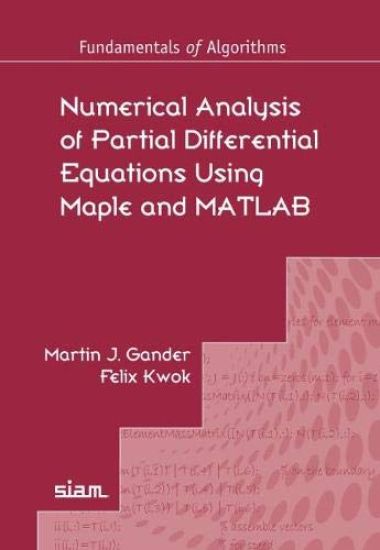
Numerical Analysis of Partial Differential Equations Using Maple and MATLAB

Numerical Analysis of Partial Differential Equations Using Maple and MATLAB

Martin J. Gander; Felix Kwok

Society for Industrial Applied Mathematics,U.S.
2018
nidottu
This book provides an elementary yet comprehensive introduction to the numerical solution of partial differential equations (PDEs). Used to model important phenomena, such as the heating of apartments and the behavior of electromagnetic waves, these equations have applications in engineering and the life sciences, and most can only be solved approximately using computers.Numerical Analysis of Partial Differential Equations Using Maple and MATLAB provides detailed descriptions of the four major classes of discretization methods for PDEs (finite difference method, finite volume method, spectral method, and finite element method) and runnable MATLAB® code for each of the discretization methods and exercises. It also gives self-contained convergence proofs for each method using the tools and techniques required for the general convergence analysis but adapted to the simplest setting to keep the presentation clear and complete.This book is intended for advanced undergraduate and early graduate students in numerical analysis and scientific computing and researchers in related fields. It is appropriate for a course on numerical methods for partial differential equations.