Kirjojen hintavertailu. Mukana 12 390 323 kirjaa ja 12 kauppaa.

Kirjailija

Martin L. Cody

Kirjat ja teokset yhdessä paikassa: 3 kirjaa, julkaisuja vuosilta 1974-2019, suosituimpien joukossa Island Biogeography in the Sea of Cortés II. Vertaile teosten hintoja ja tarkista saatavuus suomalaisista kirjakaupoista.

3 kirjaa

Kirjojen julkaisuhaarukka 1974-2019.

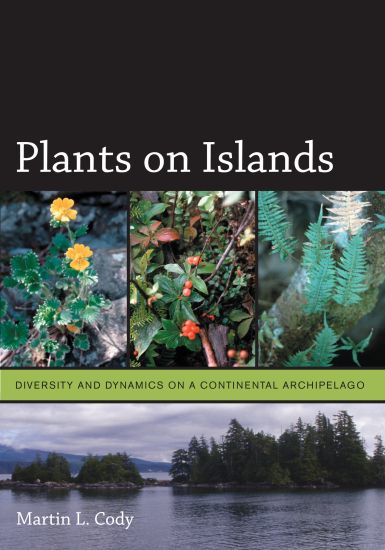
Plants on Islands

Plants on Islands

Martin L. Cody

University of California Press
2019
sidottu
This thorough and meticulous study, the result of nearly a quarter-century of research, examines the island biogeography of plants on continental islands in Barkley Sound, British Columbia. Invaluable both because of its geographical setting and because of the duration of the study, Plants on Islands summarizes the diversity, dynamics, and distribution of the approximately three hundred species of plants on more than two hundred islands. Martin Cody uses his extensive data set to test various aspects of island biogeographic theory. His thoughtful analysis, constrained by taxon and region, elucidates and enhances the understanding of the biogeographic patterns and dynamics. He provides an overview of the basic theory, concepts, and analytical tools of island biogeography. Also discussed are island relaxation to lower equilibrium species numbers post-isolation, plant distributions variously limited by island area, isolation and climatic differences, adaptation to local abiotic and biotic environments within islands, and the evolution of different island phenotypes. The book concludes with a valuable consideration of equilibrium concepts and of the interplay of coexistence and competition. Certain to challenge, Plants on Islands is among the first books to critically analyze the central tenets of the theory of island biogeography.

Island Biogeography in the Sea of Cortés II

Island Biogeography in the Sea of Cortés II

Ted J. Case; Martin L. Cody; Exequiel Ezcurra

Oxford University Press Inc
2002
sidottu
This updated and expanded A New Island Biogeography of the Sea of Cortez, first published nearly 20 years ago, integrates new and broader studies encompassing more taxa and more complete island coverage. The present synthesis provides a basis for further research and exploration in upcoming years of the biologically fascinating Sea of Cort^d's region. The Gulf region is increasingly being exploited, for its natural resources by way of marine fisheries, and for its stunning natural beauty by way of a burgeoning tourism industry. Further, the region's human population is increasing apace. It is appropriate, therefore, that this volume discusses these evolving circumstances, and the efforts of the Mexican government to regulate and manage them. The new Biogeography includes a section on the conservation issues in the Sea of Cort^d'es, past accomplishments and conservation needs as yet outstanding. This book should be of strong interest to conservation biologists, ecologists, and evolutionary biologists more generally.
Competition and the Structure of Bird Communities

Competition and the Structure of Bird Communities

Martin L. Cody

Princeton University Press
1974
pokkari
Professor Cody's monograph emphasizes the role of competition at levels above single species populations, and describes how competition, by way of the niche concept, determines the structure of communities. Communities may be understood in terms of resource gradients, or niche dimensions, along which species become segregated through competitive interactions. Most communities appear to exist in three or four such dimensions. The first three chapters describe the resource gradients (habitat types, foraging sites, food types), show what factors restrict species to certain parts of the resource gradients and so determine niche breadths, and illustrate the important role of resource predictability in niche overlap between species for resources they share. Most examples are drawn from eleven North and South American bird communities, although the concepts and methodology are far more general. Next, the optimality of community structure is tested through parallel and convergent evolution on different continents with similar climates and habitats, and the direct influence of competitors on resource use is investigated by comparisons of species--poor island communities to species-rich mainland ones. Finally, the author discusses those sorts of environments in which the evolution of one species--one resource set is not achieved, and where alternative schemes of resource allocation, often involving several species that act ecologically as one, must be followed.