Kirjojen hintavertailu. Mukana 12 390 323 kirjaa ja 12 kauppaa.

Kirjailija

Martin Paldam

Kirjat ja teokset yhdessä paikassa: 3 kirjaa, julkaisuja vuosilta 2013-2021, suosituimpien joukossa The Good Society. Vertaile teosten hintoja ja tarkista saatavuus suomalaisista kirjakaupoista.

3 kirjaa

Kirjojen julkaisuhaarukka 2013-2021.

The Grand Pattern of Development and the Transition of Institutions
The culmination of a long-lasting and impressive research program, this book summarizes the relationship between economic development with income on the one hand and the evolution of institutions on the other; the transition of countries from one economic and social system to another. The author considers the transitions of two types of institutions: The first is external; it is legal-administrative systems with staff and buildings. The political system and the economic system are considered. The second consists of traditions and beliefs. Here corruption and religiosity are considered. Contrary to the claim that institutions are causal to development, this book demonstrates that the main direction of causality is from income to institutions. As countries get wealthy, they become secular democracies with low corruption and a mixed economic system. In this impressive coda, Paldam shows that the evolution of institutions is not causal to the economic growth process but rather follows it.
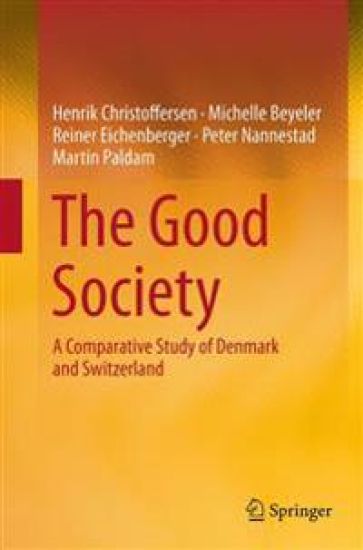
The Good Society

The Good Society

Henrik Christoffersen; Michelle Beyeler; Reiner Eichenberger; Peter Nannestad; Martin Paldam

Springer-Verlag Berlin and Heidelberg GmbH Co. K
2016
nidottu
Denmark and Switzerland are small and successful countries with exceptionally content populations. However, they have very different political institutions and economic models. They have followed the general tendency in the West toward economic convergence, but both countries have managed to stay on top. They both have a strong liberal tradition, but otherwise their economic strategies are a welfare state model for Denmark and a safe haven model for Switzerland. The Danish welfare state is tax-based, while the expenditures for social welfare are insurance-based in Switzerland. The political institutions are a multiparty unicameral system in Denmark, and a permanent coalition system with many referenda and strong local government in Switzerland. Both approaches have managed to ensure smoothly working political power-sharing and economic systems that allocate resources in a fairly efficient way. To date, they have also managed to adapt the economies to changes in the external environment with a combination of stability and flexibility.
The Good Society

The Good Society

Henrik Christoffersen; Michelle Beyeler; Reiner Eichenberger; Peter Nannestad; Martin Paldam

Springer-Verlag Berlin and Heidelberg GmbH Co. K
2013
sidottu
Denmark and Switzerland are small and successful countries with exceptionally content populations. However, they have very different political institutions and economic models. They have followed the general tendency in the West toward economic convergence, but both countries have managed to stay on top. They both have a strong liberal tradition, but otherwise their economic strategies are a welfare state model for Denmark and a safe haven model for Switzerland. The Danish welfare state is tax-based, while the expenditures for social welfare are insurance-based in Switzerland. The political institutions are a multiparty unicameral system in Denmark, and a permanent coalition system with many referenda and strong local government in Switzerland. Both approaches have managed to ensure smoothly working political power-sharing and economic systems that allocate resources in a fairly efficient way. To date, they have also managed to adapt the economies to changes in the external environment with a combination of stability and flexibility.