Kirjojen hintavertailu. Mukana 12 595 353 kirjaa ja 12 kauppaa.

Kirjailija

Martin Porter

Kirjat ja teokset yhdessä paikassa: 4 kirjaa, julkaisuja vuosilta 2000-2025, suosituimpien joukossa Environmental Governance in Europe. Vertaile teosten hintoja ja tarkista saatavuus suomalaisista kirjakaupoista.

4 kirjaa

Kirjojen julkaisuhaarukka 2000-2025.

Buzz Me In

Buzz Me In

Martin Porter; David Goggin

THAMES HUDSON LTD
2025
sidottu
The inside story of Record Plant studios – the real ‘Hotel California’ – that reveals how the greatest music of the seventies was recorded and why the artists checked out but rarely left. In the 1970s, Record Plant Studios was ground zero for the largest boom in record production in music history. With complexes in New York, Los Angeles and Sausalito, and a fleet of remote recording trucks, Record Plant was everywhere there was music. In 1976 alone, the studio produced three number-one albums: Stevie Wonder’s Songs in the Key of Life, the Eagles’ Hotel California and Fleetwood Mac’s Rumours. Written by two veteran music journalists, this engrossing book tells the incredible story of the evolution of Record Plant Studios tape by tape. Starting on the westside of New York in 1968 with the recording of Jimi Hendrix’s Electric Ladyland, Record Plant expanded to LA, where Stevie Wonder produced his greatest hits, and then to Sausalito where Sly Stone, Bob Marley and Fleetwood Mac encamped; John Lennon made New York his post-Beatles home, and the Eagles conceived Hotel California while working in LA. Each location showcased the founders’ proven formula of combining state-of-the-art audio, fantasy bedrooms and group jacuzzis, with sex, drugs and celebrity jams. Largely based on the memoirs and archives of studio co-founder Chris Stone, and supplemented by interviews with over 100 studio employees, music producers and recording artists, this is the untold story, in all its brazen glory, of the recording of classic rock’n’roll as told by the insiders who gladly toiled behind the locked doors of the most prolific recording factory of all time.

Windows of the Soul

Windows of the Soul

Martin Porter

Clarendon Press
2005
sidottu
In late fifteenth century Florence, Renaissance humanists rediscovered a secret, natural language hidden in the visual wisdom of the proverb 'the eyes are the windows of the soul'. Through its magical prism, the language of eyes, faces, voices, laughs, walks, even stones, plants and animals, all became windows into the souls of other people, of oneself, of nature, and ultimately of God. Some saw in its words the perfect hieroglyphic language by which Adam had first named nature, which, when combined with the art of memory, could bring about a form of 'inner writing' or mystical self-transformation. Yet many others dismissed it as a collection of arbitrary conventions, superstitious enigmas, or 'gypsy' riddles. Embroiled in the religious persecution of the Reformation, rejected as a science during the Scientific Revolution, in the age of Enlightenment physiognomy came to be seen as nothing more than an amusing entertainment. But with the dawn of Romanticism, be it in the realms of science, religion, or poetry, some began to see that physiognomy was no game and the flame of serious interest in physiognomy was once again rekindled. Combining book history and visual history, Dr Porter reconstructs this physiognomical eye, interprets the way in which books on physiognomy were read and traces the wider intellectual, social, and cultural changes that contributed to the metamorphosis of this way of beholding oneself and the natural world from the Renaissance to the dawn of Romanticism.
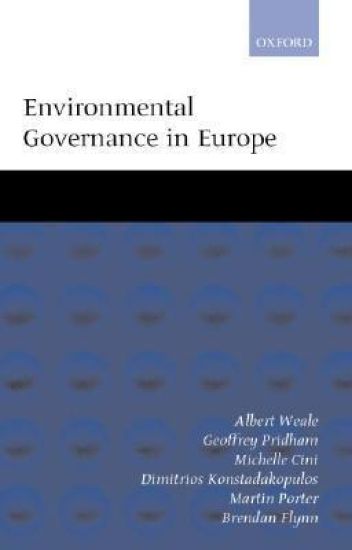
Environmental Governance in Europe

Environmental Governance in Europe

Albert Weale; Geoffrey Pridham; Michelle Cini; Dimitrios Konstadakopulos; Martin Porter; Brendan Flynn

Oxford University Press
2002
nidottu
Over the last thirty years, the European Union has created a system of environmental governance in Europe. With a large number of legislative measures, the EU's environmental policy is broad in scope, extensive in detail and often stringent in effect. Environmental governance also extends to the ways in which decision making on environmental policy has become institutionalized within Europe, both at the level of the EU itself and in the practices of the member states. This work seeks to understand this new system of environmental governance both at the European level and at the level of member states. It argues that the system is multi-level, horizontally complex, evolving and incomplete. Locating developments at the European level in theories of European integration, it goes on to examine the extent of convergence and divergence in environmental policy among six member states: Germany, Spain, Greece, Italy, the Netherlands, and the UK. It then looks at the operation of the system of environmental governance through an examination of policy case studies before examining the wider political significance of these developments.
Environmental Governance in Europe

Environmental Governance in Europe

Albert Weale; Geoffrey Pridham; Michelle Cini; Dimitrios Konstadakopulos; Martin Porter; Brendan Flynn

Oxford University Press
2000
sidottu
Over the last thirty years, the European Union has created a system of environmental governance in Europe. With a large number of legislative measures, the EU's environmental policy is broad in scope, extensive in detail and often stringent in effect. Environmental governance also extends to the ways in which decision making on environmental policy has become institutionalized within Europe, both at the level of the EU itself and in the practices of the member states. This work seeks to understand this new system of environmental governance both at the European level and at the level of member states. It argues that the system is multi-level, horizontally complex, evolving and incomplete. Locating developments at the European level in theories of European integration, it goes on to examine the extent of convergence and divergence in environmental policy among six member states: Germany, Spain, Greece, Italy, the Netherlands, and the UK. It then looks at the operation of the system of environmental governance through an examination of policy case studies before examining the wider political significance of these developments.