Kirjojen hintavertailu. Mukana 12 595 353 kirjaa ja 12 kauppaa.

Kirjailija

Martin Rees

Kirjat ja teokset yhdessä paikassa: 24 kirjaa, julkaisuja vuosilta 1998-2027, suosituimpien joukossa What We Still Don't Know. Vertaile teosten hintoja ja tarkista saatavuus suomalaisista kirjakaupoista.

24 kirjaa

Kirjojen julkaisuhaarukka 1998-2027.

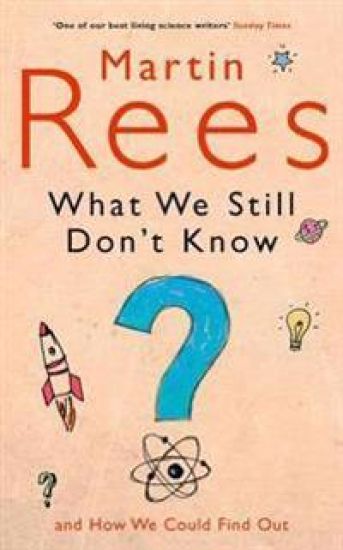
What We Still Don't Know

What We Still Don't Know

Martin Rees

Allen Lane
2027
sidottu
Science in the twenty-first century inherits a fantastic record of accomplishment. Yet there remain enormous questions to answer - some of them revealed by those very past successes. Why is 95 per cent of the universe undetectable dark matter', and does it control the cosmos - how it began, its eventual fate and whether it is finite or infinite? Is our universe the only one, or could there be an infinity of others? Do other universes operate on different physical laws. Is there complex life in other star systems. If so, how far could it outstrip our intelligence? Could a sufficiently advanced life form even create new universes to its own design? In this playful and accessible book, Britain's best-known commentator on the most profound questions in science looks at whether they could be answered and asks, if they are, will the human brain be capable of comprehending the results? What we Still Don't Know looks beyond the edge of current scientific understanding, and poses problems for a new generation of inquiry.
If Science is to Save Us

If Science is to Save Us

Martin Rees

JOHN WILEY AND SONS LTD
2026
nidottu
There has never been a time when ‘following the science’ has been more important for humanity. At no other point in history have we had such advanced knowledge and technology at our fingertips, nor had such astonishing capacity to determine the future of our planet. But the decisions we must make on how science is applied belong outside the lab and should be the outcome of wide public debate. For that to happen, science needs to become part of our common culture. Science is not just for scientists: if it were, it could never save us from the multiple crises we face. For science can save us, if its innovations mesh carefully into society and its applications are channelled for the common good. As Martin Rees argues in this expert and personal analysis of the scientific endeavour on which we all depend, we need to think globally, we need to think rationally and we need to think long-term, empowered by twenty-first-century technology but guided by values that science alone cannot provide. Also available as an audiobook.
Vaid kuus arvu

Vaid kuus arvu

Martin Rees

UNKNOWN
2025
nidottu
Inimesed on uudishimulikud. Me soovime teada oma kosmilist päritolu, see kajastub muistendites ja usundites. Juba antiikajal tekkis vajadus aja täpsemaks arvestuseks ja oma asukoha määramiseks, et suhelda naabritega ja võtta ette pikemaid reise. Nii loodi antiikne maailmapilt. Aja jooksul see täienes ja muutus. Kokkuvõtteks võib öelda, et Martin Reesi raamat on suurepärane sissejuhatus moodsasse kosmoloogiasse, mis aitab meil mõista meie Universumi ehitust ja arengut ning alles lahendamist ootavaid probleeme. Eesti väljaande on inglise keelest tõlkinud Peeter Einasto, järelsõna on sellele kirjutanud Jaan Einasto.
The Shape of Wonder: How Scientists Think, Work, and Live

The Shape of Wonder: How Scientists Think, Work, and Live

Alan Lightman; Martin Rees

Pantheon Books
2025
sidottu
In this captivating, insightful book, acclaimed physicists Alan Lightman and Martin Rees illuminate the life and work of numerous scientists in order to demystify the scientific process and show that scientists are concerned citizens, just like the rest of us. "Remarkable. . . . Illuminating with refreshing clarity the ordinary and sometimes extraordinary work of scientists. This book is essential reading." --Jennifer Ackerman, bestselling author of What an Owl Knows In an age of rapid scientific discovery and technological advancement, it's understandable that many feel uneasy about the future. While we might have confidence in these new developments when we go to the hospital for a medical procedure, fly in an airplane, or take an elevator to the top floor of a building, the motivations and lives of scientists themselves feel shrouded from public view. There is a growing sense that scientists are not to be trusted--that they may be guided by political or financial interests, or beholden to governments, or state institutions. This growing mistrust of scientists is an urgent problem. With the onset of climate change, the imminent threats of pandemic or nuclear war, and rapid acceleration in the fields of artificial intelligence and DNA sequencing, innovations in science have the potential to change the world. It's crucial that we not only gain a better understanding of science as a field, but also reestablish trust with its practitioners. The Shape of Wonder guides us through the fascinating lives and minds of scientists around the world and throughout time, from a young theoretical physicist who works as a research assistant professor at the University of Washington and rock climbs in their free time; to German physicist Werner Heisenberg in his early life, when he was a student of music and philosophy; to Govind Swarup, an Indian astronomer whose work on radio telescopes was profoundly important. We get an inside peek at what makes scientists tick--their daily lives, passions, and concerns about the societies they live in. In this brilliant and elucidative work, Lightman and Rees pull back the curtain on the field of science, revealing that scientists are driven by the same sense of curiosity, wonder, and responsibility towards the future that shapes us all.
Vsego shest chisel: Glavnye sily, formirujuschie Vselennuju
Kljuchevye ponjatija kosmologii opisany dostupnym jazykom, bez ispolzovanija slozhnogo matematicheskogo apparataV knige vsemirno izvestnogo astrofizika, chlena Korolevskogo astronomicheskogo obschestva sera Martina Risa opisyvajutsja fundamentalnye sily, upravljajuschie nashej Vselennoj. Avtor utverzhdaet, chto rasshirjajuschajasja Vselennaja mozhet byt opredelena vsego shestju chislami: N, e, W, l, Q, D, kazhdoe iz kotorykh igraet osobuju i reshajuschuju rol v ee evoljutsii, a vmeste oni opredeljajut ee razvitie i potentsial vozmozhnostej.Dva iz nikh svjazany s osnovnymi silami; drugie dva opredeljajut razmer i obschuju strukturu Vselennoj i pokazyvajut, budet li ona suschestvovat vechno; esche dva govorjat o svojstvakh samoj Vselennoj. Esli by ljuboe iz nikh bylo chut chut drugim, ne bylo by zvezd i ne mogla by suschestvovat zhizn.My mogli pojavitsja - i suschestvuem sejchas - tolko vo Vselennoj s pravilnoj kombinatsiej etikh osnovopolagajuschikh chisel. A potomu osoznanie etogo daet sovershenno novuju tochku zrenija na Vselennuju i nashe mesto v nej, a takzhe na samu prirodu fizicheskikh zakonov.Martinu Risu udalos dostupnym jazykom, bez ispolzovanija slozhnogo matematicheskogo apparata opisat kljuchevye ponjatija kosmologii, kotoraja stremitelno razvivaetsja i segodnja nakhoditsja na perednem krae nauki.Tsitata"Sila tjagotenija po-prezhnemu ostaetsja tainstvennoj. Ona ozadachivaet bolshe, chem ljubaja drugaja sila prirody. No eto byla pervaja sila, opisannaja matematicheskim putem. V XVII v. ser Isaak Njuton rasskazal nam, chto pritjazhenie mezhdu dvumja ljubymi obektami podchinjaetsja "zakonu obratnykh kvadratov".
If Science is to Save Us

If Science is to Save Us

Martin Rees

JOHN WILEY AND SONS LTD
2022
sidottu
There has never been a time when ‘following the science’ has been more important for humanity. At no other point in history have we had such advanced knowledge and technology at our fingertips, nor had such astonishing capacity to determine the future of our planet. But the decisions we must make on how science is applied belong outside the lab and should be the outcome of wide public debate. For that to happen, science needs to become part of our common culture. Science is not just for scientists: if it were, it could never save us from the multiple crises we face. For science can save us, if its innovations mesh carefully into society and its applications are channelled for the common good. As Martin Rees argues in this expert and personal analysis of the scientific endeavour on which we all depend, we need to think globally, we need to think rationally and we need to think long-term, empowered by twenty-first-century technology but guided by values that science alone cannot provide.Also available as an audiobook.
The End of Astronauts

The End of Astronauts

Donald Goldsmith; Martin Rees

HARVARD UNIVERSITY PRESS
2022
sidottu
A History Today Book of the YearA world-renowned astronomer and an esteemed science writer make the provocative argument for space exploration without astronauts.Human journeys into space fill us with wonder. But the thrill of space travel for astronauts comes at enormous expense and is fraught with peril. As our robot explorers grow more competent, governments and corporations must ask, does our desire to send astronauts to the Moon and Mars justify the cost and danger? Donald Goldsmith and Martin Rees believe that beyond low-Earth orbit, space exploration should proceed without humans.In The End of Astronauts, Goldsmith and Rees weigh the benefits and risks of human exploration across the solar system. In space humans require air, food, and water, along with protection from potentially deadly radiation and high-energy particles, at a cost of more than ten times that of robotic exploration. Meanwhile, automated explorers have demonstrated the ability to investigate planetary surfaces efficiently and effectively, operating autonomously or under direction from Earth. Although Goldsmith and Rees are alert to the limits of artificial intelligence, they know that our robots steadily improve, while our bodies do not. Today a robot cannot equal a geologist’s expertise, but by the time we land a geologist on Mars, this advantage will diminish significantly.Decades of research and experience, together with interviews with scientific authorities and former astronauts, offer convincing arguments that robots represent the future of space exploration. The End of Astronauts also examines how spacefaring AI might be regulated as corporations race to privatize the stars. We may eventually decide that humans belong in space despite the dangers and expense, but their paths will follow routes set by robots.
On the Future

On the Future

Martin Rees

Princeton University Press
2021
pokkari
A provocative and inspiring look at the future of humanity and science from world-renowned scientist and bestselling author Martin ReesHumanity has reached a critical moment. Our world is unsettled and rapidly changing, and we face existential risks over the next century. Various outcomes—good and bad—are possible. Yet our approach to the future is characterized by short-term thinking, polarizing debates, alarmist rhetoric, and pessimism. In this short, exhilarating book, renowned scientist and bestselling author Martin Rees argues that humanity’s prospects depend on our taking a very different approach to planning for tomorrow.The future of humanity is bound to the future of science and hinges on how successfully we harness technological advances to address our challenges. If we are to use science to solve our problems while avoiding its dystopian risks, we must think rationally, globally, collectively, and optimistically about the long term. Advances in biotechnology, cybertechnology, robotics, and artificial intelligence—if pursued and applied wisely—could empower us to boost the developing and developed world and overcome the threats humanity faces on Earth, from climate change to nuclear war. At the same time, further advances in space science will allow humans to explore the solar system and beyond with robots and AI. But there is no “Plan B” for Earth—no viable alternative within reach if we do not care for our home planet.Rich with fascinating insights into cutting-edge science and technology, this accessible book will captivate anyone who wants to understand the critical issues that will define the future of humanity on Earth and beyond.
Gravity's Fatal Attraction

Gravity's Fatal Attraction

Mitchell Begelman; Martin Rees

Cambridge University Press
2020
pokkari
Richly illustrated with the images from observatories on the ground and in space, and computer simulations, this book shows how black holes were discovered, and discusses what we've learned about their nature and their role in cosmic evolution. This thoroughly updated third edition covers new discoveries made in the past decade, including the discovery of gravitational waves from merging black holes and neutron stars, the first close-up images of the region near a black hole event horizon, and observations of debris from stars torn apart when they ventured too close to a supermassive black hole. Avoiding mathematics, the authors blend theoretical arguments with observational results to demonstrate how both have contributed to the subject. Clear, explanatory illustrations and photographs reveal the strange and amazing workings of our universe. The engaging style makes this book suitable for introductory undergraduate courses, amateur astronomers, and all readers interested in astronomy and physics.
Our amazing world Seen by a scientist, a thinker, an Astronomer Royal
Read how a leading scientist of our age sees the future of space travel, the prospects of life elsewhere, the nature of our solar system and of galaxies and the 'multiverse', how science works, and the begnning and likely cold and lonely ending of our universe. And will, our world survive? A stunning and highly readable account of our amazing world and a glimpse into his personal vision. Unique.
Ripples in Spacetime

Ripples in Spacetime

Govert Schilling; Martin Rees

The Belknap Press
2019
nidottu
A Physics Today Best Book of the YearA Forbes “For the Physics and Astronomy Lover in Your Life” Selection“Succinct, accessible, and remarkably timely… This book is a rare find.”—Physics Today“Belongs on the shelf of anyone interested in learning the scientific, historical, and personal stories behind some of the most incredible scientific advances of the 21st century.”—ForbesThe detection of gravitational waves has already been called the scientific breakthrough of the century. Einstein predicted these tiny ripples in the fabric of spacetime over a hundred years ago, but they were only recently perceived directly for the first time. Ripples in Spacetime is an engaging account of the international effort to complete Einstein’s project, capture his elusive ripples, and launch an era of gravitational-wave astronomy that promises to explain, more vividly than ever before, our universe’s structure and origin.“Schilling’s deliciously nerdy grand tour takes us through compelling backstory, current research, and future expectations.”—Nature“A lively and readable account… Schilling underlines that this discovery is the opening of a new window on the universe, the beginning of a new branch of science.”—Graham Farmelo, The Guardian
Om framtiden : mänsklighetens utmaningar

Om framtiden : mänsklighetens utmaningar

Martin Rees

Fri Tanke Förlag
2019
sidottu
Mänskligheten har nått ett kritiskt ögonblick. Vår värld är i gungning och den förändras snabbt. Hur kommer världen att se ut efter 2050? Vilka prövningar för framtiden med sig?Den världskända astrofysikern och författaren Martin Rees reder ut begreppen och diskuterar alla de stora frågorna som kommer att påverka livet för människan i framtiden. Kommer vi att kunna förhindra klimatförändringarnas katastrofala följder? Hur kommer vardagen att påverkas när artificiell intelligens och robotteknik börjar ta över allt fler av våra uppgifter? Kommer jorden fortsätta att vara mänsklighetens hem även i framtiden?Trots alla svåra beslut vi står inför är vår inställning till framtiden kortsiktig, debatterna polariserade, retoriken alarmerande och pessimistisk. Martin Rees attityd är positiv, men också saklig: Mänsklighetens framtid är beroende av hur vi planerar för morgondagen.Martin Rees är brittisk kosmolog och astrofysiker, utnämnd till Astronomer Royal. Han har varit utländsk ledamot i svenska Kungl. Vetenskapsakademien sedan 1993. Som tidigare ordförande för Royal Society har Rees varit involverad i många projekt på temat internationell vetenskap och teknologins risker och han har även skrivit ett flertal populärvetenskapliga böcker på samma teman. Om framtiden är hans andra bok som är översatt till svenska. Martin Rees erbjuder en övertygande vision om mänskligheten, jorden och universums framtid. Elon Musk grundare av SpaceX och Tesla MotorsEn engagerande analys av de absolut viktigaste av frågor om vår världs framtid, strösslad med insikter och fylld av vishet och medmänsklighet. Steven Pinker, författare av Upplysning Nu!Denna inspirerande och tankeväckande bok, skriven av en av världens ledande forskare och visionärer, måste läsas av alla som bryr sig om mänsklighetens framtid. Max Tegmark, professor i fysik vid MIT och medgrundare av Future of Life Institute
Vsego shest chisel: Glavnye sily, formirujuschie Vselennuju
V knige vsemirno izvestnogo astrofizika, chlena Korolevskogo astronomicheskogo obschestva sera Martina Risa opisyvajutsja fundamentalnye sily, upravljajuschie nashej Vselennoj. Avtor utverzhdaet, chto rasshirjajuschajasja Vselennaja mozhet byt opredelena vsego shestju chislami, kazhdoe iz kotorykh igraet osobuju i reshajuschuju rol v ee evoljutsii, a vmeste oni opredeljajut ee razvitie i potentsial vozmozhnostej. Dva iz nikh svjazany s osnovnymi silami; drugie dva opredeljajut razmer i obschuju strukturu Vselennoj i pokazyvajut, budet li ona suschestvovat vechno; esche dva govorjat o svojstvakh samoj Vselennoj. Esli by ljuboe iz nikh bylo chut-chut drugim, ne bylo by zvezd i ne mogla by suschestvovat zhizn. My mogli pojavitsja - i suschestvuem sejchas - tolko vo Vselennoj s pravilnoj kombinatsiej etikh osnovopolagajuschikh chisel. A potomu osoznanie etogo daet sovershenno novuju tochku zrenija na Vselennuju i nashe mesto v nej, a takzhe na samu prirodu fizicheskikh zakonov.
On the Future

On the Future

Martin Rees

Princeton University Press
2018
sidottu
A provocative and inspiring look at the future of humanity and science from world-renowned scientist and bestselling author Martin ReesHumanity has reached a critical moment. Our world is unsettled and rapidly changing, and we face existential risks over the next century. Various outcomes—good and bad—are possible. Yet our approach to the future is characterized by short-term thinking, polarizing debates, alarmist rhetoric, and pessimism. In this short, exhilarating book, renowned scientist and bestselling author Martin Rees argues that humanity’s prospects depend on our taking a very different approach to planning for tomorrow.The future of humanity is bound to the future of science and hinges on how successfully we harness technological advances to address our challenges. If we are to use science to solve our problems while avoiding its dystopian risks, we must think rationally, globally, collectively, and optimistically about the long term. Advances in biotechnology, cybertechnology, robotics, and artificial intelligence—if pursued and applied wisely—could empower us to boost the developing and developed world and overcome the threats humanity faces on Earth, from climate change to nuclear war. At the same time, further advances in space science will allow humans to explore the solar system and beyond with robots and AI. But there is no “Plan B” for Earth—no viable alternative within reach if we do not care for our home planet.Rich with fascinating insights into cutting-edge science and technology, this accessible book will captivate anyone who wants to understand the critical issues that will define the future of humanity on Earth and beyond.
On the Future: Prospects for Humanity

On the Future: Prospects for Humanity

Martin Rees

PRINCETON UNIVERSITY PRESS
2018
muu
A provocative and inspiring look at the future of humanity and science from world-renowned scientist and bestselling author Martin ReesHumanity has reached a critical moment. Our world is unsettled and rapidly changing, and we face existential risks over the next century. Various outcomes--good and bad--are possible. Yet our approach to the future is characterized by short-term thinking, polarizing debates, alarmist rhetoric, and pessimism. In this short, exhilarating book, renowned scientist and bestselling author Martin Rees argues that humanity's prospects depend on our taking a very different approach to planning for tomorrow.The future of humanity is bound to the future of science and hinges on how successfully we harness technological advances to address our challenges. If we are to use science to solve our problems while avoiding its dystopian risks, we must think rationally, globally, collectively, and optimistically about the long term. Advances in biotechnology, cybertechnology, robotics, and artificial intelligence--if pursued and applied wisely--could empower us to boost the developing and developed world and overcome the threats humanity faces on Earth, from climate change to nuclear war. At the same time, further advances in space science will allow humans to explore the solar system and beyond with robots and AI. But there is no "Plan B" for Earth--no viable alternative within reach if we do not care for our home planet.Rich with fascinating insights into cutting-edge science and technology, this accessible book will captivate anyone who wants to understand the critical issues that will define the future of humanity on Earth and beyond.
30-Second Astronomy

30-Second Astronomy

François Fressin; Martin Rees

Icon Books Ltd
2018
nidottu
How hot is Venus? Can you distinguish between a pulsar and a quasar? Is there a universe or a multiverse? Where do we fit into the infinitely grand scheme of things? How do we map the Cosmic Microwave Background? Most tantalizing of all: Is there anyone out there?The answers to these and many other far-out questions lie in your hands. Everyone's gazing at the heavens, but a voyage through the star-studded contents of this book will blow your mind. Astronomy encapsulates the terrifying hugeness of the cosmos into bite-size particles that mere earthlings can understand: 50 incredible discoveries brought down to Earth using no more than two pages, 300 words, and a picture. This one small volume takes you on a cosmic tour, shedding light on the most awesome of objects and places, explaining some very big ideas, concepts, and discoveries, and presenting the scientists and observers who have done so much to crack Life, the Universe, and Everything. Welcome aboard.
30-Second Theories

30-Second Theories

Martin Rees; Paul Parsons; Susan Blackmore

Icon Books Ltd
2018
nidottu
When it comes to big science, very few things are conclusively known. From Quantum Mechanics to Natural Selection, what we have instead are theories - ideas explain why things happen the way they do. We don't know for certain these are correct - no one ever saw the Big Bang - but with them we can paint beautiful, breathtaking pictures of everything from human behaviour to what the future may hold. Profiling the key scientists behind each theory, "30-Second Theories" presents each entry in a unique, eye-catching full-colour design, with thought-provoking extras and stylish illustrations. It is essential for anyone keen on expanding their mind with science's most thrilling ideas.
Our Cosmic Habitat

Our Cosmic Habitat

Martin Rees

Princeton University Press
2017
pokkari
Our universe seems strangely "biophilic," or hospitable to life. Is this happenstance, providence, or coincidence? According to cosmologist Martin Rees, the answer depends on the answer to another question, the one posed by Einstein's famous remark: "What interests me most is whether God could have made the world differently." This highly engaging book explores the fascinating consequences of the answer being "yes." Rees explores the notion that our universe is just a part of a vast "multiverse," or ensemble of universes, in which most of the other universes are lifeless. What we call the laws of nature would then be no more than local bylaws, imposed in the aftermath of our own Big Bang. In this scenario, our cosmic habitat would be a special, possibly unique universe where the prevailing laws of physics allowed life to emerge. Rees begins by exploring the nature of our solar system and examining a range of related issues such as whether our universe is or isn't infinite. He asks, for example: How likely is life? How credible is the Big Bang theory? Rees then peers into the long-range cosmic future before tracing the causal chain backward to the beginning. He concludes by trying to untangle the paradoxical notion that our entire universe, stretching 10 billion light-years in all directions, emerged from an infinitesimal speck. As Rees argues, we may already have intimations of other universes. But the fate of the multiverse concept depends on the still-unknown bedrock nature of space and time on scales a trillion trillion times smaller than atoms, in the realm governed by the quantum physics of gravity. Expanding our comprehension of the cosmos, Our Cosmic Habitat will be read and enjoyed by all those--scientists and nonscientists alike--who are as fascinated by the universe we inhabit as is the author himself.
The Cambridge Phenomenon: Global Impact

The Cambridge Phenomenon: Global Impact

Kate Kirk; Charles Cotton; Martin Rees

THIRD MILLENNIUM PUBLISHING
2016
sidottu
What do CERN, smartphones, the iridium satellite network, the most popular app stores in the world, the biggest online game in the world, Moscow drivers, Seniors golfer Tony Johnstone, sufferers of rheumatoid arthritis and anyone who has their DNA sequenced have in common? They all rely on innovations that have come out of the technology cluster known as the Cambridge Phenomenon. This book, a follow-up to The Cambridge Phenomenon: 50 Years of Innovation and Enterprise, showcases what the Cambridge technology cluster has done for the world. The Cambridge Phenomenon: Global Impact reveals just how many of us, all around the globe, rely on Cambridge technology every day. This book tells the important, hidden story of how academic excellence and entrepreneurial endeavour have improved people's lives the world over. It is crucial reading for anybody interested in the ways successful businesses work, and the fundamental role of our great educational institutions in fostering that success.