Kirjojen hintavertailu. Mukana 12 595 353 kirjaa ja 12 kauppaa.

Kirjailija

Martin S. Indyk

Kirjat ja teokset yhdessä paikassa: 4 kirjaa, julkaisuja vuosilta 2008-2022, suosituimpien joukossa The Case for a New U.S.-Saudi Strategic Compact. Vertaile teosten hintoja ja tarkista saatavuus suomalaisista kirjakaupoista.

4 kirjaa

Kirjojen julkaisuhaarukka 2008-2022.

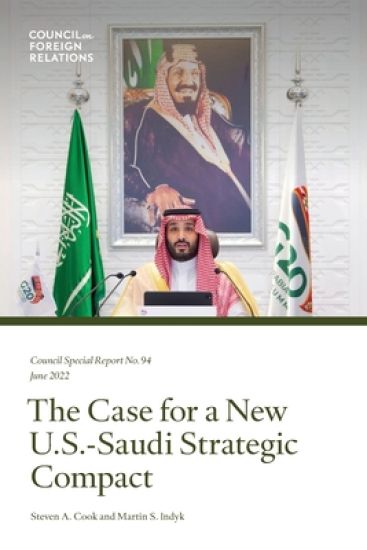
The Case for a New U.S.-Saudi Strategic Compact

The Case for a New U.S.-Saudi Strategic Compact

Steven a. Cook; Martin S. Indyk

Council on Foreign Relations Press
2022
nidottu
The encounter between President Franklin D. Roosevelt and King Abdulaziz Al Saud aboard the USS Quincy in the Suez Canal on February 14, 1945, represents the launching point for relations between the United States and Saudi Arabia. From the start, it was an unlikely partnership. The deal that developed over time was straightforward. The United States needed unimpeded access to the vast reservoirs of oil beneath Al Saud's desert sands, and Saudi Arabia needed protection from avaricious neighbors and great powers.But in recent years, the U.S.-Saudi strategic partnership has frayed. The United States has grown frustrated with Saudi Arabia's human rights record and reluctance to stabilize the oil market, while Riyadh has come to believe that Washington is no longer willing to guarantee the kingdom's security.With their new Council Special Report, The Case for a New U.S.-Saudi Strategic Compact, Eni Enrico Mattei Senior Fellow for Middle East and Africa Studies Steven A. Cook and Distinguished Fellow Martin S. Indyk give a thorough history of the special relationship between the world's foremost democracy and the Middle East's preeminent monarchy, and envision what a renewed partnership would look like.As Cook and Indyk warn, "Seventy-seven years after the original Roosevelt-Abdulaziz pact, the changing circumstances require a reassessment of the relationship's value to each side, for if urgent action is not taken, the process of separation that is already under way is likely to accelerate, damaging the interests of both sides."
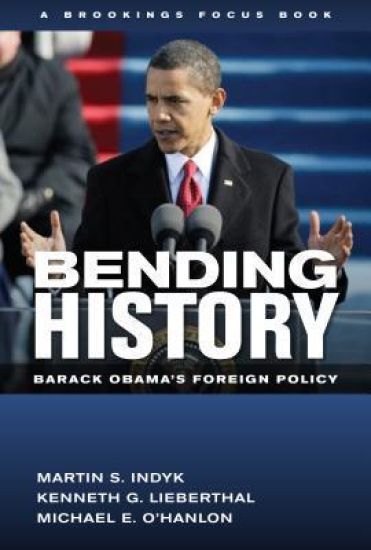
Bending History

Bending History

Martin S. Indyk; Kenneth G. Lieberthal; Michael E. O'Hanlon

Brookings Institution
2013
nidottu
"By the time of Barack Obama's inauguration as the 44th president of the United States, he had already developed an ambitious foreign policy vision. By his own account, he sought to bend the arc of history toward greater justice, freedom, and peace; within a year he was awarded the Nobel Peace Prize, largely for that promise.In Bending History, Martin Indyk, Kenneth Lieberthal, and Michael O'Hanlon measure Obama not only against the record of his predecessors and the immediate challenges of the day, but also against his own soaring rhetoric and inspiring goals. Bending History assesses the considerable accomplishments as well as the failures and seeks to explain what has happened.Obama's best work has been on major and pressing foreign policy challenges—counterterrorism policy, including the daring raid that eliminated Osama bin Laden; the ""reset"" with Russia; managing the increasingly significant relationship with China; and handling the rogue states of Iran and North Korea. Policy on resolving the Israeli-Palestinian conflict, however, has reflected serious flaws in both strategy and execution. Afghanistan policy has been plagued by inconsistent messaging and teamwork. On important ""softer"" security issues—from energy and climate policy to problems in Africa and Mexico—the record is mixed. As for his early aspiration to reshape the international order, according greater roles and responsibilities to rising powers, Obama's efforts have been well-conceived but of limited effectiveness.On issues of secondary importance, Obama has been disciplined in avoiding fruitless disputes (as with Chavez in Venezuela and Castro in Cuba) and insisting that others take the lead (as with Qaddafi in Libya). Notwithstanding several missteps, he has generally managed well the complex challenges of the Arab awakenings, striving to strike the right balance between U.S. values and interests.The authors see Obama's foreign policy to date as a triumph of discipline and realism over ideology. He has been neither the transformative beacon his devotees have wanted, nor the weak apologist for America that his critics allege. They conclude that his grand strategy for promoting American interests in a tumultuous world may only now be emerging, and may yet be curtailed by conflict with Iran. Most of all, they argue that he or his successor will have to embrace U.S. economic renewal as the core foreign policy and national security challenge of the future."
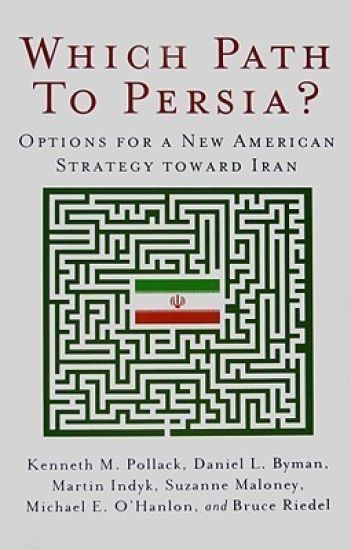
Which Path to Persia?

Which Path to Persia?

Kenneth M. Pollack; Daniel L. Byman; Martin S. Indyk

Brookings Institution
2009
nidottu
"Crafting a new policy toward Iran is a complicated, uncertain, and perilous challenge. Since it is an extremely complex society, with an opaque political system, it is no wonder that the United States has not yet figured out the puzzle that is Iran. With the clock ticking on Iran's pursuit of nuclear capabilities, solving this puzzle is more urgent than ever. In Which Path to Persia? a group of experts with the Saban Center for Middle East Policy at Brookings lays out the courses of action available to the United States. What are the benefits and drawbacks of airstrikes? Can engagement be successful? Is regime change possible? In answering such questions, the authors do not argue for one approach over another. Instead, they present the details of the policies so that readers can understand the complexity of the challenge and decide for themselves which course the United States should take."
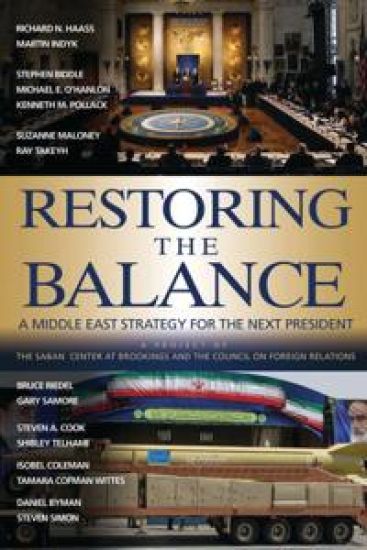
Restoring the Balance

Restoring the Balance

Richard N. Haass; Martin S. Indyk

Brookings Institution
2008
nidottu
"The next U.S. president will need to pursue a new strategic framework for advancing American interests in the Middle East. The mounting challenges include sectarian conflict in Iraq, Iran's pursuit of nuclear capabilities, failing Palestinian and Lebanese governments, a dormant peace process, and the ongoing war against terror. Compounding these challenges is a growing hostility toward U.S. involvement in the Middle East. The old policy paradigms, whether President George W. Bush's model of regime change and democratization or President Bill Clinton's model of peacemaking and containment, will no longer suit the likely circumstances confronting the next administration in the Middle East. In R estoring the Balance, experts from the Saban Center at the Brookings Institution and from the Council on Foreign Relations propose a new, nonpartisan strategy drawing on the lessons of past failures to address both the short-term and long-term challenges to U.S. interests. Following an overview chapter by Richard N. Haass, president of the Council on Foreign Relations, and Martin Indyk, director of the Saban Center, individual chapters address the Arab-Israeli conflict, counterterrorism, Iran, Iraq, political and economic development, and nuclear proliferation. Specific policy recommendations stem from in-depth research and extensive dialogue with individuals in government, media, academia, and the private sector throughout the region. The experts include Stephen Biddle, Isobel Coleman, Steven A. Cook, Steven Simon, and Ray Takeyh from the Council on Foreign Relations and Daniel L. Byman, Suzanne Maloney, Kenneth M. Pollack, Bruce Riedel, ShibleyTelhami, and Tamara Cofman Wittes from Brookings' Saban Center."