Kirjojen hintavertailu. Mukana 12 595 353 kirjaa ja 12 kauppaa.

Kirjailija

Martin Weale

Kirjat ja teokset yhdessä paikassa: 5 kirjaa, julkaisuja vuosilta 1986-2017, suosituimpien joukossa Macroeconomic Policy. Vertaile teosten hintoja ja tarkista saatavuus suomalaisista kirjakaupoista.

5 kirjaa

Kirjojen julkaisuhaarukka 1986-2017.

Macroeconomic Policy

Macroeconomic Policy

Martin Weale; Andrew Blake; Nicos Christodoulakis; James Meade; David Vines

Routledge
2017
nidottu
This analysis of macroeconomic policy, originally published in 1989, argues that key government objectives, such as reduced inflation, decreased unemployment and an adequate level of national saving can be achieved only by employing both monetary and fiscal policies, in conjunction with supply-side policies expressly designed to improve the workings of the labour market. Part 1 is a comparative analysis showing the effects of monetary and fiscal policy on the economy. Real-wage rigidity in the labour market is shown to have important consequences for the working of both types of policy, because it conditions the economy’s response to tax changes. Part 2 presents an econometric model which combines consistent stock-flow accounts with a full range of expectational effects. Part 3 presents an innovative technique for solving rational expectations models with the need for arbitary terminal conditions.
Macroeconomic Policy

Macroeconomic Policy

Martin Weale; Andrew Blake; Nicos Christodoulakis; James Meade; David Vines

Routledge
2015
sidottu
This analysis of macroeconomic policy, originally published in 1989, argues that key government objectives, such as reduced inflation, decreased unemployment and an adequate level of national saving can be achieved only by employing both monetary and fiscal policies, in conjunction with supply-side policies expressly designed to improve the workings of the labour market. Part 1 is a comparative analysis showing the effects of monetary and fiscal policy on the economy. Real-wage rigidity in the labour market is shown to have important consequences for the working of both types of policy, because it conditions the economy’s response to tax changes. Part 2 presents an econometric model which combines consistent stock-flow accounts with a full range of expectational effects. Part 3 presents an innovative technique for solving rational expectations models with the need for arbitary terminal conditions.
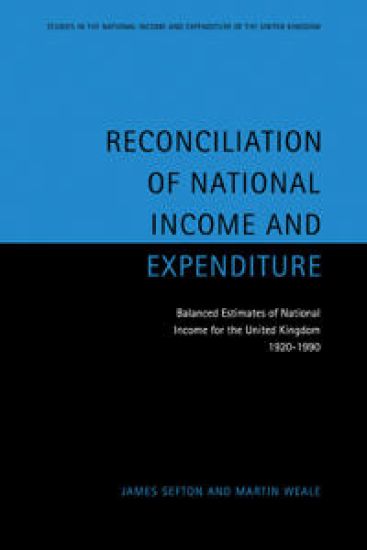
Reconciliation of National Income and Expenditure

Reconciliation of National Income and Expenditure

James Sefton; Martin Weale

Cambridge University Press
2009
pokkari
This book was first published in 1995. The problem of disparities between different estimates of GDP is well known and widely discussed. Here, the authors describe a method for examining the discrepancies using a technique allocating them with reference to data reliability. The method enhances the reliability of the underlying data and leads to maximum-likelihood estimates. It is illustrated by application to the UK national accounts for the period 1920–1990. The book includes a full set of estimates for this period, including runs of industrial data for the period 1948–1990, which are longer than those available from any other source. The statistical technique allows estimates of standard errors of the data to be calculated and verified; these are presented both for data in levels and for changes in variables over 1-, 2- and 5-year periods.
Reconciliation of National Income and Expenditure

Reconciliation of National Income and Expenditure

James Sefton; Martin Weale

Cambridge University Press
1996
sidottu
The problem of disparities between different estimates of GDP is well known and widely discussed. Here, the authors describe a method for examining the discrepancies using a technique allocating them with reference to data reliability. The method enhances the reliability of the underlying data and leads to maximum-likelihood estimates. It is illustrated by application to the UK national accounts for the period 1920-1990. The book includes a full set of estimates for this period, including runs of industrial data for the period 1948-1990 which are longer than those available from any other source. The statistical technique allows estimates of standard errors of the data to be calculated and verified; these are presented both for data in levels and for changes in variables over 1-, 2- and 5-year periods. A disk with the dataset in machine readable form is available separately.