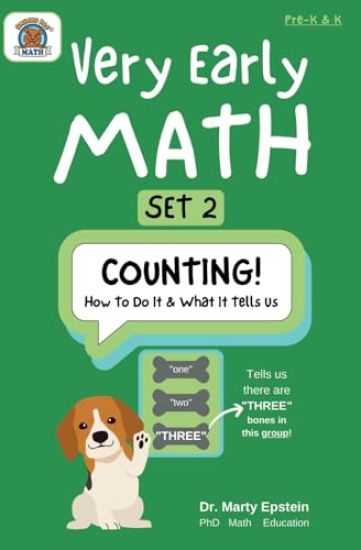
COUNTING It's not as easy as "1 - 2 - 3 " YIKES Many young children who can "count" don't understand why we count (to find out a group's size) or how counting works to tell us a group's size (the Cardinal Principle). This book is designed to help Informed by research and building on skills from Very Early Math SET 1, SET 2 provides tools to help your child understand the foundational math ideas of: Why we count (i.e., to find out a group's size), How counting tells us a group's size, How to count.This matters a lot Arithmetic simply won't make sense to a child who can "count," but who doesn't understand the idea of a group, that numbers tell us the size of a group, and how counting tells us a group's size. That child might think 1 + 2 = 3 meansSomething named "1" (because it happened to be counted first) combined with Something named "2" (because it happened to be counted second) becomes Something named "3?" This simply makes no sense It's not what 1 + 2 = 3 means mathematically.What does 1 + 2 = 3 mean mathematically? Here's an example of how it could be usedA group with 1 apple combined with a group with 2 apples equals a group with 3 apples.See how core (please excuse the pun when writing about apples) the idea of a "group" is to mathematics, even the most basic arithmetic? Understanding the idea of a group and how counting tells us the size of a group is a nonnegotiable, critical foundation to math.A child who doesn't yet have this understanding may be able to memorize 1 + 2 = 3, for example, but will not understand what 1 + 2 = 3 means. It's a bit like knowing how to pronounce and spell "cat" and "dog" without understanding what they mean.It turns out that many adults, caregivers, and early childhood educators assume a child understands the idea of a group and how counting tells us a group's size when the child, in fact, doesn't yet understand these ideas. And it turns out that many approaches we use to help a child learn these key ideas actually don't work as well as we think they do.That's why I made these books-to help children understand these core math ideas.