Kirjojen hintavertailu. Mukana 12 511 400 kirjaa ja 12 kauppaa.

Kirjailija

Mary Jo Bane

Kirjat ja teokset yhdessä paikassa: 6 kirjaa, julkaisuja vuosilta 1980-2022, suosituimpien joukossa The Nation's Families. Vertaile teosten hintoja ja tarkista saatavuus suomalaisista kirjakaupoista.

6 kirjaa

Kirjojen julkaisuhaarukka 1980-2022.

Who Will Provide? The Changing Role Of Religion In American Social Welfare
Leading scholars examine how the church, community organizations, and the government must work together to provide for America's poor in the aftermath of welfare reform. . Who will provide for Americas children, elderly, and working families? Not since the 1930s has our nation faced such fundamental choices over how to care for all its citizens. Now, amid economic prosperity, Americans are asking what government, business, and non-profit organizations can and can’t do and what they should and shouldn’t be asked to do. As both political parties look to faith-based organizations to meet material and spiritual needs, the center of this historic debate is the changing role of religion. These essays combine a fresh perspective and detailed analysis on these pressing issues. They emerge from a three-year Harvard Seminar sponsored by the Center for the Study of Values in Public Life that brought together scholars in public policy, government, religion, sociology, law, education, and non-profit leadership. By putting the present moment in broad historical perspective, these essays offer rich insights into the resources of faith-based organizations, while cautioning against viewing their expanded role as an alternative to the government’s responsibility. In Who Will Provide? community leaders, organizational managers, public officials, and scholars will find careful analysis drawing on a number of fields to aid their work of devising better partnerships of social provision locally and nationally. It was named a Choice Outstanding Academic Book of 2001..
Who Will Provide? The Changing Role Of Religion In American Social Welfare
Leading scholars examine how the church, community organizations, and the government must work together to provide for America's poor in the aftermath of welfare reform. . Who will provide for Americas children, elderly, and working families? Not since the 1930s has our nation faced such fundamental choices over how to care for all its citizens. Now, amid economic prosperity, Americans are asking what government, business, and non-profit organizations can and can’t do and what they should and shouldn’t be asked to do. As both political parties look to faith-based organizations to meet material and spiritual needs, the center of this historic debate is the changing role of religion. These essays combine a fresh perspective and detailed analysis on these pressing issues. They emerge from a three-year Harvard Seminar sponsored by the Center for the Study of Values in Public Life that brought together scholars in public policy, government, religion, sociology, law, education, and non-profit leadership. By putting the present moment in broad historical perspective, these essays offer rich insights into the resources of faith-based organizations, while cautioning against viewing their expanded role as an alternative to the government’s responsibility. In Who Will Provide? community leaders, organizational managers, public officials, and scholars will find careful analysis drawing on a number of fields to aid their work of devising better partnerships of social provision locally and nationally. It was named a Choice Outstanding Academic Book of 2001..
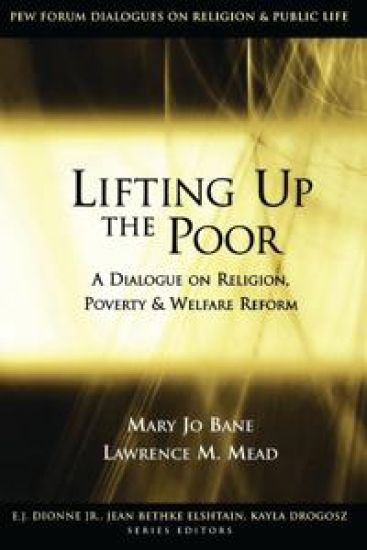
Lifting Up the Poor

Lifting Up the Poor

Mary Jo Bane; Lawrence M. Mead

Brookings Institution
2003
nidottu
"People who participate in debates about the causes and cures of poverty often speak from religious conviction. But those convictions are rarely made explicit or debated on their own terms. Rarely is the influence of personal religious commitment on policy decisions examined. Two of the nation's foremost scholars and policy advocates break the mold in this lively volume, the first to be published in the new Pew Forum Dialogues on Religion and Public Life. The authors bring their faith traditions, policy experience, academic expertise, and political commitments together in this moving, pointed, and informed discussion of poverty, one of our most vexing public issues. Mary Jo Bane writes of her experiences running social service agencies, work that has been informed by ""Catholic social teaching, and a Catholic sensibility that is shaped every day by prayer and worship."" Policy analysis, she writes, is often ""indeterminate"" and ""inconclusive."" It requires grappling with ""competing values that must be balanced."" It demands judgment calls, and Bane's Catholic sensibility informs the calls she makes. Drawing from various Christian traditions, Lawrence Mead's essay discusses the role of nurturing Christian virtues and personal responsibility as a means of transforming a ""defeatist culture"" and combating poverty. Quoting Shelley, Mead describes theologians as the ""unacknowledged legislators of mankind"" and argues that even nonbelievers can look to the Christian tradition as ""the crucible that formed the moral values of modern politics."" Bane emphasizes the social justice claims of her tradition, and Mead challenges the view of many who see economic poverty as a biblical priority that deserves ""preference ahead of other social concerns."" But both assert that an engagement with religious traditions is indispensable to an honest and searching debate about poverty, policy choices, and the public purposes of religion. "
Welfare Realities

Welfare Realities

Mary Jo Bane; David T. Ellwood

Harvard University Press
1996
nidottu
Mary Jo Bane and David Ellwood examine the American welfare system—its recipients, its providers, and the swirl of policy ideas surrounding it—with objectivity and clarity. Focusing on the AFDC Program (Aid to Families with Dependent Children), they examine the composition of the populations receiving assistance, the duration of that assistance—who receives benefits for a long time and who only briefly, during important transitional periods—and the prospects facing AFDC recipients within the administrative culture of the system. The authors identify three models that have been used to explain “welfare dependency” and test them against an accumulating body of evidence They offer suggestions for identifying potential long-term recipients so that resources can be targeted to encourage self-sufficiency. Finally, they review policy options.
The Nation's Families

The Nation's Families

George Masnick; Mary Jo Bane

Praeger Publishers Inc
1980
sidottu
Describes trends that signal societal changes in household composition, family structure, and women's working patterns. Interprets their implications for future policy planning and institutional accommodation.
The Nation's Families

The Nation's Families

George Masnick; Mary Jo Bane

Praeger Publishers Inc
1980
nidottu
Describes trends that signal societal changes in household composition, family structure, and women's working patterns. Interprets their implications for future policy planning and institutional accommodation.