Kirjojen hintavertailu. Mukana 12 390 323 kirjaa ja 12 kauppaa.

Kirjailija

Mary S. Morgan

Kirjat ja teokset yhdessä paikassa: 5 kirjaa, julkaisuja vuosilta 1995-2019, suosituimpien joukossa Methodology and Tacit Knowledge. Vertaile teosten hintoja ja tarkista saatavuus suomalaisista kirjakaupoista.

5 kirjaa

Kirjojen julkaisuhaarukka 1995-2019.

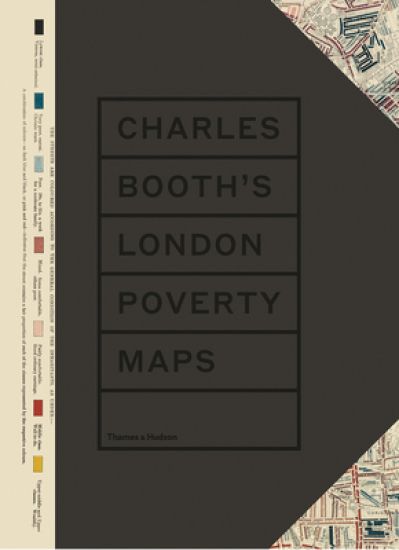
Charles Booth’s London Poverty Maps

Charles Booth’s London Poverty Maps

Mary S. Morgan; Iain Sinclair; London School of Economics

Thames Hudson Ltd
2019
sidottu
A splendid – and necessary – publication…a great resource Iain SinclairCharles Booth’s landmark survey of life in late-19th-century London, published for the first time in one volume. In the late nineteenth century, Charles Booth's landmark social and economic survey found that 35 percent of Londoners were living in abject poverty. Booth's team of social investigators interviewed Londoners from all walks of life, recording their comments, together with their own unrestrained remarks and statistical information, in 450 notebooks. Their findings formed the basis of Booth's colour-coded social mapping (from vicious and semi-criminal to wealthy) and his seventeen-volume survey Inquiry into the Life and Labour of the People of London, 1886-1903.Organized into six geographical sections, Charles Booth's London Poverty Maps presents the hand-colored preparatory and printed social mapping of London. Accompanying the maps are reproductions of pages from the original notebooks, containing anecdotes and observations too judgmental for Booth to include in his final published survey. An introduction by professor Mary S. Morgan clarifies the aims and methodology of Booth's survey and six themed essays contextualize the the survey's findings, accompanied by evocative period photographs. Providing insights into the minutia of everyday life viewed through the lens of inhabitants of every trade, class, creed, and nationality, Charles Booth's London Poverty Maps brings to life the diversity and dynamism of late nineteenth-century London.
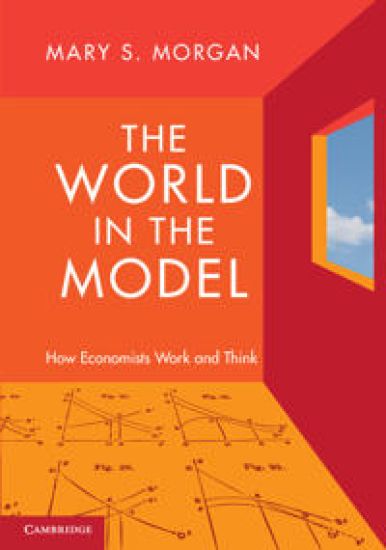
The World in the Model

The World in the Model

Mary S. Morgan

Cambridge University Press
2012
sidottu
During the last two centuries, the way economic science is done has changed radically: it has become a social science based on mathematical models in place of words. This book describes and analyses that change - both historically and philosophically - using a series of case studies to illuminate the nature and the implications of these changes. It is not a technical book; it is written for the intelligent person who wants to understand how economics works from the inside out. This book will be of interest to economists and science studies scholars (historians, sociologists and philosophers of science). But it also aims at a wider readership in the public intellectual sphere, building on the current interest in all things economic and on the recent failure of the so-called economic model, which has shaped our beliefs and the world we live in.
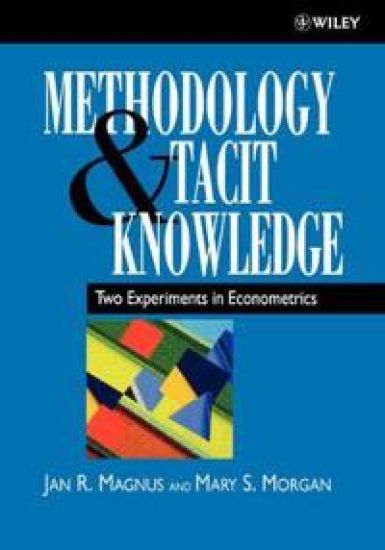
Methodology and Tacit Knowledge

Methodology and Tacit Knowledge

Jan R. Magnus; Mary S. Morgan

John Wiley Sons Inc
1999
sidottu
"Econometrics textbooks see their subject as a set of techniques; Magnus and Morgan see it as a set of practices. A combination of controlled experiment and anthropology of science, Methodology and Tacit Knowledge gives a rare inside view of how econometricians work, why econometrics is an art and not a set of simple recipes, and why, like all artists, econometricians differ in their techniques and finished works. This is economic methodology at its best." Kevin Hoover, University of California, Davis "The tacit knowledge experiment was a highly commendable initiative. Its exploration of the theme of how knowledge is acquired and used in applied econometrics is unique and produced some fascinating insights into this process." Adrian Pagan, Australian National University "It is rare, perhaps unique, to find leading empirical economists face the prospect of modelling the same phenomena, with the same data within the same limited time frame. A valuable and illuminating experiment in comparative research methodologies, made all the more provocative when compared to the excellent original study by Tobin." Richard Blundell, University College London This book will be of considerable interest to economists and to econometricians concerned about the methodology of their own discipline, and will provide valuable material for researchers in science studies and for teachers of econometrics.
The Foundations of Econometric Analysis

The Foundations of Econometric Analysis

David F. Hendry; Mary S. Morgan

Cambridge University Press
1997
pokkari
In this compelling 1995 book, David Hendry and Mary Morgan bring together the classic papers of the pioneer econometricians. Together, these papers form the foundations of econometric thought. They are essential reading for anyone seeking to understand the aims, method and methodology of econometrics and the development of this statistical approach in economics. However, because they are technically straightforward, the book is also accessible to students and non-specialists. An editorial commentary places the readings in their historical context and indicates the continuing relevance of these early, yet highly sophisticated, works for current econometric analysis. While this book provides a companion volume to Mary Morgan's acclaimed The History of Econometric Ideas, the editors' commentary both adds to that earlier volume and also provides a stand-alone and synthetic account of the development of econometrics.
The Foundations of Econometric Analysis

The Foundations of Econometric Analysis

David F. Hendry; Mary S. Morgan

Cambridge University Press
1995
sidottu
In this compelling 1995 book, David Hendry and Mary Morgan bring together the classic papers of the pioneer econometricians. Together, these papers form the foundations of econometric thought. They are essential reading for anyone seeking to understand the aims, method and methodology of econometrics and the development of this statistical approach in economics. However, because they are technically straightforward, the book is also accessible to students and non-specialists. An editorial commentary places the readings in their historical context and indicates the continuing relevance of these early, yet highly sophisticated, works for current econometric analysis. While this book provides a companion volume to Mary Morgan's acclaimed The History of Econometric Ideas, the editors' commentary both adds to that earlier volume and also provides a stand-alone and synthetic account of the development of econometrics.