Kirjojen hintavertailu. Mukana 12 595 353 kirjaa ja 12 kauppaa.

Kirjailija

Mason David S.

Kirjat ja teokset yhdessä paikassa: 2 kirjaa, julkaisuja vuosilta 2000-2011, suosituimpien joukossa Marketing Democracy. Vertaile teosten hintoja ja tarkista saatavuus suomalaisista kirjakaupoista.

2 kirjaa

Kirjojen julkaisuhaarukka 2000-2011.

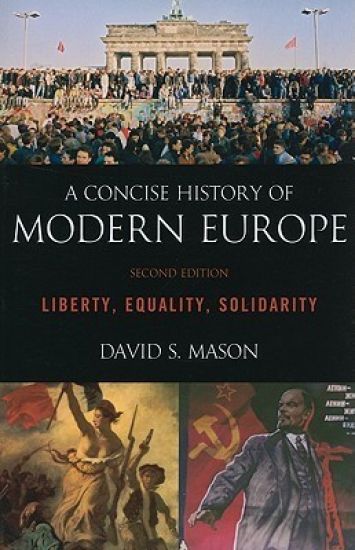
A Concise History of Modern Europe

A Concise History of Modern Europe

Mason David S.

Rowman Littlefield Publishers
2011
pokkari
Highlighting the key events, ideas, and individuals that have shaped modern Europe, this fresh and lively book provides a succinct history of the continent from the Enlightenment to the present. Drawing on the enduring theme of revolution, David S. Mason explores the causes and consequences of revolution: political, economic, and scientific; the development of human rights; and issues of European identity and integration. He deliberately avoids a detailed chronology of every country and time period by emphasizing the most crucial events in shaping contemporary Europe. Fourteen focused chapters address such topical issues as the Enlightenment; the French Revolution and Napoleon; the Industrial Revolution; the theories and impact of Marx and Darwin; the revolutions of 1848, 1917, and 1989; the unifications of Germany and Italy; European imperialism; the two World Wars; the Cold War and decolonization; and the evolution and expansion of the European Union. Any reader needing a broad overview of the sweep of European history since 1789 will find this book, published in a first edition under the title Revolutionary Europe, an engaging and cohesive narrative.
Marketing Democracy

Marketing Democracy

Mason David S.; Kluegel James R.

Rowman Littlefield Publishers
2000
sidottu
This groundbreaking work explores popular attitudes on social, economic, and political justice in the former communist states of Russia, Hungary, the Czech Republic, Bulgaria, and eastern Germany. Drawing on detailed opinion surveys conducted in 13 countries in east and west in 1991, and replicated in Eastern Europe in 1996, the authors go beyond typical survey questions to explore the philosophically and theoretically important concept of justice. The 1991 survey showed that citizens of the region enthusiastically endorsed market capitalism in principle. Over the next five years, however, this enthusiasm waned, with growing popular sentiment that the economic order was not working fairly in fact. Elements of egalitarianism from the communist era persist, and people see a fair society as one with a substantially greater degree of economic equality than found in western capitalist states. Citizens of eastern Europe hope to create societies where people who work hard can earn and keep good money, but also where those in want have their basic needs met. The results show increasingly close links between economics and politics and underscore the critical importance of economic revival for democratic success. Only small minorities consider themselves “winners” from the transition process assuring their support for democratic and economic transition. But most people feel they personally and their societies in general have gained little, or even lost, from the process. Many are increasingly fatalistic and apathetic and as a result have withdrawn from the political process. Invaluable for its longitudinal data and east-west comparisons, the book will have profound implications for the building of successful democracies in postcommunist systems.