Kirjojen hintavertailu. Mukana 12 595 353 kirjaa ja 12 kauppaa.

Kirjailija

Massimiliano Tomba

Kirjat ja teokset yhdessä paikassa: 9 kirjaa, julkaisuja vuosilta 2005-2025, suosituimpien joukossa Insurgent Universality. Vertaile teosten hintoja ja tarkista saatavuus suomalaisista kirjakaupoista.

9 kirjaa

Kirjojen julkaisuhaarukka 2005-2025.

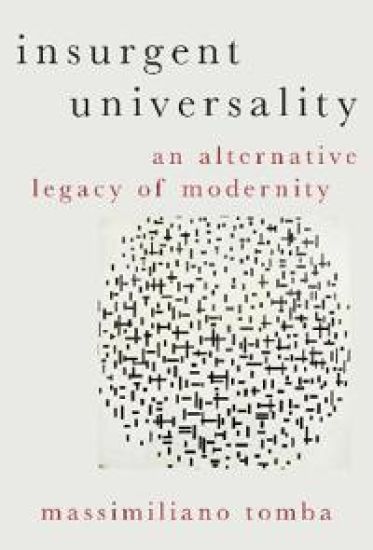
Insurgent Universality

Insurgent Universality

Massimiliano Tomba

Oxford University Press Inc
2019
sidottu
Scholars commonly take the Declaration of the Rights of Man and Citizen of 1789, written during the French Revolution, as the starting point for the modern conception of human rights. According to the Declaration, the rights of man are held to be universal, at all times and all places. But as recent crises around migrants and refugees have made obvious, this idea, sacred as it might be among human rights advocates, is exhausted. It's long past time to reconsider the principles on which Western economic and political norms rest. This book advocates for a tradition of political universality as an alternative to the juridical universalism of the Declaration. Insurgent universality isn't based on the idea that we all share some common humanity but, rather, on the democratic excess by which people disrupt and reject an existing political and economic order. Going beyond the constitutional armor of the representative state, it brings into play a plurality of powers to which citizens have access, not through the funnel of national citizenship but in daily political practice. We can look to recent history to see various experiments in cooperative and insurgent democracy: the Indignados in Spain, the Arab Spring, Occupy, the Zapatistas in Mexico, and, going further back, the Paris Commune, the 1917 peasant revolts during the Russian Revolution, and the Haitian Revolution. This book argues that these movements belong to the common legacy of insurgent universality, which is characterized by alternative trajectories of modernity that have been repressed, hindered, and forgotten. Massimiliano Tomba examines these events to show what they could have been and what they can still be. As such he explores how their common legacy can be reactivated. Insurgent Universality analyzes the manifestos and declarations that came out of these experiments considering them as collective works of an alternative canon of political theory that challenges the great names of the Western pantheon of political thought and builds bridges between European and non-European political and social experiments.
Insurgent Universality

Insurgent Universality

Massimiliano Tomba

Oxford University Press Inc
2021
nidottu
Scholars commonly take the Declaration of the Rights of Man and Citizen of 1789, written during the French Revolution, as the starting point for the modern conception of human rights. According to the Declaration, the rights of man are held to be universal, at all times and all places. But as recent crises around migrants and refugees have made obvious, this idea, sacred as it might be among human rights advocates, is exhausted. It's long past time to reconsider the principles on which Western economic and political norms rest. This book advocates for a tradition of political universality as an alternative to the juridical universalism of the Declaration. Insurgent universality isn't based on the idea that we all share some common humanity but, rather, on the democratic excess by which people disrupt and reject an existing political and economic order. Going beyond the constitutional armor of the representative state, it brings into play a plurality of powers to which citizens have access, not through the funnel of national citizenship but in daily political practice. We can look to recent history to see various experiments in cooperative and insurgent democracy: the Indignados in Spain, the Arab Spring, Occupy, the Zapatistas in Mexico, and, going further back, the Paris Commune, the 1917 peasant revolts during the Russian Revolution, and the Haitian Revolution. This book argues that these movements belong to the common legacy of insurgent universality, which is characterized by alternative trajectories of modernity that have been repressed, hindered, and forgotten. Massimiliano Tomba examines these events to show what they could have been and what they can still be. As such he explores how their common legacy can be reactivated. Insurgent Universality analyzes the manifestos and declarations that came out of these experiments considering them as collective works of an alternative canon of political theory that challenges the great names of the Western pantheon of political thought and builds bridges between European and non-European political and social experiments.
Storming Heaven

Storming Heaven

Steve Wright; Harry Cleaver; Riccardo Bellofiore; Massimiliano Tomba

Pluto Press
2017
sidottu
Storming Heaven is the only book which looks at Italian workerist theory and practice, from its origins in the anti-Stalinist left of the 1950s to its heyday twenty years later. It focuses on the theme of workerism, or 'operaismo', which includes the refusal of work, class self-organisation, mass illegality and the extension of revolutionary agency, of of which are still practiced today by workers across the world. Emphasising the dynamic nature of class struggle as the distinguishing feature of workerist thought, Storming Heaven reveals how this form of radical politics developed alongside emerging social movements to great effect. It assesses the strengths and limitations of workerism as first developed by Antonio Negri, Mario Tronti, Sergio Bologna and others. This edition includes a new chapter looking at the debates around operaismo and Autonomia since the book originally appeared in 2002, and is updated with a new foreword and afterword.
Storming Heaven

Storming Heaven

Steve Wright; Harry Cleaver; Riccardo Bellofiore; Massimiliano Tomba

Pluto Press
2017
pokkari
Storming Heaven is the only book which looks at Italian workerist theory and practice, from its origins in the anti-Stalinist left of the 1950s to its heyday twenty years later. It focuses on the theme of workerism, or 'operaismo', which includes the refusal of work, class self-organisation, mass illegality and the extension of revolutionary agency, of of which are still practiced today by workers across the world. Emphasising the dynamic nature of class struggle as the distinguishing feature of workerist thought, Storming Heaven reveals how this form of radical politics developed alongside emerging social movements to great effect. It assesses the strengths and limitations of workerism as first developed by Antonio Negri, Mario Tronti, Sergio Bologna and others. This edition includes a new chapter looking at the debates around operaismo and Autonomia since the book originally appeared in 2002, and is updated with a new foreword and afterword.
Marx's Temporalities

Marx's Temporalities

Massimiliano Tomba

Haymarket Books
2013
nidottu
Rethinking the central categories of Marx's work, this study provides a critical analysis of his political and theoretical development. By integrating the paradigm of the spatialisation of time with that of the temporalisation of space, Tomba shows that an adequate historiographical paradigm for capitalism must consider the plurality of temporal layers that come into conflict in modernity.
Marx's Temporalities

Marx's Temporalities

Massimiliano Tomba

Brill
2012
sidottu
The book rethinks the central categories of Marx's work beyond any philosophy of history, providing a critical analysis of his political and theoretical development from his early writings, to the elaboration of the critique of political economy and his final anthropological studies on pre-individualistic and communist forms. The study aims to integrate the paradigm of the spatialisation of time with that of the temporalisation of space, showing how capital places diverse temporalities into hierarchies that incessantly produce and reproduce new forms of class struggle. An adequate historiographical paradigm for globalised capitalism has to consider the plurality of temporal layers that are combined and come into conflict in the violently unifying historical dimension of modernity.
Krise Und Kritik Bei Bruno Bauer

Krise Und Kritik Bei Bruno Bauer

Massimiliano Tomba

Peter Lang AG
2005
nidottu
Bruno Bauer (1809-1882) war der politische Theologe einer Krise, die sich sehr bald als epochal erwies. Er erforschte sie in Theologie, Metaphysik und Politik und suchte aktiv in sie einzugreifen, indem er den gesamten Begriffsapparat seiner Zeit der Selbstaufloesung entgegentrieb. Einige bedeutende geisteswissenschaftliche Stroemungen des 20. Jahrhunderts vorwegnehmend, arbeitete Bauer in der Ausschliesslichkeit ein konstitutives Moment jeder Religion heraus und fand dieselbe Ausschliessung im Herzen des Politischen wieder. Gerade dank der Kritik des Ausschlusscharakters jeder politischen Form vermochte Bauer die Frage der allgemeinen Befreiung auf neue Grundlagen zu stellen. In den Jahren des Nachmarz richtete er seine Aufmerksamkeit in wachsendem Masse auf die Schattenseiten dieser Befreiung: auf Nivellement und Diktatur als Auswuchse des Individualismus und der Demokratie.