
Kirjailija
Matt Harrison
Kirjat ja teokset yhdessä paikassa: 8 kirjaa, julkaisuja vuosilta 2012-2020, suosituimpien joukossa Treading on Python Volume 2: Intermediate Python. Vertaile teosten hintoja ja tarkista saatavuus suomalaisista kirjakaupoista.
8 kirjaa
Kirjojen julkaisuhaarukka 2012-2020.

Use the power of pandas to solve most complex scientific computing problems with ease. Revised for pandas 1.x. Key Features This is the first book on pandas 1.x Practical, easy to implement recipes for quick solutions to common problems in data using pandas Master the fundamentals of pandas to quickly begin exploring any dataset Book DescriptionThe pandas library is massive, and it's common for frequent users to be unaware of many of its more impressive features. The official pandas documentation, while thorough, does not contain many useful examples of how to piece together multiple commands as one would do during an actual analysis. This book guides you, as if you were looking over the shoulder of an expert, through situations that you are highly likely to encounter. This new updated and revised edition provides you with unique, idiomatic, and fun recipes for both fundamental and advanced data manipulation tasks with pandas. Some recipes focus on achieving a deeper understanding of basic principles, or comparing and contrasting two similar operations. Other recipes will dive deep into a particular dataset, uncovering new and unexpected insights along the way. Many advanced recipes combine several different features across the pandas library to generate results.What you will learn Master data exploration in pandas through dozens of practice problems Group, aggregate, transform, reshape, and filter data Merge data from different sources through pandas SQL-like operations Create visualizations via pandas hooks to matplotlib and seaborn Use pandas, time series functionality to perform powerful analyses Import, clean, and prepare real-world datasets for machine learning Create workflows for processing big data that doesn’t fit in memory Who this book is forThis book is for Python developers, data scientists, engineers, and analysts. Pandas is the ideal tool for manipulating structured data with Python and this book provides ample instruction and examples. Not only does it cover the basics required to be proficient, but it goes into the details of idiomatic pandas.
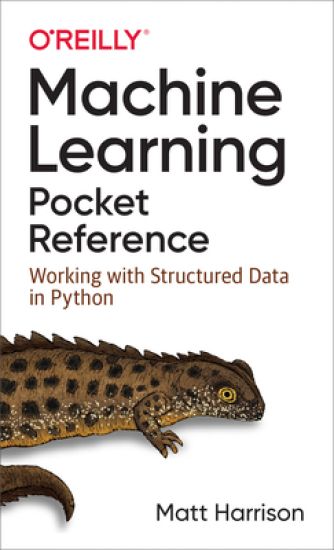
With detailed notes, tables, and examples, this handy reference will help you navigate the basics of structured machine learning. Author Matt Harrison delivers a valuable guide that you can use for additional support during training and as a convenient resource when you dive into your next machine learning project. Ideal for programmers, data scientists, and AI engineers, this book includes an overview of the machine learning process and walks you through classification with structured data. You’ll also learn methods for clustering, predicting a continuous value (regression), and reducing dimensionality, among other topics. This pocket reference includes sections that cover: Classification, using the Titanic dataset Cleaning data and dealing with missing data Exploratory data analysis Common preprocessing steps using sample data Selecting features useful to the model Model selection Metrics and classification evaluation Regression examples using k-nearest neighbor, decision trees, boosting, and more Metrics for regression evaluation Clustering Dimensionality reduction Scikit-learn pipelines

Hello and welcome to Effective PyCharm. In this book, we're going to look at all the different features of one of the very best environments for interacting and creating Python code, PyCharm.PyCharm is an IDE (integrated development environment) and this book will teach you how you can make the most of this super powerful editor.The first thing we are going to talk about is why do we want to use an IDE in the first place? What value does a relatively heavyweight application like PyCharm bring and why would we want to use it?There are many features that make PyCharm valuable. However, let's begin by talking about the various types of editors we can use and what the trade-offs are there.We're going to start by focusing on creating new projects and working with all the files in them. You'll see there's a bunch of configuration switches we can set to be more effective. Then we're going to jump right into what I would say is the star of the show--the editor. If you're writing code, you need an editor. You will be writing a lot of code. This includes typing new text and manipulating existing text. The editor has to be awesome and aid you in these tasks. We're going to focus on all the cool features that the PyCharm editor offers.We'll see that source control in particular, Git and Subversion are deeply integrated into PyCharm. There are all sorts of powerful things we can do beyond git, including actual GitHub integration. We are going to focus on source control and the features right inside the IDE.PyCharm is great at *refactoring*. Refactoring code is changing our code to restructure it in a different way, to use a slightly different algorithm, while not actually changing the behavior of the code. There are many powerful techniques in PyCharm that you can use to do this. Because it understands all of your files at once, it can safely refactor. It will even refactor doc strings and other items that could be overlooked without a deep understanding of code structures.There is powerful database tooling in PyCharm. You can interact with most databases including SQLite, MySQL, and Postgres. You can edit the data, edit the schemes, run queries and more. Because PyCharm has a deep understanding of your code, there is even integration between your database schema and the Python text editor. Note that PyCharm has a free version and a professional version. The database features are only available in the professional version.PyCharm is excellent at building web applications using libraries like Django, Pyramid, or Flask. It also has a full JavaScript editor and environment so you can use TypeScript or CoffeeScript. We'll look into both server-side and client-side features.PyCharm has a great visual debugger, and we are going to look at all the different features of it. You can use it to debug and understand your application. It has powerful breakpoint operations and data visualization that typically editors don't have.Profiling is a common task if you want to understand how your code is running. If your application is slow and you want it to go faster, you shouldn't guess where it is slow. PyCharm makes it easy to look at the code determine what it fast and slow, rather than relying on our intuition which may be flawed. PyCharm has some tremendous built-in visual types of tools for us to fundamentally understand the performance of our app.PyCharm has built-in test runners for pytest, unittest, and a number of Python testing frameworks. If you are doing any unit testing or integration testing, PyCharm will come to your aid. For example, one feature you can turn on is auto test execution. If you are changing certain parts of your code, PyCharm will automatically re-run the tests. There are a couple of additional tools that don't really land in any of the above categories.

Illustrated Guide to Python 3: A Complete Walkthrough of Beginning Python with Unique Illustrations Showing how Python Really Works. Now covering Pyt
Matt Harrison
Createspace Independent Publishing Platform
2017
nidottu
Introducing Your Guide to Learning PythonIllustrated Guide to Learning Python is designed to bring developers and others who are anxious to learn Python up to speed quickly. Not only does it teach the basics of syntax, but it condenses years of experience. You will learn warts, gotchas, best practices and hints that have been gleaned through the years in days. You will hit the ground running and running in the right way.Learn Python QuicklyPython is an incredible language. It is powerful and applicable in many areas. It is used for automation of simple or complex tasks, numerical processing, web development, interactive games and more. Whether you are a programmer coming to Python from another language, managing Python programmers or wanting to learn to program, it makes sense to cut to the chase and learn Python the right way. You could scour blogs, websites and much longer tomes if you have time. Treading on Python lets you learn the hints and tips to be Pythonic quickly.Packed with Useful Hints and TipsYou'll learn the best practices without wasting time searching or trying to force Python to be like other languages. I've collected all the gems I've gleaned over years of writing and teaching Python for you.A No Nonsense Guide to Mastering Basic PythonPython is a programming language that lets you work more quickly and integrate your systems more effectively. You can learn to use Python and see almost immediate gains in productivity and lower maintenance costs.What you will learn: Distilled best practices and tipsHow interpreted languages workUsing basic types such as Strings, Integers, and FloatsBest practices for using the interpreter during developmentThe difference between mutable and immutable dataSets, Lists, and Dictionaries, and when to use eachGathering keyboard inputHow to define a classLooping constructsHandling Exceptions in codeSlicing sequencesCreating modular codeUsing librariesLaying out codeCommunity prescribed conventions
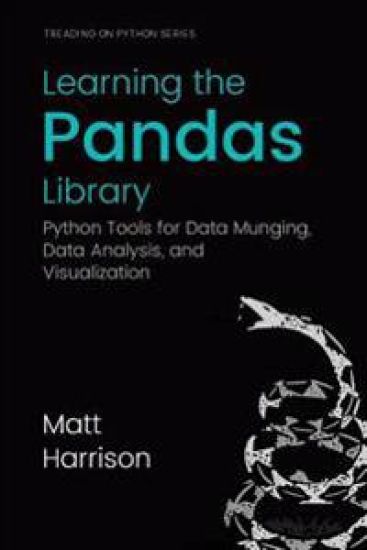
Learning the Pandas Library: Python Tools for Data Munging, Analysis, and Visual
Matt Harrison
Createspace Independent Publishing Platform
2016
nidottu
Python is one of the top 3 tools that Data Scientists use. One of the tools in their arsenal is the Pandas library. This tool is popular because it gives you so much functionality out of the box. In addition, you can use all the power of Python to make the hard stuff easy Learning the Pandas Library is designed to bring developers and aspiring data scientists who are anxious to learn Pandas up to speed quickly. It starts with the fundamentals of the data structures. Then, it covers the essential functionality. It includes many examples, graphics, code samples, and plots from real world examples. The Content Covers: Installation Data Structures Series CRUD Series Indexing Series Methods Series Plotting Series Examples DataFrame Methods DataFrame Statistics Grouping, Pivoting, and Reshaping Dealing with Missing Data Joining DataFrames DataFrame Examples Preliminary Reviews This is an excellent introduction benefitting from clear writing and simple examples. The pandas documentation itself is large and sometimes assumes too much knowledge, in my opinion. Learning the Pandas Library bridges this gap for new users and even for those with some pandas experience such as me. -Garry C. I have finished reading Learning the Pandas Library and I liked it... very useful and helpful tips even for people who use pandas regularly. -Tom Z.
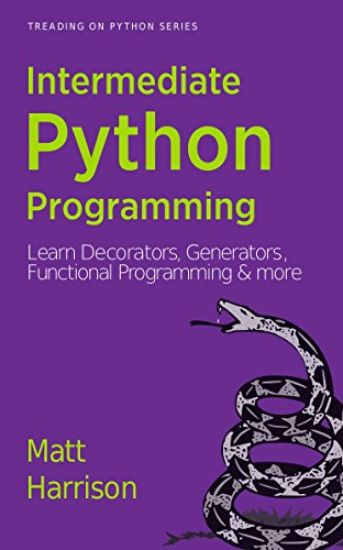
Treading on Python Volume 2: Intermediate Python
Matt Harrison
Createspace Independent Publishing Platform
2013
nidottu
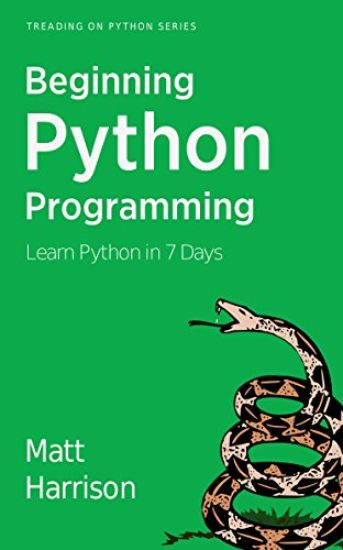
Treading on Python Volume 1: Foundations of Python
Matt Harrison
Createspace Independent Publishing Platform
2012
nidottu