Kirjojen hintavertailu. Mukana 12 595 353 kirjaa ja 12 kauppaa.

Kirjailija

Matt Hern

Kirjat ja teokset yhdessä paikassa: 8 kirjaa, julkaisuja vuosilta 2017-2024, suosituimpien joukossa O My Friends, There is No Friend. Vertaile teosten hintoja ja tarkista saatavuus suomalaisista kirjakaupoista.

8 kirjaa

Kirjojen julkaisuhaarukka 2017-2024.

Outside the Outside

Outside the Outside

Matt Hern

Verso Books
2024
sidottu
Matt Hern argues that the changing relationship between the urban center and the suburban periphery forces us to rethink the entire identity of the city itself. Today, most of the Western world lives on the city outskirts. Yet these neighborhoods that once offered security and respite from the perceived dangers of the city center have been radically transformed in the last few decades to poor, working-class and racialized communities. Outside the Outside maps these changes and argues for a revival of the social life of the city as a whole.Hern shows how language that relegates parts of the urban to the "outside" and designates other parts as the "center" echoes colonial forms of domination. This should come as no surprise in an era when communities are forced onto the periphery and beyond by gentrification.With on-the-ground reportage in, among other places, Vancouver, Portland, London, Ferguson and Rabat, Hern demonstrates how we need to challenge our misconceptions and see the "sub-urbs" as vibrant places of resistance and regeneration and to celebrate the movement, circulation and difference to be found there.
O My Friends, There is No Friend

O My Friends, There is No Friend

Matt Hern; Am Johal

TRANSCRIPT VERLAG
2024
nidottu
Can friendship as a political practice offer enough traction to imagine a borderless world? The startling contemporary rise in aggressive ethno-nationalism and end-times ecological crises have the same root: an inability to be together with humans as much as the natural world. Matt Hern and Am Johal suggest that porous renditions of being-together animated by friendship can spark a repoliticization of the political to surpass the foreclosures of the state, speak to a freedom of movement, and find renovated relationships with the more-than-human. This volume includes interviews with Jean-Luc Nancy, Leela Gandhi and Leanne Simpson.
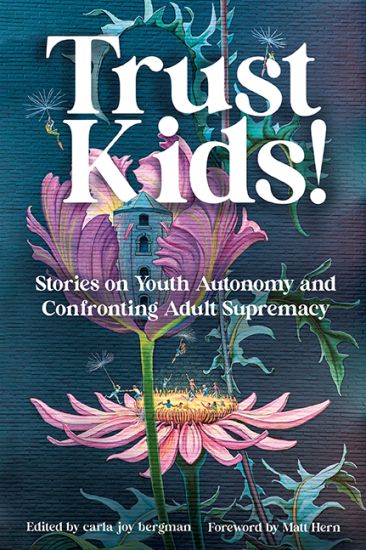
Trust Kids!

Trust Kids!

Matt Hern

AK PRESS
2023
nidottu
Trust Kids weaves together essays, interviews, poems, and artwork from scholars, activists, and artists about our relationships with children in all areas of our lives.The contributors of Trust Kids write from different backgrounds, genders, ages, and sexualities and combine past lineages with more recent child-rearing ideas to offer a fresh, inspiring perspective. Many works on parenting and families wind up re-inscribing hierarchies by declaring how kids should be liberated. Trust Kids insists on youth autonomy, listening to youth, and questioning adult supremacy on every page. At the heart of the book are conversations about all the ways that children can be included, loved, and cared for in more generative, just, and egalitarian ways. Its essays explore the liberatory potential of consent and autonomy in relationships among children, youth, and the adults in their lives. They also trace how oppressive attitudes toward children, far from being "natural" forms of kinship with the youngest members of our families and communities, have identifiable social and historical roots.
Big Moves

Big Moves

Anthony Perl; Matt Hern; Jeffrey Kenworthy

McGill-Queen's University Press
2020
sidottu
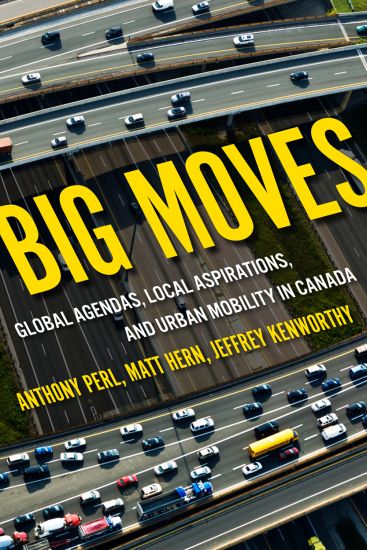
All countries have distinctive urban regions, but Canadian cities especially differ from one another in culture, structure, and history. Anthony Perl, Matt Hern, and Jeffrey Kenworthy reveal that despite the peculiarities and singular traits that each city embodies, a common logic has guided the development of transportation infrastructure across the country. Big Moves analyzes how Canada's three largest urban regions - Montreal, Toronto, and Vancouver - have been shaped by the interplay of globalized imperatives, aspirations, activism, investment, and local development initiatives, both historically and in a contemporary context. Canadian urban development follows a distinct pattern that involves compromise between local viewpoints and values and the pursuit of global capital at particular historical junctures. As the authors show, the success or failure of each city to construct major mobility infrastructure has always depended on the timing of investments and the specific ways that cities have gained access to necessary capital. Drawing on urban mobility history and global city theory, this book delves into the details of the big moves that have affected transport infrastructure in major Canadian cities. Knowing where urban development will head in the twenty-first century requires understanding how cities' major mobility infrastructures were built. Big Moves explains the shape of Canada's three biggest cities and how their mix of expressways and rapid transit emerged.
Big Moves

Big Moves

Anthony Perl; Matt Hern; Jeffrey Kenworthy

McGill-Queen's University Press
2020
nidottu
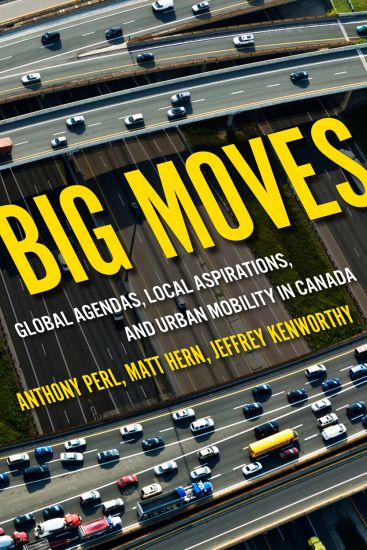
All countries have distinctive urban regions, but Canadian cities especially differ from one another in culture, structure, and history. Anthony Perl, Matt Hern, and Jeffrey Kenworthy reveal that despite the peculiarities and singular traits that each city embodies, a common logic has guided the development of transportation infrastructure across the country. Big Moves analyzes how Canada's three largest urban regions - Montreal, Toronto, and Vancouver - have been shaped by the interplay of globalized imperatives, aspirations, activism, investment, and local development initiatives, both historically and in a contemporary context. Canadian urban development follows a distinct pattern that involves compromise between local viewpoints and values and the pursuit of global capital at particular historical junctures. As the authors show, the success or failure of each city to construct major mobility infrastructure has always depended on the timing of investments and the specific ways that cities have gained access to necessary capital. Drawing on urban mobility history and global city theory, this book delves into the details of the big moves that have affected transport infrastructure in major Canadian cities. Knowing where urban development will head in the twenty-first century requires understanding how cities' major mobility infrastructures were built. Big Moves explains the shape of Canada's three biggest cities and how their mix of expressways and rapid transit emerged.
On This Patch of Grass

On This Patch of Grass

Matt Hern; Selena Couture; Daisy Couture; Sadie Couture

Fernwood Publishing Co Ltd
2018
nidottu
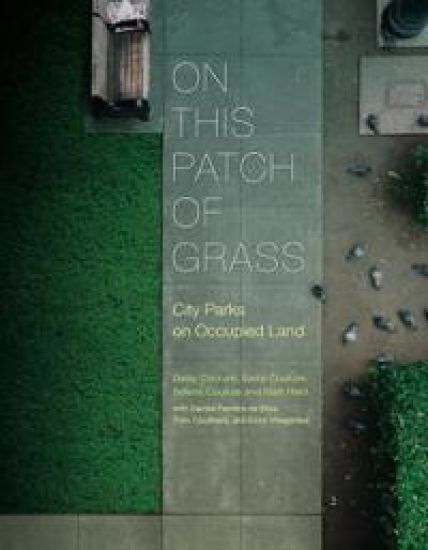
Parks are importantly fertile places to talk about land. Whether its big national parks, provincial campgrounds, isolated conservation areas, destination parks, or humble urban patches of grass, we tend to speak of parks as unqualified goods. People think of parks as public or common land, and it is a common belief that parks are the best uses of land and are good for everyone.But no park is innocent. Parks are lionized as "natural oases," and urban parks as "pure nature" in the midst of the city - but that's absurd. Parks are as "natural" as the roads or buildings around them, and just as political. Every park in North America is performing modernity and settler colonialism everyday. Furthermore, parks are not private property, but while they are called 'public', they are highly regulated spaces that normatively demand and closely control behaviours. Parks are a certain kind of property, and thus creations of law, and they are subject to all kinds of presumptions about what parks are for, and what kinds of people should be doing what kinds of things in them. Parks - as they are currently constituted - are colonial enterprises.On This Patch of Grass is an investigation into one small urban park - Vancouver's Victoria Park, or Bocce Ball Park - as a way to interrogate the politics of land. The authors grapple with the fact that they are uninvited guests on the occupied and traditional territories of the Musqueam (x?m??k??y??m), Squamish (Skwxwú7mesh), and Tsleil-Waututh (s?lilw?ta??) nations. But Bocce Ball Park is also a wonderful place in many ways, with a startling plurality of users and sovereignties, and all kinds of overlapping activities and all kinds of overlapping people co-existing more-or-less peaceably. It is a living exhibition of the possibilities of sharing land and perhaps offers some clues to a decolonial horizon.The book is a collaborative exercise between one white family and some friends looking at the park from a variety of perspectives, asking what we might say about this patch of grass, and what kinds of occupation might this place imply.
Global Warming and the Sweetness of Life

Global Warming and the Sweetness of Life

Matt Hern; Am Johal

MIT Press
2018
pokkari
Seeking new definitions of ecology in the tar sands of northern Alberta and searching for the sweetness of life in the face of planetary crises.Confounded by global warming and in search of an affirmative politics that links ecology with social change, Matt Hern and Am Johal set off on a series of road trips to the tar sands of northern Alberta-perhaps the world's largest industrial site, dedicated to the dirty work of extracting oil from Alberta's vast reserves. Traveling from culturally liberal, self-consciously "green" Vancouver, and aware that our well-meaning performances of recycling and climate-justice marching are accompanied by constant driving, flying, heating, and fossil-fuel consumption, Hern and Johal want to talk to people whose lives and fortunes depend on or are imperiled by extraction. They are seeking new definitions of ecology built on a renovated politics of land. Traveling with them is their friend Joe Sacco-infamous journalist and cartoonist, teller of complex stories from Gaza to Paris-who contributes illustrations and insights and a chapter-length comic about the contradictions of life in an oil town. The epic scale of the ecological horror is captured through an series of stunning color photos by award-winning aerial photographer Louis Helbig.Seamlessly combining travelogue, sophisticated political analysis, and ecological theory, speaking both to local residents and to leading scholars, the authors propose a new understanding of ecology that links the domination of the other-than-human world to the domination of humans by humans. They argue that any definition of ecology has to start with decolonization and that confronting global warming requires a politics that speaks to a different way of being in the world-a reconstituted understanding of the sweetness of life.Published with the help of funding from Furthermore: a program of the J. M. Kaplan fund
What a City Is For

What a City Is For

Matt Hern

MIT Press
2017
pokkari
An investigation into gentrification and displacement, focusing on the case of Portland, Oregon's systematic dispersal of black residents from its Albina neighborhood.Portland, Oregon, is one of the most beautiful, livable cities in the United States. It has walkable neighborhoods, bike lanes, low-density housing, public transportation, and significant green space-not to mention craft-beer bars and locavore food trucks. But liberal Portland is also the whitest city in the country. This is not circumstance; the city has a long history of officially sanctioned racialized displacement that continues today.Over the last two and half decades, Albina-the one major Black neighborhood in Portland-has been systematically uprooted by market-driven gentrification and city-renewal policies. African Americans in Portland were first pushed into Albina and then contained there through exclusionary zoning, predatory lending, and racist real estate practices. Since the 1990s, they've been aggressively displaced-by rising housing costs, developers eager to get rid of low-income residents, and overt city policies of gentrification.Displacement and dispossessions are convulsing cities across the globe, becoming the dominant urban narratives of our time. In What a City Is For, Matt Hern uses the case of Albina, as well as similar instances in New Orleans and Vancouver, to investigate gentrification in the twenty-first century. In an engaging narrative, effortlessly mixing anecdote and theory, Hern questions the notions of development, private property, and ownership. Arguing that home ownership drives inequality, he wants us to disown ownership. How can we reimagine the city as a post-ownership, post-sovereign space? Drawing on solidarity economics, cooperative movements, community land trusts, indigenous conceptions of alternative sovereignty, the global commons movement, and much else, Hern suggests repudiating development in favor of an incrementalist, non-market-driven unfolding of the city.