
Kirjojen hintavertailu. Mukana 12 657 676 kirjaa ja 12 kauppaa.

Kirjailija

Matthew Handelman

Kirjat ja teokset yhdessä paikassa: 3 kirjaa, julkaisuja vuosilta 2019-2025, suosituimpien joukossa Digital Theory. Vertaile teosten hintoja ja tarkista saatavuus suomalaisista kirjakaupoista.

3 kirjaa

Kirjojen julkaisuhaarukka 2019-2025.

Digital Theory

Digital Theory

M. Beatrice Fazi; Alexander R. Galloway; Matthew Handelman; Leif Weatherby

UNIVERSITY OF MINNESOTA PRESS
2025
nidottu
Proposes a powerful new theoretical approach to the concept of the digitalDigital Theory argues that the digital is theoretical and should be understood not uniquely in terms of consumer electronics but rather more broadly as a form of mediation using discrete units. Building on this definition, the three essays in this volume explore digitality’s relation to thinking, signs, and difference. M. Beatrice Fazi begins the discussion by way of three propositions on the ontological reach and epistemological scope of digital theory. Alexander R. Galloway then defines the necessary conditions for any symbolic order of the digital type, specifying a series of ten simple mathemes. Matthew Handelman and Leif Weatherby conclude by characterizing digital theory through the dialectical relation between quality and quantity. Taken together, these works expound productively and provocatively on the digital’s far-reaching theoretical potential. Retail e-book files for this title are screen-reader friendly with images accompanied by short alt text and/or extended descriptions.
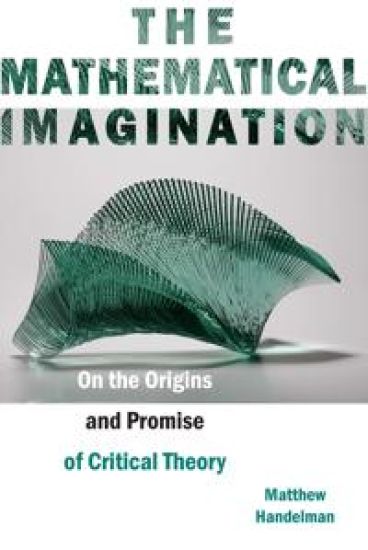
The Mathematical Imagination

The Mathematical Imagination

Matthew Handelman

Fordham University Press
2019
pokkari
This book offers an archeology of the undeveloped potential of mathematics for critical theory. As Max Horkheimer and Theodor W. Adorno first conceived of the critical project in the 1930s, critical theory steadfastly opposed the mathematization of thought. Mathematics flattened thought into a dangerous positivism that led reason to the barbarism of World War II. The Mathematical Imagination challenges this narrative, showing how for other German-Jewish thinkers, such as Gershom Scholem, Franz Rosenzweig, and Siegfried Kracauer, mathematics offered metaphors to negotiate the crises of modernity during the Weimar Republic. Influential theories of poetry, messianism, and cultural critique, Handelman shows, borrowed from the philosophy of mathematics, infinitesimal calculus, and geometry in order to refashion cultural and aesthetic discourse. Drawn to the austerity and muteness of mathematics, these friends and forerunners of the Frankfurt School found in mathematical approaches to negativity strategies to capture the marginalized experiences and perspectives of Jews in Germany. Their vocabulary, in which theory could be both mathematical and critical, is missing from the intellectual history of critical theory, whether in the work of second generation critical theorists such as Jürgen Habermas or in contemporary critiques of technology. The Mathematical Imagination shows how Scholem, Rosenzweig, and Kracauer's engagement with mathematics uncovers a more capacious vision of the critical project, one with tools that can help us intervene in our digital and increasingly mathematical present. The Mathematical Imagination is available from the publisher on an open-access basis.
The Mathematical Imagination

The Mathematical Imagination

Matthew Handelman

FORDHAM UNIVERSITY PRESS
2019
sidottu
This book offers an archeology of the undeveloped potential of mathematics for critical theory. As Max Horkheimer and Theodor W. Adorno first conceived of the critical project in the 1930s, critical theory steadfastly opposed the mathematization of thought. Mathematics flattened thought into a dangerous positivism that led reason to the barbarism of World War II. The Mathematical Imagination challenges this narrative, showing how for other German-Jewish thinkers, such as Gershom Scholem, Franz Rosenzweig, and Siegfried Kracauer, mathematics offered metaphors to negotiate the crises of modernity during the Weimar Republic. Influential theories of poetry, messianism, and cultural critique, Handelman shows, borrowed from the philosophy of mathematics, infinitesimal calculus, and geometry in order to refashion cultural and aesthetic discourse. Drawn to the austerity and muteness of mathematics, these friends and forerunners of the Frankfurt School found in mathematical approaches to negativity strategies to capture the marginalized experiences and perspectives of Jews in Germany. Their vocabulary, in which theory could be both mathematical and critical, is missing from the intellectual history of critical theory, whether in the work of second generation critical theorists such as Jürgen Habermas or in contemporary critiques of technology. The Mathematical Imagination shows how Scholem, Rosenzweig, and Kracauer's engagement with mathematics uncovers a more capacious vision of the critical project, one with tools that can help us intervene in our digital and increasingly mathematical present. The Mathematical Imagination is available from the publisher on an open-access basis.